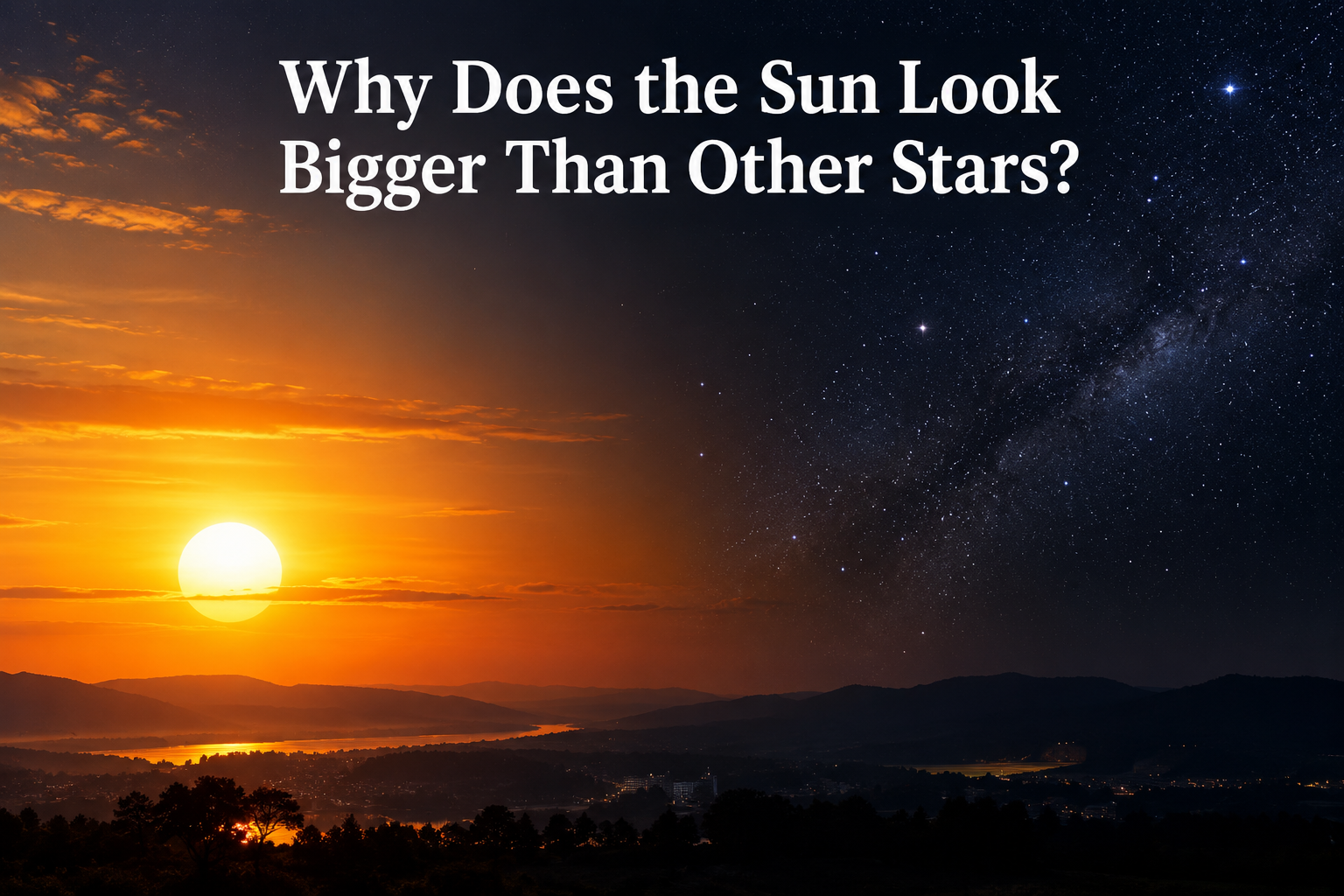
When we look at the sky during the day, the Sun appears as a large, bright circle. At night, however, thousands of stars may appear as tiny points of light. This difference can make us wonder why the Sun looks bigger than other stars. Is the Sun really much larger than every other star, or is there another reason behind its appearance?
The simple answer is distance. The Sun looks bigger than other stars mainly because it is much closer to Earth. In reality, the Sun is a star just like the countless stars we see in the night sky. Some stars are smaller than the Sun, while many others are much larger. However, those stars are located incredibly far away, so they appear only as small points of light.
Understanding why the Sun looks bigger than other stars helps us understand distance, size, light, and our place in the universe.
The Sun Is Our Closest Star
The most important reason the Sun looks so large is that it is the closest star to Earth.
The average distance between Earth and the Sun is about 150 million kilometers. This distance may sound enormous when compared with distances we travel on Earth, but in astronomical terms, the Sun is extremely close.
Other stars are much farther away.
The nearest star system beyond the Sun is more than four light years from Earth. A light year is the distance light travels in one year. Since light moves incredibly fast, a single light year represents an enormous distance.
This means even the closest stars outside our solar system are hundreds of thousands of times farther away than the Sun.
Because the Sun is so much closer, it appears much larger in our sky.
Distance Changes How Large Something Appears
We experience the effect of distance every day.
Imagine standing near a large building. From a few meters away, the building may fill much of your view. If you travel several kilometers away, the same building appears much smaller.
The building has not changed its actual size. Only your distance from it has changed.
The same idea explains why the Sun looks bigger than other stars.
A star can be physically much larger than the Sun, but if it is located hundreds or thousands of light years away, it will appear very small from Earth.
Astronomers often describe this difference using two ideas: actual size and apparent size.
Actual size refers to the true physical dimensions of an object.
Apparent size refers to how large the object appears from a particular distance.
The Sun has a very large apparent size because it is close to us.
Is the Sun Bigger Than Other Stars?
The Sun is a huge object compared with Earth, but it is not the largest star in the universe.
The Sun has a diameter of about 1.39 million kilometers. Around 109 Earths could fit side by side across the diameter of the Sun.
This makes the Sun enormous from a human point of view.
However, stars exist in many different sizes.
Some stars are smaller than the Sun. These are often called red dwarfs. They are among the most common types of stars in our galaxy.
Other stars are much larger.
Giant and supergiant stars can have diameters many times greater than that of the Sun. Some enormous stars would extend far beyond Earth’s orbit if they were placed at the center of our solar system.
So the Sun does not look bigger because it is the largest star. It looks bigger mainly because it is the nearest star.
Why Do Other Stars Look Like Tiny Dots?
When we look at stars at night, they usually appear as tiny points rather than visible circles.
This happens because they are extremely far away.
Even powerful telescopes often cannot show ordinary stars as large disks in the same way that we see the Sun. Their apparent sizes are simply too small.
Instead, telescopes collect more light from distant stars. This allows astronomers to study their brightness, temperature, chemical composition, movement, and other properties.
The enormous distances involved reduce the visible size of stars so greatly that our eyes see them only as points of light.
This is why a star that is physically much larger than the Sun may still look tiny from Earth.
The Sun’s Brightness Also Makes It Stand Out
Size is not the only reason the Sun looks different from other stars.
The Sun also appears extremely bright because of its closeness.
The Sun produces energy through a process called nuclear fusion. Deep inside its core, hydrogen atoms combine to form helium. This process releases enormous amounts of energy.
That energy eventually travels outward from the Sun and spreads through space as light and heat.
Other stars also produce energy through similar processes, but they are located so far away that only a small fraction of their light reaches Earth.
The Sun’s light is powerful enough to illuminate our planet during the day and make most other stars impossible to see with the naked eye.
The stars are still present in the daytime sky, but the brightness of sunlight scattered through Earth’s atmosphere makes them difficult to observe.
What Is Apparent Angular Size?
Astronomers often measure how large an object appears in the sky by using angular size.
Angular size describes the amount of space an object seems to occupy in our field of view.
The Sun has an angular diameter of about half a degree when viewed from Earth.
Interestingly, the Moon has almost the same apparent angular size in our sky. This is why the Moon can cover the Sun during a total solar eclipse.
The Moon is much smaller than the Sun, but it is also much closer to Earth. The combination of size and distance makes both objects appear approximately the same size from our viewpoint.
This provides an excellent example of how apparent size depends on both physical size and distance.
Why Does the Moon Sometimes Look Similar in Size to the Sun?
The Sun’s diameter is roughly 400 times greater than the Moon’s diameter.
However, the Sun is also around 400 times farther away from Earth than the Moon.
Because these two ratios are surprisingly similar, the Sun and Moon appear almost equal in size in our sky.
During a total solar eclipse, the Moon passes between Earth and the Sun and can temporarily block the Sun’s bright surface.
This does not mean that the Sun and Moon are physically similar in size. Their similar appearance is caused by their different distances from Earth.
The same basic principle explains why distant stars appear much smaller than the Sun.
How Far Away Are the Other Stars?
The distances between stars are difficult to imagine because they are so enormous.
Light from the Sun takes a little more than eight minutes to reach Earth.
In comparison, light from the nearest stars outside our solar system takes several years to reach us.
Many stars visible at night are tens, hundreds, or even thousands of light years away.
This means when we look at a distant star, we are actually seeing light that left the star many years ago.
If a star is 500 light years away, the light reaching our eyes tonight began traveling toward Earth around 500 years ago.
These enormous distances make even giant stars appear like tiny dots.
Could Another Star Look Bigger Than the Sun?
If Earth were placed close enough to another star, that star could look as large as the Sun or even larger.
Imagine standing on a planet orbiting a giant star at a suitable distance. That star might dominate the sky and appear much larger than our Sun does from Earth.
The appearance would depend on both the star’s physical size and the planet’s distance from it.
This shows that what we see from Earth is influenced strongly by our location.
From our perspective, the Sun is the largest looking star because Earth orbits it.
From another solar system, a different star would be the main star in the sky.
Why Does the Sun Look Like a Disk?
Unlike distant stars, the Sun is close enough for us to see its circular surface.
The visible surface of the Sun is called the photosphere. This is the layer from which most visible sunlight escapes into space.
When viewed safely using proper solar equipment, the Sun appears as a clear round disk.
Astronomers can observe features on the Sun, including sunspots and other patterns on its surface.
Ordinary stars are usually too far away for their surfaces to be seen clearly without advanced astronomical techniques.
This difference again comes mainly from distance.
Are There Stars Much Larger Than the Sun?
Yes. The universe contains many stars that are far larger than our Sun.
Some giant stars have radii tens of times greater than the Sun. Supergiants can be even larger.
If certain massive stars were placed where our Sun is located, their outer layers could extend through a large part of our solar system.
Despite their tremendous size, these stars still look tiny from Earth because of their immense distances.
This teaches us an important lesson about astronomy. What appears large or small in the sky does not always tell us the true size of an object.
Scientists must measure distance and gather additional information to understand the real properties of stars.
How Do Astronomers Determine the Size of Stars?
Astronomers use several methods to estimate the sizes of stars.
They study a star’s brightness, temperature, distance, and spectrum. By combining this information with scientific models, they can estimate the star’s radius and overall size.
In some cases, astronomers study binary star systems. These systems contain two stars orbiting each other. Their movements can provide important information about their sizes and masses.
Advanced telescopes and specialized observing techniques can also help scientists study the apparent sizes of certain stars.
These methods reveal that stars vary enormously.
The Sun is therefore not special because it is the biggest star. It is special to us because it is our nearest star and the center of our solar system.
Why Is the Sun Important to Earth?
Although the Sun is just one star among countless others, it has an extraordinary importance for life on Earth.
Sunlight provides energy for plants through photosynthesis. Plants use sunlight to produce food, and this process supports much of Earth’s food chain.
The Sun also warms Earth’s surface and atmosphere. Its energy drives weather patterns, influences climate, and powers the water cycle.
Earth’s position at a suitable distance from the Sun allows temperatures that support liquid water over large parts of the planet.
Without the Sun, Earth would be dark, extremely cold, and unable to support life as we know it.
Its closeness is therefore important for much more than its appearance in the sky.
The Sun Is Only One Star in a Huge Galaxy
The Sun is located in the Milky Way galaxy, which contains a vast number of stars.
Our Sun may appear dominant from Earth, but on a galactic scale, it is just one star among an enormous stellar population.
The Milky Way itself is only one galaxy among countless galaxies in the observable universe.
This gives us a useful sense of perspective.
During the day, the Sun seems to control the entire sky. At night, we begin to see that it belongs to a much larger universe filled with stars of many sizes, colors, temperatures, and ages.
Why Does the Sun Look Bigger Than Other Stars at Sunset?
People sometimes notice that the Sun appears especially large when it is close to the horizon.
In reality, the Sun’s physical size and distance from Earth have not suddenly changed enough to explain this appearance.
The effect is mainly related to human visual perception.
When the Sun is near the horizon, we see it beside familiar objects such as buildings, trees, hills, and landscapes. Our brain compares the Sun with these nearby features, which can make it seem larger.
When the Sun is high in an open sky, there are fewer visual reference points.
A similar effect happens with the Moon, which often seems unusually large near the horizon.
What Can the Sun Teach Us About the Universe?
The simple question of why the Sun looks bigger than other stars introduces several important ideas in astronomy.
It shows that distance strongly influences appearance.
It teaches us that an object’s apparent size may be very different from its actual size.
It also reminds us that Earth is part of a solar system centered around an ordinary star.
Other stars may appear tiny, but many are enormous worlds of glowing plasma producing incredible amounts of energy.
Their small appearance tells us more about their distance than their true size.
Final Thoughts
So, why does the Sun look bigger than other stars?
The main reason is that the Sun is much closer to Earth than any other star. Although some stars are physically larger than the Sun, their enormous distances make them appear as tiny points of light.
The Sun is about 150 million kilometers from Earth, while even the nearest stars beyond our solar system are several light years away. This enormous difference in distance changes how large each star appears in our sky.
The Sun therefore looks large not because it is the biggest star in the universe, but because it is our closest star.
Learning this simple fact opens the door to a much bigger understanding of astronomy. The night sky may look filled with tiny dots, but many of those dots are enormous stars located at distances almost beyond imagination. Our Sun is one member of that vast family of stars, but because it is our cosmic neighbor, it appears larger, brighter, and more important from our place on Earth.