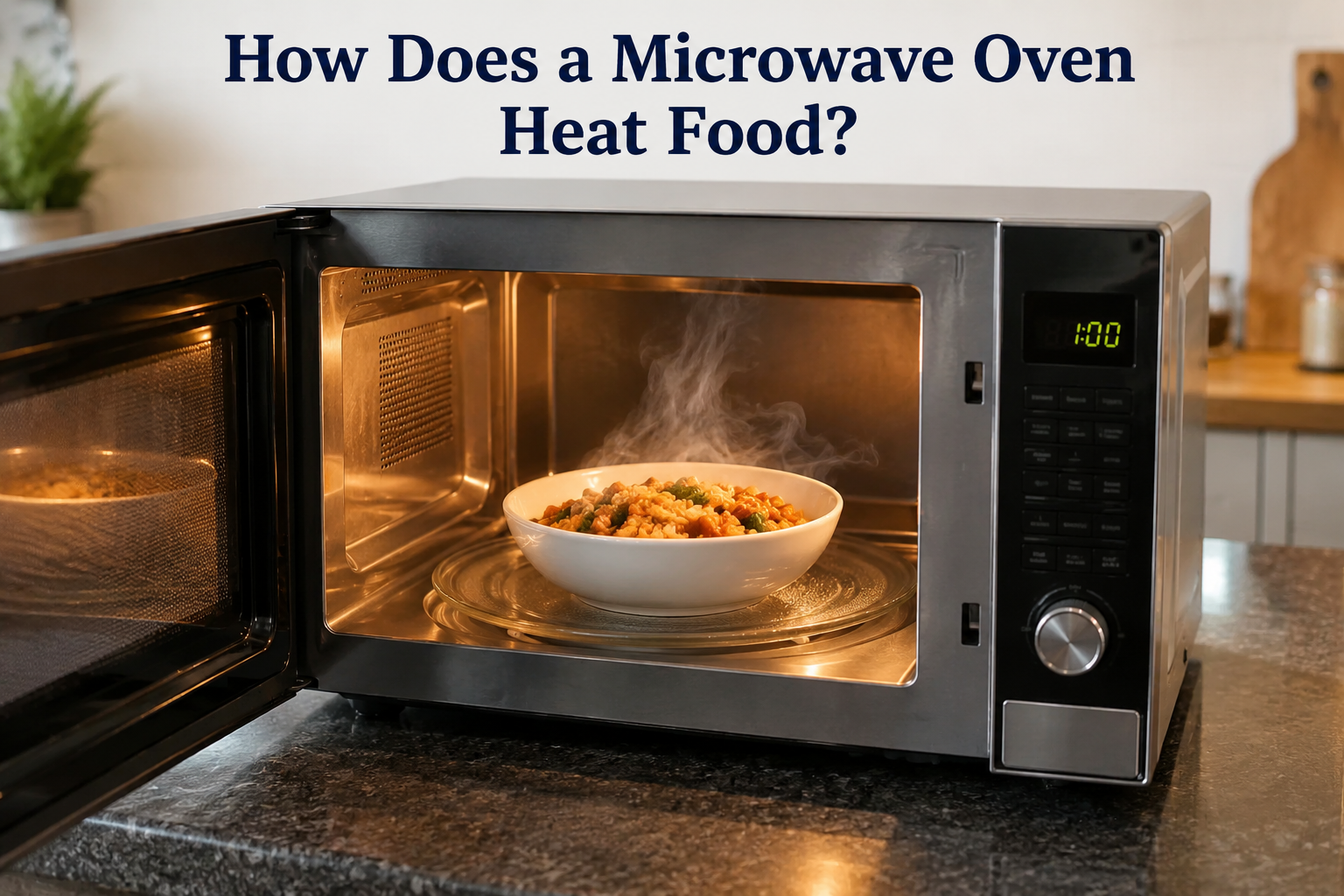
A microwave oven is one of the most common appliances found in modern kitchens. It can warm leftovers, heat milk, cook vegetables, soften butter, and prepare many foods within minutes. Because it works so quickly, many people wonder how a microwave oven heats food and why it can warm a meal much faster than a traditional oven.
The basic idea is surprisingly interesting. A microwave oven uses a form of electromagnetic energy called microwaves. These waves enter the food and interact mainly with water and other molecules inside it. The movement of these molecules produces heat, which gradually warms or cooks the food.
Understanding how a microwave oven works becomes easier when we look at the process step by step.
What Are Microwaves?
Microwaves are a type of electromagnetic radiation. They belong to the same general family as visible light, radio waves, and infrared radiation, although they have different wavelengths and frequencies.
Inside a microwave oven, electrical energy is converted into microwave energy. These microwaves are then directed into the cooking chamber where the food is placed.
The microwaves used in kitchen ovens are designed to interact with certain molecules found in food. Water molecules are especially important because most foods naturally contain water.
Fresh vegetables, fruits, meat, cooked rice, soups, and many other foods contain significant amounts of moisture. This moisture makes microwave heating possible.
How Does a Microwave Oven Produce Microwaves?
The main component responsible for producing microwaves is called a magnetron.
When you switch on a microwave oven, electricity flows into the magnetron. The magnetron converts electrical energy into microwave energy.
These microwaves then travel through a special passage and enter the metal cooking chamber.
The walls inside a microwave oven are made of metal because metal reflects microwaves. Instead of allowing the energy to escape, the metal surfaces help keep the microwaves inside the oven.
As the waves reflect around the cooking chamber, they repeatedly pass through the food.
This allows the energy to interact with molecules inside the meal.
Why Water Molecules Are Important
To understand how a microwave oven heats food, it is useful to understand the behavior of water molecules.
A water molecule has a slightly positive side and a slightly negative side. Because of this structure, it reacts to changing electromagnetic fields.
Microwaves create rapidly changing electric fields inside the oven.
When water molecules are exposed to these changing fields, they try to turn and realign themselves again and again.
This movement happens extremely quickly.
As the molecules move, rotate, and interact with nearby molecules, energy is transferred through the food. This molecular motion contributes to the rise in temperature.
In simple words, the microwave energy causes certain molecules inside the food to move more actively, and this energy eventually becomes heat.
Does a Microwave Heat Food From the Inside Out?
Many people believe that microwave ovens cook food from the inside out. This is not completely correct.
Microwaves can penetrate below the surface of food, which is different from some traditional cooking methods where heat mainly enters from the outside.
However, microwaves do not normally reach the exact center of thick food equally well.
Instead, microwave energy penetrates a certain distance into the food. The areas reached by the microwaves heat first. Heat then moves into deeper areas through normal heat transfer.
This is why thick foods sometimes become hot around the edges while the center remains cooler.
It is also one reason why stirring food during heating can be helpful.
Why Does Food Heat Unevenly in a Microwave?
Anyone who has used a microwave oven has probably experienced uneven heating.
One part of a plate may become very hot while another part remains only warm.
This happens because microwave energy is not always distributed perfectly throughout the oven.
Microwaves reflect from the metal walls and interact with each other. This can create areas where more energy is concentrated and areas where less energy reaches the food.
The shape, thickness, moisture content, and position of the food can also affect heating.
For example, a thick piece of food may heat differently from a thin layer of soup.
This is why many microwave ovens use a rotating glass plate.
The rotating plate moves the food through different areas of microwave energy, helping the food heat more evenly.
Why Stirring Food Helps
Stirring is one of the easiest ways to improve microwave heating.
Suppose you are heating a bowl of soup. Some areas may absorb more microwave energy than others.
When you stir the soup, the hotter and cooler portions mix together.
Heat is then distributed more evenly throughout the bowl.
The same idea applies to foods such as rice, pasta, sauces, and vegetables.
If the food can be safely stirred during cooking, doing so can reduce cold spots and improve the final result.

Why Food Continues Heating After the Microwave Stops
Food may continue cooking for a short time even after the microwave has stopped.
This happens because heat keeps moving from hotter areas into cooler areas.
For example, the outside of a piece of food may become hotter than the center during microwave heating.
Once the microwave stops, this heat begins spreading through the food.
This process can gradually warm the cooler center.
For this reason, some cooking instructions recommend allowing food to stand for a short time after microwaving.
Standing time can help the temperature become more even.
Why Some Foods Heat Faster Than Others
Different foods respond differently to microwave energy.
The amount of water in the food is one important factor.
Foods with high moisture content often heat efficiently because water molecules interact strongly with microwave energy.
Soup, vegetables, sauces, and many cooked foods usually contain plenty of water.
Dry foods may behave differently.
Fat and sugar can also absorb microwave energy, although their heating behavior is different from water.
The density and thickness of the food matter as well.
A small portion may become hot very quickly, while a large frozen meal may require several minutes.
Food composition therefore plays an important role in microwave cooking.
How Does a Microwave Heat Frozen Food?
Frozen food contains water in the form of ice.
The molecules in solid ice are less free to move than molecules in liquid water.
As frozen food begins absorbing energy, certain areas start warming and melting.
Once some of the ice becomes liquid water, those areas may begin heating more efficiently.
This can sometimes lead to uneven defrosting.
One part of the food may begin cooking while another part is still frozen.
Most microwave ovens have a defrost setting that uses lower power or cycles the microwave energy on and off.
This gives heat more time to spread through the food.
Turning or rearranging frozen food during defrosting can also improve the result.
Why Metal Should Usually Not Be Put in a Microwave
Metal behaves very differently from food when exposed to microwaves.
Instead of absorbing the microwave energy in the same way, metal generally reflects it.
Large smooth metal surfaces may simply reflect microwaves, but thin metal objects, sharp edges, or crumpled foil can create electrical effects that may produce sparks.
This is why metal forks, certain foil containers, and dishes with metallic decorations are generally not suitable for microwave use unless the manufacturer specifically states that they are microwave safe.
Microwave safe glass, ceramic, and suitable plastic containers are usually better choices for everyday heating.
Why Microwave Safe Containers Matter
The container used in a microwave oven is important.
A suitable container should allow microwave energy to reach the food without becoming damaged.
Glass and many ceramics are commonly used because microwaves can pass through them effectively.
Some plastics are also designed for microwave use.
However, not every plastic container should be heated.
Certain plastics may soften, warp, or release unwanted substances when exposed to high temperatures.
Checking the label for microwave safe instructions is a simple way to choose the correct container.
Why Does the Microwave Plate Sometimes Become Hot?
The glass plate inside a microwave does not usually absorb microwave energy as efficiently as food.
However, it can still become hot.
One major reason is heat transfer from the food or container.
If a hot bowl sits on the glass plate, heat can move from the bowl into the plate.
The plate may therefore feel hot even though the microwave energy was mainly heating the food.
The same thing can happen to a ceramic plate or cup.
The food may heat the container through direct contact.
How Is Microwave Cooking Different From a Traditional Oven?
A traditional oven mainly heats food by warming the surrounding air and surfaces.
Heat then moves from the outside of the food toward the center.
This process can take time because the entire oven must become hot.
A microwave oven works differently.
Instead of heating all the air inside the cooking chamber to a high temperature, it sends microwave energy directly into the food.
Because the energy interacts with molecules inside the food, heating can begin very quickly.
This is why reheating a plate of food may take only a few minutes in a microwave.
A traditional oven may require much longer.
Why Does Microwave Food Not Always Turn Brown?
Traditional ovens can produce crispy and brown surfaces because the outside of the food becomes very hot.
Microwave ovens usually do not heat the surrounding air in the same way.
The surface of microwaved food often stays relatively moist because water is present.
As a result, ordinary microwave cooking does not always create the same browning or crisp texture produced by baking, grilling, or frying.
Some modern microwave ovens include grill or convection functions to solve this problem.
These features combine microwave heating with other types of heat.
Is Microwave Energy Left Inside the Food?
No.
Microwave energy does not stay inside food after the oven is switched off.
The microwaves transfer energy to molecules while the oven is operating.
Once the magnetron stops producing microwaves, the microwave energy inside the cooking chamber quickly disappears.
The food remains hot because it has absorbed energy and its temperature has increased.
It does not become radioactive.
This is an important difference between microwave radiation and certain forms of high energy radiation.
Why Does a Microwave Oven Have a Metal Screen on the Door?
If you look closely at a microwave oven door, you may notice a metal mesh with tiny holes.
This mesh has an important purpose.
It helps keep microwaves inside the oven while still allowing you to see the food.
The holes are much smaller than the wavelength of the microwaves used inside the appliance.
Because of this, microwaves are largely reflected back into the cooking chamber.
Visible light has a much shorter wavelength, so light can pass through the small holes.
That is why you can safely watch your food while it is cooking.
Why Microwave Cooking Is So Fast
The speed of microwave cooking comes from the way energy is delivered.
Traditional cooking methods often require heat to travel slowly from the outside of the food toward the center.
Microwaves can penetrate into part of the food and transfer energy directly to molecules within that region.
This allows heating to begin in a larger volume of the food at the same time.
However, microwave heating still depends on the size, shape, moisture content, and thickness of the food.
Large meals may need additional cooking time and occasional stirring.
How to Heat Food More Evenly in a Microwave
A few simple habits can improve microwave heating.
Spread food in an even layer when possible.
Place thicker pieces toward the outside of the plate.
Stir soups, sauces, rice, and similar foods during heating.
Turn larger foods halfway through cooking if necessary.
Allow food to stand briefly after heating.
Use microwave safe containers.
These simple methods help heat spread more evenly through the meal.
The Science Behind Everyday Microwave Cooking
A microwave oven may look like a simple kitchen appliance, but the science behind it involves electricity, electromagnetic waves, molecular movement, and heat transfer.
Electrical energy enters the microwave oven and powers the magnetron.
The magnetron produces microwaves.
These microwaves move into the metal cooking chamber and interact with molecules inside the food.
Water molecules respond strongly to the changing electromagnetic field.
Their rapid movement and interaction with surrounding molecules transfer energy through the food.
As more energy is transferred, the temperature rises.
Heat then continues spreading from warmer areas into cooler areas until the food reaches a more even temperature.
Final Thoughts
So, how does a microwave oven heat food?
A microwave oven uses electromagnetic waves to transfer energy into food. These microwaves interact mainly with water and other molecules, causing molecular movement that contributes to heating. The metal walls keep the microwave energy inside the cooking chamber, while the rotating plate helps expose the food to different areas of energy.
Microwave ovens do not simply heat food from the inside out. Microwave energy penetrates part of the food, while normal heat transfer helps warm deeper areas. This is why stirring, turning, and allowing food to rest can improve the result.
The reason microwave ovens are so useful is their speed and convenience. Instead of spending a long time heating the surrounding air, they deliver energy directly into the food. What looks like a simple kitchen process is actually a practical example of physics working in everyday life.
Once we understand how a microwave oven heats food, the appliance becomes more interesting. Every time a cup of soup warms, leftovers become hot, or frozen food begins to thaw, electromagnetic energy and molecular motion are working together to turn electrical energy into the heat we use every day.