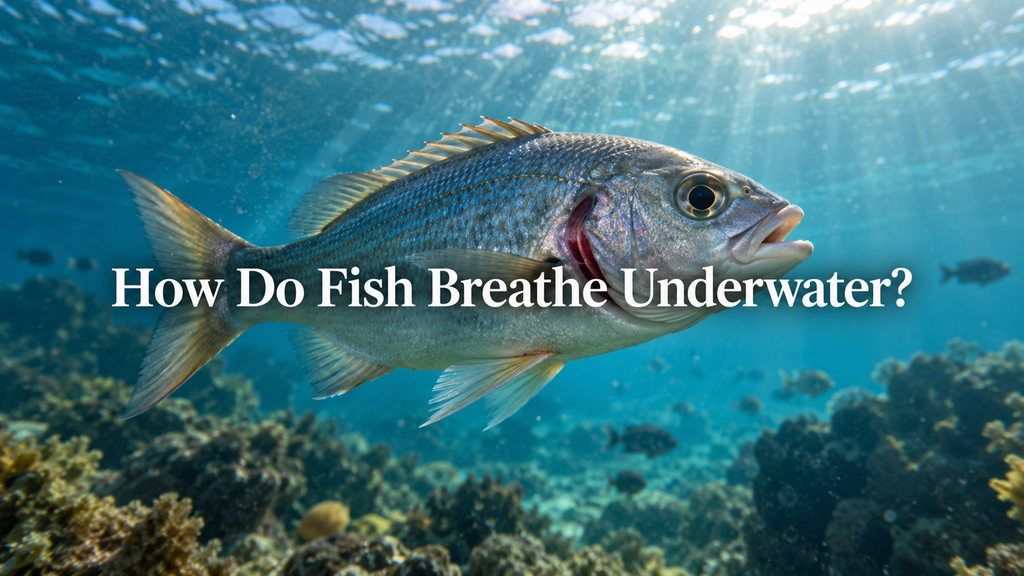
Fish live in a world that is very different from ours. Humans depend on air to breathe, but fish spend almost their entire lives underwater. This naturally raises an interesting question: how do fish breathe underwater?
The answer lies in a special organ called the gills. Fish do not breathe water itself. Instead, they take oxygen that is dissolved in water and move it into their bloodstream through their gills. At the same time, they remove carbon dioxide from their bodies.
This process may look simple from the outside, but it is actually a highly efficient biological system. Understanding how fish breathe underwater gives us a better idea of how animals adapt to the environments in which they live.
Fish Need Oxygen Just Like Humans
Fish and humans are very different animals, but both need oxygen to survive. Oxygen is required by cells to release energy from food. Without enough oxygen, the body cannot continue normal life processes.
Humans get oxygen by breathing air into the lungs. Air contains a large amount of oxygen compared with water. Fish cannot use lungs in the same way because they live underwater.
Water contains dissolved oxygen. This oxygen enters water from the atmosphere and is also produced by aquatic plants and algae during photosynthesis.
Fish have evolved gills that can collect this dissolved oxygen very efficiently.
So, when we ask how fish breathe underwater, the basic answer is that they use their gills to remove dissolved oxygen from water.
What Are Fish Gills?
Gills are soft respiratory organs usually found on both sides of a fish’s head. In many fish, the gills are protected by a hard covering called the operculum.
Inside the gills are several structures that provide a very large surface area. This large surface area is important because it allows more oxygen to move from water into the blood.
Each gill contains gill arches. Attached to these arches are thin structures known as gill filaments.
The gill filaments contain even smaller structures called lamellae. These lamellae are extremely thin and contain many tiny blood vessels.
Because the walls of the lamellae are so thin, oxygen can move easily from the water into the bloodstream.
Carbon dioxide moves in the opposite direction, leaving the blood and entering the water.
How Water Moves Through the Gills
For fish to breathe underwater, a constant flow of water must pass across their gills.
In many fish, the process begins when the fish opens its mouth. Water enters the mouth and moves toward the gills.
The fish then closes its mouth and uses movements of the mouth and gill covers to push the water across the gill surfaces.
After passing over the gills, the water leaves through openings on the sides of the head.
As water moves across the gills, oxygen dissolved in the water comes very close to the blood inside the gill capillaries.
This allows oxygen to enter the blood through a process called diffusion.
What Is Diffusion?
Diffusion is the movement of substances from an area where they are more concentrated to an area where they are less concentrated.
In the case of fish gills, the water passing over the gills usually contains more oxygen than the blood arriving at the gills.
Because of this difference, oxygen naturally moves from the water into the blood.
At the same time, the blood contains more carbon dioxide than the surrounding water. Carbon dioxide therefore moves from the blood into the water.
This exchange happens quickly because the gill surfaces are thin and have a rich blood supply.
Diffusion is one of the main reasons gills are so effective at helping fish breathe underwater.
The Countercurrent Exchange System
One of the most interesting parts of fish respiration is something called countercurrent exchange.
In many fish, water flows across the gills in one direction, while blood inside the gill capillaries flows in the opposite direction.
This arrangement helps fish absorb more oxygen from the water.
As fresh water moves across the gills, it continually meets blood that contains less oxygen than the water.
Because the water always has a higher oxygen concentration than the nearby blood, oxygen continues to move into the bloodstream along almost the entire length of the gill.
This system is much more efficient than if the blood and water moved in the same direction.
Countercurrent exchange allows fish to remove a large percentage of the available oxygen from the water.
Why Fish Cannot Usually Breathe Air
Most fish cannot survive for long outside water even though air contains much more oxygen than water.
The problem is not simply that fish cannot find oxygen. The main problem is that their gills are designed to work while supported by water.
In water, the delicate gill filaments remain spread apart. This creates a large surface area for oxygen exchange.
When a fish is removed from water, the gill filaments can collapse and stick together.
This greatly reduces the surface area available for breathing.
As a result, the fish may not be able to absorb enough oxygen even though it is surrounded by air.
This explains why keeping fish in water with enough dissolved oxygen is essential for their survival.
Do All Fish Breathe in the Same Way?
Most fish use gills, but not every fish depends entirely on the same breathing method.
Some species have developed additional ways to obtain oxygen.
For example, certain fish can breathe air from the surface.
Lungfish are a famous example. They have organs that function somewhat like lungs and allow them to breathe atmospheric air.
Some catfish and other species can also absorb oxygen using special structures.
Bettas and gouramis have an organ called the labyrinth organ. This allows them to take oxygen directly from air at the water surface.
These adaptations are especially useful in warm or stagnant water where dissolved oxygen levels may be low.
Why Does Water Contain Oxygen?
Water molecules contain oxygen atoms, but fish cannot simply separate the oxygen atoms from water molecules.
Instead, fish breathe oxygen gas that is dissolved between the water molecules.
Oxygen enters water mainly from the surrounding air.
Waves, flowing rivers, waterfalls and surface movement help mix atmospheric oxygen into the water.
Aquatic plants and algae also add oxygen through photosynthesis when light is available.
The amount of dissolved oxygen can change depending on water temperature, movement, pollution and biological activity.
Fish depend heavily on these oxygen levels.
Water Temperature Affects Fish Breathing
Temperature plays an important role in how much oxygen water can hold.
Cold water usually holds more dissolved oxygen than warm water.
This is one reason some fish species prefer colder rivers and lakes.
Warm water contains less oxygen, and fish living in warm conditions may need to move more water across their gills to get enough oxygen.
Temperature also affects a fish’s metabolism.
When water becomes warmer, many fish become more active and their bodies may require more oxygen.
This can create a difficult situation because warm water may contain less oxygen while the fish needs more of it.
Why Fish Sometimes Gasp at the Surface
If you have ever seen fish repeatedly coming to the surface and appearing to gasp, low oxygen may be one possible reason.
When dissolved oxygen levels become too low, fish may move closer to the surface because the upper part of the water can contain more oxygen.
This can happen in ponds or aquariums with poor water circulation.
Overcrowding, high temperatures, pollution or too much decaying organic material can also reduce oxygen levels.
However, surface breathing can be normal for certain fish species.
Some fish naturally take air from the surface as part of their normal respiratory system.
How Fish Blood Carries Oxygen
After oxygen enters the blood through the gills, it must be transported throughout the fish’s body.
Fish blood contains hemoglobin, a protein found inside red blood cells.
Hemoglobin can bind with oxygen.
Once oxygen enters the bloodstream at the gills, hemoglobin carries it to different tissues and organs.
The oxygen is then released where the cells need it.
The cells use oxygen during cellular respiration to release energy from nutrients.
Carbon dioxide is produced as a waste product and carried back toward the gills.
At the gills, carbon dioxide leaves the blood and enters the surrounding water.
This creates a continuous breathing cycle.
Why Gills Have Such a Large Surface Area
Efficient breathing depends heavily on surface area.
The more surface area available, the more oxygen can move into the blood at the same time.
Fish gills are designed with many filaments and countless tiny lamellae.
These structures greatly increase the total area available for gas exchange without taking up too much space inside the fish.
A similar idea can be seen in human lungs.
Our lungs contain millions of tiny air sacs called alveoli that create a very large surface area.
Fish gills and human lungs look different, but both use large surface areas to make oxygen exchange more efficient.
Do Fish Ever Run Out of Oxygen?
Yes, fish can suffer when the water does not contain enough dissolved oxygen.
A condition where oxygen levels become very low is sometimes called hypoxia.
Several things can cause this problem.
Large amounts of algae can reduce oxygen levels, especially at night.
Decaying plants and animals also use oxygen as microorganisms break them down.
Pollution can disturb the natural oxygen balance of rivers, lakes and ponds.
Very warm weather can also reduce the amount of oxygen available in water.
When oxygen becomes too low, fish may become weak, gather near the surface or die.
Healthy aquatic environments therefore need a proper balance of oxygen, temperature and water quality.
How Fast Do Fish Breathe?
The breathing rate of fish can change depending on several conditions.
A fish may move its gill covers faster when it is active because its muscles need more oxygen.
The breathing rate may also increase when the water contains less oxygen.
Temperature, stress, water quality and the fish species can all affect breathing.
For aquarium owners, unusually rapid gill movement can sometimes be a sign that the fish is stressed or that something is wrong with the water.
Healthy water conditions are important because fish are constantly exchanging gases with their environment.
Sharks Breathe a Little Differently
Sharks are fish, but their breathing structures differ slightly from those of many bony fish.
Most sharks have several visible gill slits on each side of the body instead of a single gill cover.
Water passes through the mouth and moves across the gills before leaving through these slits.
Some sharks actively pump water over their gills while resting.
Other species depend more heavily on forward movement to keep water flowing across the gills.
This method is sometimes called ram ventilation.
It is one reason certain sharks appear to spend much of their time swimming.
Fish Gills Also Help With Other Body Functions
Gills are mainly known for respiration, but they can also perform other important functions.
Fish live in environments where the balance of salt and water inside the body must be carefully controlled.
Special cells in the gills help regulate salts and minerals.
The gills can also help remove some waste products from the body.
This means the gills are involved not only in breathing but also in maintaining the fish’s internal chemical balance.
They are highly specialized organs that perform several essential tasks.
Freshwater and Saltwater Fish Face Different Challenges
Fish living in freshwater and fish living in the ocean face different problems when controlling water and salt levels.
Freshwater contains fewer salts than the fluids inside the bodies of many fish.
As a result, water tends to enter freshwater fish naturally.
Marine fish face almost the opposite situation because seawater contains a high concentration of salt.
Their bodies must prevent excessive water loss and remove extra salt.
The gills play an important role in these processes.
Although this is separate from breathing, it shows how important the gill system is to fish survival.
Why Fish Are So Well Adapted to Water
Fish have lived in aquatic environments for hundreds of millions of years.
Over time, their bodies developed features that make underwater life possible.
Streamlined shapes help them move efficiently.
Fins provide balance and control.
Special sensory systems help them detect changes in the surrounding water.
Most importantly for respiration, gills allow them to obtain oxygen without leaving the water.
The combination of thin gill surfaces, rich blood vessels, continuous water movement and countercurrent exchange creates an extremely effective breathing system.
Conclusion
So, how do fish breathe underwater?
Fish breathe using gills that remove dissolved oxygen from the water. Water enters through the mouth and passes over the gills. Oxygen moves through the thin gill surfaces into the bloodstream, while carbon dioxide moves from the blood into the water.
Many fish also use a countercurrent exchange system that allows them to absorb oxygen very efficiently.
The oxygen is carried through the body by hemoglobin and used by cells to release energy.
Although fish live in water and humans live on land, both depend on the same essential gas for survival. The main difference is the respiratory system used to obtain it.
Fish gills are a remarkable example of how living organisms adapt to their environment. Their delicate structure allows fish to collect oxygen from water continuously and survive in oceans, rivers, lakes and ponds around the world.
The next time you watch a fish opening and closing its mouth or moving its gill covers, you are seeing a carefully designed breathing system in action.