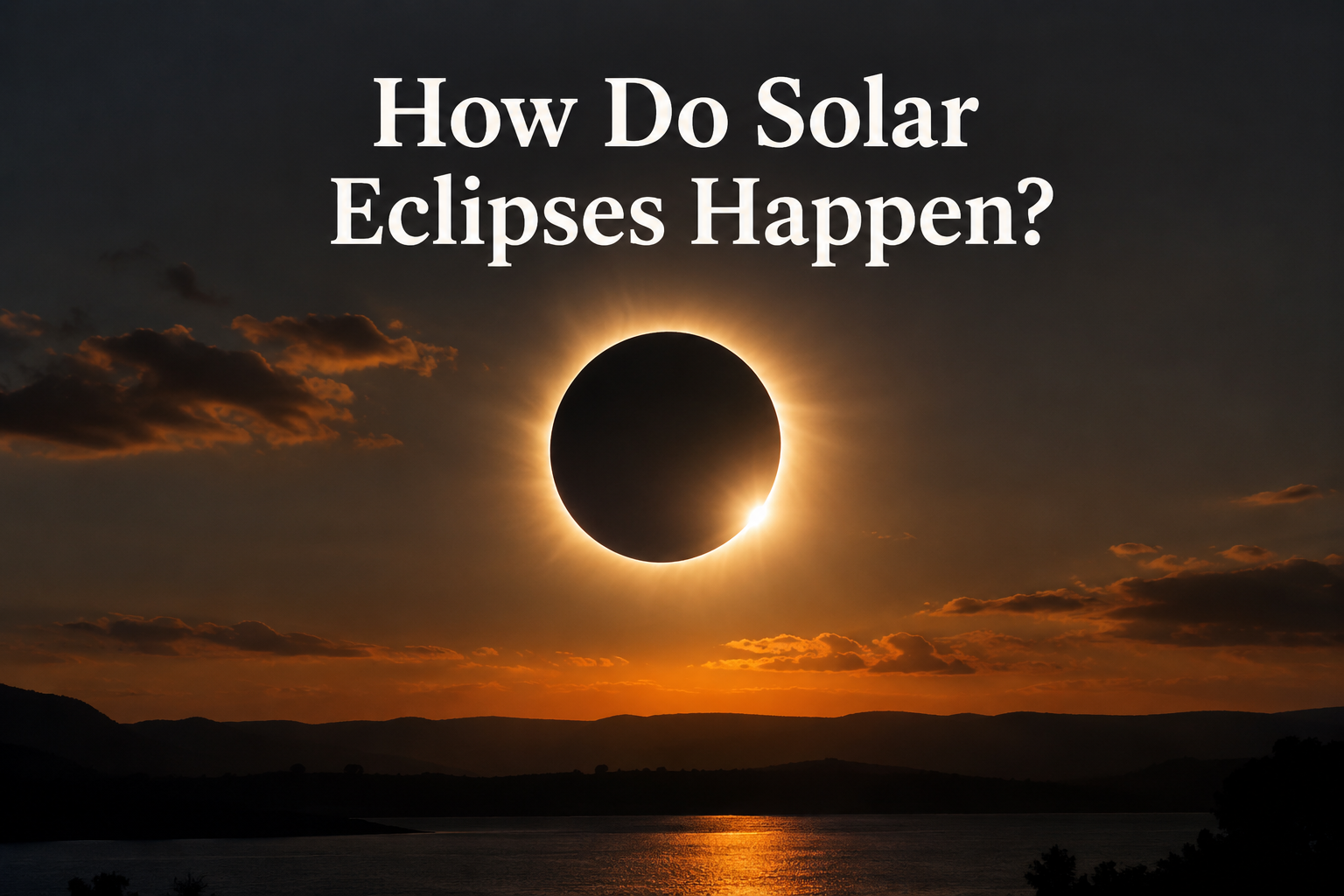
A solar eclipse is one of the most fascinating natural events we can see in the sky. For a short time, daylight can become dim, the temperature may drop slightly, and the Sun may appear partly or completely covered. To someone seeing it for the first time, a solar eclipse can feel mysterious. In reality, it happens because of a simple movement involving the Sun, the Moon, and Earth.
A solar eclipse happens when the Moon moves between Earth and the Sun and blocks some or all of the Sun’s light from reaching a particular area of Earth. The Moon is much smaller than the Sun, but it is also much closer to Earth. Because of this special combination of size and distance, the Moon can sometimes appear almost the same size as the Sun in our sky.
Understanding how solar eclipses happen becomes much easier when we look at the positions and movements of these three objects.
The Basic Idea Behind a Solar Eclipse
The Sun produces the light that reaches Earth during the daytime. The Moon does not produce its own visible light. Instead, it reflects sunlight.
The Moon travels around Earth in an orbit. As it moves around our planet, its position changes compared with the Sun. Sometimes the Moon passes between Earth and the Sun.
When the Sun, Moon, and Earth line up in the correct way, the Moon blocks sunlight and casts a shadow on Earth. People standing inside this shadow may see a solar eclipse.
In simple terms, the order during a solar eclipse is:
Sun, Moon, Earth.
This alignment is the main reason a solar eclipse happens.
Why Does the Moon Cover the Sun?
The Sun is enormous compared with the Moon. The diameter of the Sun is about 1.39 million kilometers, while the Moon is only about 3,474 kilometers wide.
This means the Sun is roughly 400 times wider than the Moon.
However, the Sun is also about 400 times farther away from Earth than the Moon is. This creates an interesting visual effect. From Earth, the Sun and Moon appear to have nearly the same size in the sky.
Because of this, the Moon can sometimes cover the entire visible surface of the Sun.
This is one of the remarkable features of our place in the solar system. If the Moon appeared much smaller in our sky, total solar eclipses would not look the way they do today.
Why Does a Solar Eclipse Not Happen Every Month?
This is one of the most common questions people ask about solar eclipses.
The Moon moves around Earth about once every month. During a new moon, the Moon is positioned roughly between Earth and the Sun. It may seem that a solar eclipse should happen every new moon.
However, this does not happen because the Moon’s orbit is slightly tilted compared with Earth’s orbit around the Sun.
The Moon’s orbit is tilted by about five degrees.
Most of the time, the Moon passes slightly above or slightly below the Sun from our point of view. Its shadow therefore misses Earth.
A solar eclipse happens only when the new moon is close to one of the points where the Moon’s orbit crosses the plane of Earth’s orbit.
These crossing points are called nodes.
When the timing and position are right, the Sun, Moon, and Earth line up closely enough for the Moon’s shadow to fall on Earth.
What Is the Shadow of the Moon?
When the Moon blocks sunlight, it creates a shadow behind it.
This shadow has different parts, and the type of solar eclipse a person sees depends on which part of the shadow passes over their location.
The two most important parts are called the umbra and penumbra.
The umbra is the darkest central part of the Moon’s shadow. If you are standing inside the umbra, the Moon can completely cover the Sun. This produces a total solar eclipse.
The penumbra is the lighter outer part of the shadow. If you are inside this region, the Moon blocks only part of the Sun. This produces a partial solar eclipse.
There is also another shadow region called the antumbra, which is important during an annular solar eclipse.
What Is a Total Solar Eclipse?
A total solar eclipse happens when the Moon completely covers the visible surface of the Sun.
This occurs only for people located inside the narrow path of the Moon’s umbra.
As the Moon begins moving across the Sun, more and more of the Sun becomes hidden. Eventually, the Sun can become completely covered.
The short period when the Sun is fully covered is called totality.
During totality, the sky can become much darker. Bright stars and planets may become visible. The temperature may fall slightly, and some animals may behave as if evening has arrived.
One of the most impressive features of a total solar eclipse is the solar corona.
The corona is the Sun’s outer atmosphere. Normally, it is difficult to see because the bright surface of the Sun overwhelms it. During totality, the Moon blocks the bright surface and allows the pale corona to become visible around the dark Moon.
A total solar eclipse is only visible along a relatively narrow path on Earth’s surface. People outside this path may see only a partial eclipse.
What Is a Partial Solar Eclipse?
A partial solar eclipse happens when the Moon covers only part of the Sun.
This occurs when an observer is inside the Moon’s penumbra rather than its umbra.
During a partial eclipse, the Sun may look as if a dark circular piece has been removed from it. The amount of the Sun that is covered depends on the observer’s location.
Some places may see only a small portion of the Sun covered, while other places may see almost the entire Sun hidden.
Partial solar eclipses are usually visible over a much larger area than total solar eclipses because the penumbra covers a wider region of Earth.
Even during a partial solar eclipse, proper eye protection is necessary when looking toward the Sun.
What Is an Annular Solar Eclipse?
An annular solar eclipse happens when the Moon passes directly in front of the Sun but appears slightly too small to cover it completely.
The Moon’s distance from Earth changes because its orbit is not a perfect circle.
At some points in its orbit, the Moon is closer to Earth. At other points, it is farther away.
When the Moon is farther from Earth, it appears slightly smaller in the sky. If a solar eclipse happens at this time, the Moon may not completely cover the Sun.
Instead, a bright ring of sunlight remains visible around the Moon.
This is often called the ring of fire.
The ring may look beautiful, but it is still extremely bright. Looking directly at it without proper solar viewing protection can seriously damage the eyes.
What Is a Hybrid Solar Eclipse?
A hybrid solar eclipse is a rare type of eclipse that changes between a total eclipse and an annular eclipse along different parts of its path.
This happens because Earth is curved and because the distances between the Sun, Moon, and different locations on Earth vary slightly.
In some places, the Moon appears large enough to cover the Sun completely. In other places, it appears slightly smaller, leaving a thin ring around the Sun.
Hybrid solar eclipses are much less common than partial, total, or annular eclipses.
How Does the Eclipse Move Across Earth?
The Moon is constantly moving in its orbit around Earth, while Earth is also rotating.
Because of these movements, the Moon’s shadow does not remain in one place.
Instead, the shadow moves across Earth’s surface.
During a total solar eclipse, the dark central shadow creates a path called the path of totality.
People located inside this path can experience the total phase of the eclipse. People outside it usually see a partial eclipse.
The path of totality can stretch across thousands of kilometers, but it is usually quite narrow.
This is why many people travel long distances to see a total solar eclipse.
How Long Does a Solar Eclipse Last?
The entire process of a solar eclipse can last for several hours from the beginning of the partial phase to the end.
However, totality at one location usually lasts only a few minutes.
The maximum possible duration of totality is a little over seven minutes under ideal conditions, although most total eclipses are shorter.
This short duration happens because the Moon’s shadow moves quickly across Earth.
The exact length of an eclipse depends on several factors, including the distances between Earth, the Moon, and the Sun.
Why Can Scientists Predict Solar Eclipses?
Solar eclipses may look dramatic, but they are not random events.
Astronomers understand the movements of Earth and the Moon very accurately. The Moon follows a predictable orbit around Earth, while Earth follows a predictable orbit around the Sun.
Using mathematics, scientists can calculate where these objects will be at different times.
This allows astronomers to predict solar eclipses many years into the future.
They can calculate the exact date of an eclipse, where it will be visible, what type of eclipse will happen, when each phase will begin, and how long it will last.
Historical eclipses can also be calculated using the same orbital patterns.
What Is an Eclipse Season?
Solar eclipses can only happen during certain periods known as eclipse seasons.
An eclipse season occurs when the Sun is close to one of the Moon’s orbital nodes.
Each eclipse season lasts for several weeks and usually happens about twice a year.
During this period, the alignment of the Sun, Moon, and Earth makes an eclipse possible.
Depending on the exact positions of these objects, an eclipse season may include a solar eclipse, a lunar eclipse, or sometimes more than one eclipse.
This explains why eclipses often seem to appear in groups rather than being spread evenly throughout the year.
How Is a Solar Eclipse Different From a Lunar Eclipse?
Solar and lunar eclipses involve the same three objects, but their positions are different.
During a solar eclipse, the Moon is between the Sun and Earth.
During a lunar eclipse, Earth is between the Sun and the Moon.
In a solar eclipse, the Moon’s shadow falls on Earth.
In a lunar eclipse, Earth’s shadow falls on the Moon.
Solar eclipses are visible only from certain areas of Earth because the Moon’s shadow covers a relatively small region.
Lunar eclipses can usually be seen from a much larger part of Earth because anyone on the nighttime side of the planet may be able to see the Moon passing through Earth’s shadow.
Is It Safe to Look at a Solar Eclipse?
Looking directly at the Sun can damage the eyes, and this is also true during most phases of a solar eclipse.
The Sun still produces powerful visible light and invisible radiation even when part of it is covered by the Moon.
Ordinary sunglasses are not safe for looking directly at the Sun.
Special solar viewing glasses designed for eclipse observation should be used. These filters reduce the Sun’s intense light to a safe level.
During the brief total phase of a total solar eclipse, when the Sun’s bright surface is completely covered, the corona may be viewed directly. However, eye protection must be used again as soon as any bright part of the Sun begins to reappear.
People should always follow reliable eclipse viewing guidance when observing this event.
Why Are Solar Eclipses Important to Science?
Solar eclipses have helped scientists learn important things about the Sun.
Before modern space telescopes existed, total solar eclipses gave astronomers a rare chance to study the solar corona.
Eclipses have also played a role in major scientific observations.
In the past, astronomers used solar eclipses to study the positions of stars near the Sun and test predictions about gravity.
Today, scientists have advanced telescopes and satellites that can observe the Sun continuously. Even so, eclipses remain useful because they allow researchers to study certain parts of the Sun’s atmosphere in unusual conditions.
They also give scientists opportunities to study changes in Earth’s atmosphere, temperature, and animal behavior during sudden darkness.
Why Do Solar Eclipses Feel So Unusual?
A solar eclipse changes several familiar things at the same time.
Humans are used to the daytime sky being bright whenever the Sun is above the horizon. During a major solar eclipse, that pattern suddenly changes.
The light becomes weaker, shadows can look different, and the surroundings may become strangely quiet.
The temperature can fall because less solar energy reaches the ground.
Animals may also react. Birds may return to resting places, while some insects may begin behaving as if evening has arrived.
These changes happen quickly and then disappear as sunlight returns.
Will Solar Eclipses Always Happen?
Interestingly, total solar eclipses will not continue forever.
The Moon is slowly moving farther away from Earth over very long periods of time.
As the Moon becomes more distant, it appears slightly smaller in the sky.
Eventually, far in the future, the Moon will appear too small to completely cover the Sun.
At that point, total solar eclipses will no longer occur, although annular and partial eclipses will still be possible.
This change is happening extremely slowly, so total solar eclipses will continue for millions of years.
Final Thoughts
So, how do solar eclipses happen? A solar eclipse occurs when the Moon moves between the Sun and Earth and blocks sunlight from reaching part of our planet. The Moon’s shadow falls on Earth, creating different types of eclipses depending on the exact positions and distances involved.
A total solar eclipse happens when the Moon completely covers the Sun. A partial eclipse occurs when only part of the Sun is covered. An annular eclipse happens when the Moon appears slightly smaller than the Sun, leaving a bright ring of sunlight around it.
Solar eclipses do not happen every month because the Moon’s orbit is tilted. Only when the Sun, Moon, and Earth line up near the Moon’s orbital nodes can an eclipse occur.
What makes a solar eclipse especially interesting is that such a dramatic event is created by predictable movements in space. The Sun, Moon, and Earth continue following their regular paths, and every once in a while, those paths line up perfectly enough to create one of the most remarkable sights in the natural world.