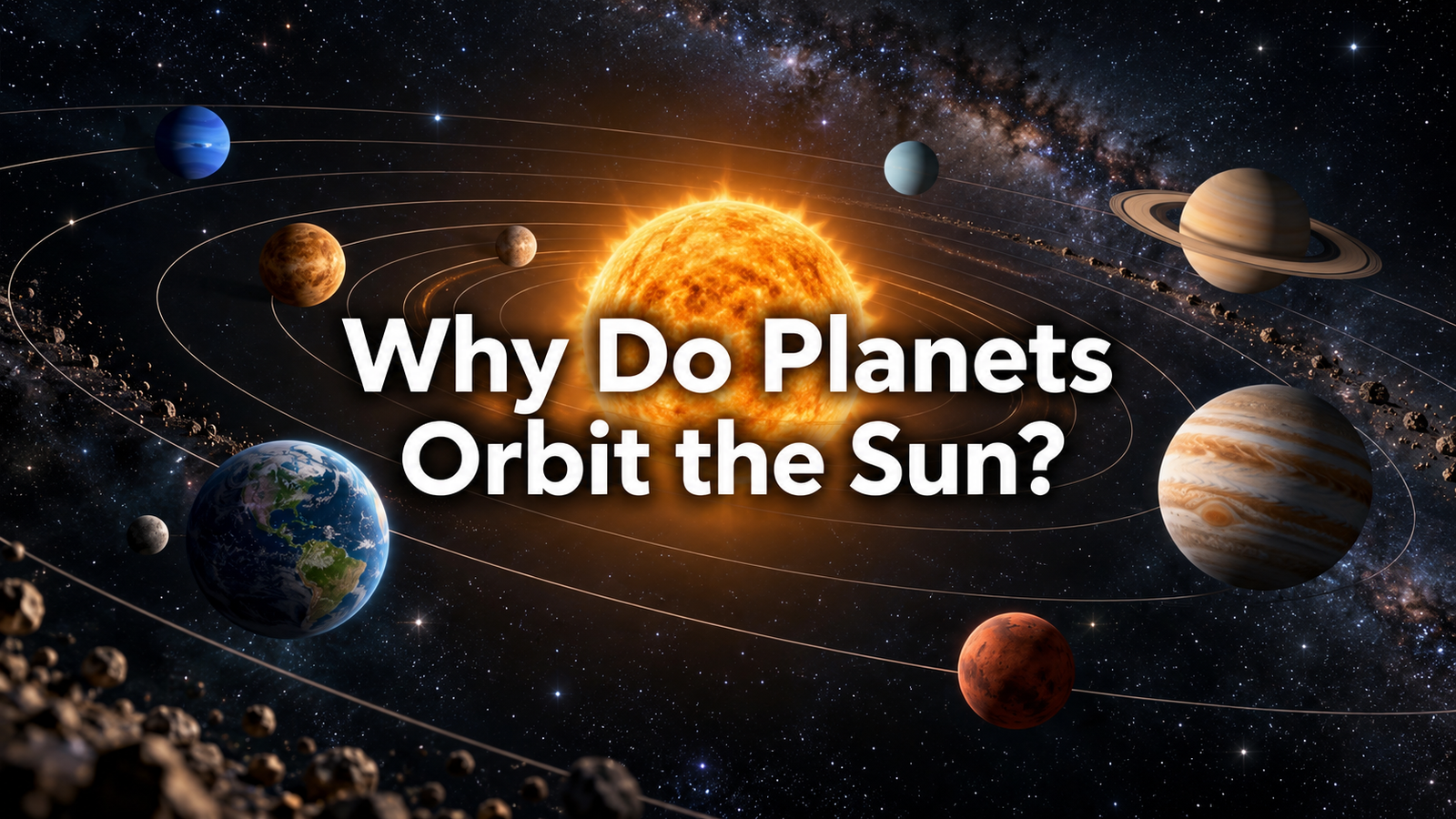
When we look at the night sky, planets seem like distant points of light moving slowly among the stars. It is easy to forget that every planet in our solar system is constantly moving at enormous speed. Earth is moving around the Sun, Mars is following its own path, Jupiter is traveling through a much larger orbit, and even distant Neptune continues its long journey around the same central star.
This naturally raises an interesting question. Why do planets orbit the Sun instead of flying away into space or falling directly into it?
The answer comes from a combination of gravity and motion. These two forces work together in a way that keeps planets traveling around the Sun in stable paths called orbits. Understanding this simple idea helps explain not only our solar system, but also how moons, satellites, stars, and even galaxies move through space.
The Sun’s Gravity Holds the Solar System Together
The main reason planets orbit the Sun is gravity.
Gravity is the natural attraction between objects that have mass. Every object with mass produces gravity, but larger objects create a much stronger gravitational pull.
The Sun contains almost all the mass in our solar system. Because it is so massive, its gravity is strong enough to influence every planet, dwarf planet, asteroid, comet, and many other objects that travel through the solar system.
The Sun constantly pulls Earth toward itself. It also pulls Mercury, Venus, Mars, Jupiter, Saturn, Uranus, and Neptune inward.
At first, this may sound as if all the planets should eventually fall into the Sun. They do not because they are also moving sideways at very high speeds.
This sideways motion is an equally important part of understanding why planets orbit the Sun.
Planets Are Always Moving Forward
A planet does not sit still in space while the Sun pulls on it. It is already moving.
Earth, for example, travels around the Sun at about 30 kilometers every second. That is roughly 108,000 kilometers per hour.
If the Sun suddenly disappeared and its gravity vanished, Earth would no longer follow its curved orbit. Instead, it would continue moving in a nearly straight line through space.
The Sun’s gravity constantly changes the direction of Earth’s motion.
Earth wants to keep moving forward, while the Sun’s gravity pulls it inward. The result is a curved path around the Sun.
This curved path is what we call an orbit.
An Orbit Is Similar to Continuous Falling
One useful way to understand planetary orbits is to think of a planet as constantly falling toward the Sun but continually missing it.
Imagine throwing a ball forward. Gravity pulls the ball downward, and eventually it reaches the ground.
Now imagine throwing the ball much faster. It would travel farther before reaching the surface.
If it could move fast enough and there were no air resistance, the curved surface of Earth would fall away beneath it at the same rate that the ball was falling. The ball would continue moving around Earth instead of hitting the ground.
This is similar to how satellites stay in orbit around Earth.
Planets behave in the same basic way around the Sun. The Sun’s gravity pulls them inward, but their forward motion prevents them from falling directly into the Sun.
They are essentially falling around the Sun continuously.
Why Do Planets Have Different Orbits?
Not every planet follows the same path.
Mercury is very close to the Sun and completes one orbit in only about 88 Earth days.
Earth takes about 365 days.
Jupiter needs almost 12 Earth years to complete a single orbit.
Neptune takes about 165 Earth years.
These differences mainly depend on distance from the Sun.
Planets closer to the Sun experience stronger gravity and generally move faster in their orbits. Planets farther away experience weaker gravitational attraction and move more slowly.
They also have much longer distances to travel.
This is why distant planets take many years to complete one revolution around the Sun.
Planetary Orbits Are Not Perfect Circles
Many drawings of the solar system show planets traveling in perfect circles. This is useful for simple diagrams, but real planetary orbits are slightly different.
Most planets move along paths known as ellipses.
An ellipse is similar to a stretched circle.
Some planetary orbits are almost circular, while others are more noticeably stretched.
Earth’s orbit is only slightly elliptical, so its distance from the Sun does not change dramatically during the year.
Johannes Kepler, a German astronomer and mathematician, helped explain planetary motion in the early seventeenth century. His studies showed that planets travel around the Sun in elliptical orbits rather than perfect circles.
This discovery became an important step in understanding the solar system.
Gravity Changes With Distance
Gravity becomes weaker as distance increases.
This is important when understanding why planets move differently.
Mercury experiences a much stronger gravitational pull from the Sun than Neptune does because Mercury is much closer.
As a result, Mercury moves through its orbit much faster.
Neptune is billions of kilometers from the Sun, so the Sun’s gravitational influence there is weaker. Neptune still remains in orbit, but it travels much more slowly.
The relationship between gravity, distance, and motion helps determine the shape and speed of every planetary orbit.
How Did the Planets Begin Orbiting the Sun?
To understand why planets orbit the Sun today, it helps to look back at how the solar system formed.
Scientists believe our solar system began about 4.6 billion years ago from a huge cloud of gas and dust.
Gravity caused this cloud to collapse inward.
As the cloud became smaller, it began spinning faster. Most of the material collected in the center and eventually formed the Sun.
The remaining gas and dust continued moving around the young Sun in a large rotating disk.
Over time, particles inside this disk collided and joined together. Small pieces became larger bodies, and some of those bodies eventually grew into planets.
Because the original disk was already rotating, the young planets inherited this motion.
Instead of simply falling into the Sun, they continued traveling around it.
That ancient motion is still visible today in the orbital movement of the planets.
Why Do Most Planets Orbit in the Same Direction?
An interesting feature of the solar system is that most planets orbit the Sun in the same direction.
Viewed from above the Sun’s north pole, the planets move mostly counterclockwise.
This shared direction is connected to how the solar system formed.
The original cloud of gas and dust was rotating. As it collapsed into a flattened disk, most of the material continued moving in the same general direction.
The planets formed inside this rotating disk, so they naturally inherited its motion.
This is also why most planetary orbits lie near the same flat region around the Sun.
Why Do Planets Not Crash Into Each Other?
The solar system may seem crowded in pictures, but in reality, the planets are separated by enormous distances.
Each major planet follows its own stable orbital path.
Earth, for example, stays at an average distance of about 150 million kilometers from the Sun. Mars follows a larger orbit, while Venus follows a smaller one.
Because these orbital paths are well separated, major planets do not normally collide.
Gravity from other planets can slightly influence an orbit, but the overall system remains remarkably stable over long periods.
Jupiter, because of its enormous mass, has a particularly strong gravitational influence on many smaller objects such as asteroids and comets.
What Would Happen If a Planet Moved Too Slowly?
The speed of a planet is important for maintaining its orbit.
If a planet suddenly lost a large amount of its sideways speed, gravity would pull it more strongly inward.
Its orbit would change, and if enough speed were lost, the planet could eventually move much closer to the Sun.
In an extreme situation, it could fall into the Sun.
However, planets naturally maintain orbital speeds that are connected to their distances from the Sun.
That balance has existed for billions of years.
What Would Happen If a Planet Moved Too Fast?
The opposite situation is also possible.
If a planet suddenly gained enough speed, it could move into a larger orbit.
If its speed became extremely high, it could even escape the Sun’s gravity completely.
The speed required to escape a gravitational field is known as escape velocity.
Planets normally travel below the speed needed to escape the solar system, so the Sun continues to hold them in orbit.
This shows how important the balance between gravity and motion really is.
Does the Sun Move Too?
It is common to imagine the Sun as completely stationary while the planets circle around it.
In reality, the Sun also moves.
The Sun and planets technically move around a shared center of mass known as the barycenter.
Because the Sun is far more massive than any planet, this point usually lies very close to the Sun and sometimes inside it.
Large planets such as Jupiter and Saturn can cause the Sun to move slightly around this shared center.
At an even larger scale, the entire solar system is also moving through the Milky Way galaxy.
The Sun travels around the center of the Milky Way while carrying all the planets with it.
So while Earth orbits the Sun, the entire solar system is also moving through space.
Newton Helped Explain Planetary Orbits
Isaac Newton provided one of the most important explanations of planetary motion.
In the seventeenth century, Newton developed laws describing motion and gravity.
He showed that the same gravity that makes objects fall toward Earth also governs the movement of the Moon and planets.
This was a major scientific breakthrough.
Before this idea became widely accepted, people often thought events in the sky followed completely different rules from events on Earth.
Newton demonstrated that the same physical laws apply throughout the universe.
His work showed mathematically how gravity could bend a planet’s motion into an orbit around the Sun.
Einstein Improved Our Understanding of Gravity
Newton’s description of gravity works extremely well for most everyday calculations and planetary motion.
However, Albert Einstein later developed a deeper explanation through his theory of general relativity.
According to Einstein, massive objects such as the Sun affect the structure of space and time around them.
A simple way to imagine this is to picture a heavy ball placed on a stretched sheet. The ball creates a depression in the surface.
Smaller objects moving nearby follow curved paths because the surface itself is curved.
The real universe is much more complex than this example, but the basic idea is useful.
The Sun changes the geometry of space around it, and planets move through this curved space.
This gives us a more complete explanation of gravity and planetary orbits.
Do Other Solar Systems Work the Same Way?
Yes.
Astronomers have discovered thousands of planets orbiting stars beyond our solar system. These planets are called exoplanets.
They orbit their stars because of the same basic relationship between gravity and motion.
Some orbit very close to their stars and complete an entire year in only a few days.
Others follow much wider paths.
Scientists study these distant planetary systems to understand how planets form and how common solar systems like ours may be.
The same laws of physics that control Earth’s orbit also operate around stars many light years away.
Why Planetary Orbits Matter for Life on Earth
Earth’s stable orbit is extremely important for life.
Our distance from the Sun allows Earth to receive enough energy to maintain temperatures where liquid water can exist across much of the planet.
If Earth were significantly closer to the Sun, temperatures would generally be much higher.
If it were much farther away, the planet would receive less solar energy.
Earth’s orbit also helps create the regular yearly cycle we use to measure time.
The seasons themselves are mainly caused by Earth’s tilted axis, not by major changes in distance from the Sun, but our yearly journey around the Sun determines the timing of those seasons.
The stability of Earth’s orbit has helped provide relatively predictable environmental conditions over very long periods.
The Simple Balance Behind Every Orbit
The answer to why planets orbit the Sun can be summarized through two main ideas.
The Sun’s gravity pulls planets inward.
At the same time, planets are moving forward through space.
Gravity bends that forward motion into a curved path.
If gravity disappeared, the planets would move away in straight lines. If their forward motion disappeared, they would fall toward the Sun.
Because both effects are happening together, the planets continue traveling around the Sun.
This balance has continued for billions of years and gives our solar system its familiar structure.
Final Thoughts
The movement of planets around the Sun may look peaceful and simple from Earth, but it represents a remarkable balance of gravity, speed, distance, and motion.
Every planet is constantly being pulled toward the Sun while also moving forward fast enough to avoid falling directly into it. The result is a stable orbit.
These orbits began when the solar system formed from a rotating cloud of gas and dust billions of years ago. The same physical laws continue to guide the planets today.
Understanding why planets orbit the Sun also teaches us something much bigger about the universe. Gravity and motion are not limited to our solar system. They control moons around planets, planets around distant stars, stars inside galaxies, and many other objects across space.
The next time you look at the sky, it is worth remembering that Earth is not standing still. At every moment, our planet is racing through space while following a carefully balanced path around the Sun, completing a journey that has continued almost unchanged for billions of years.