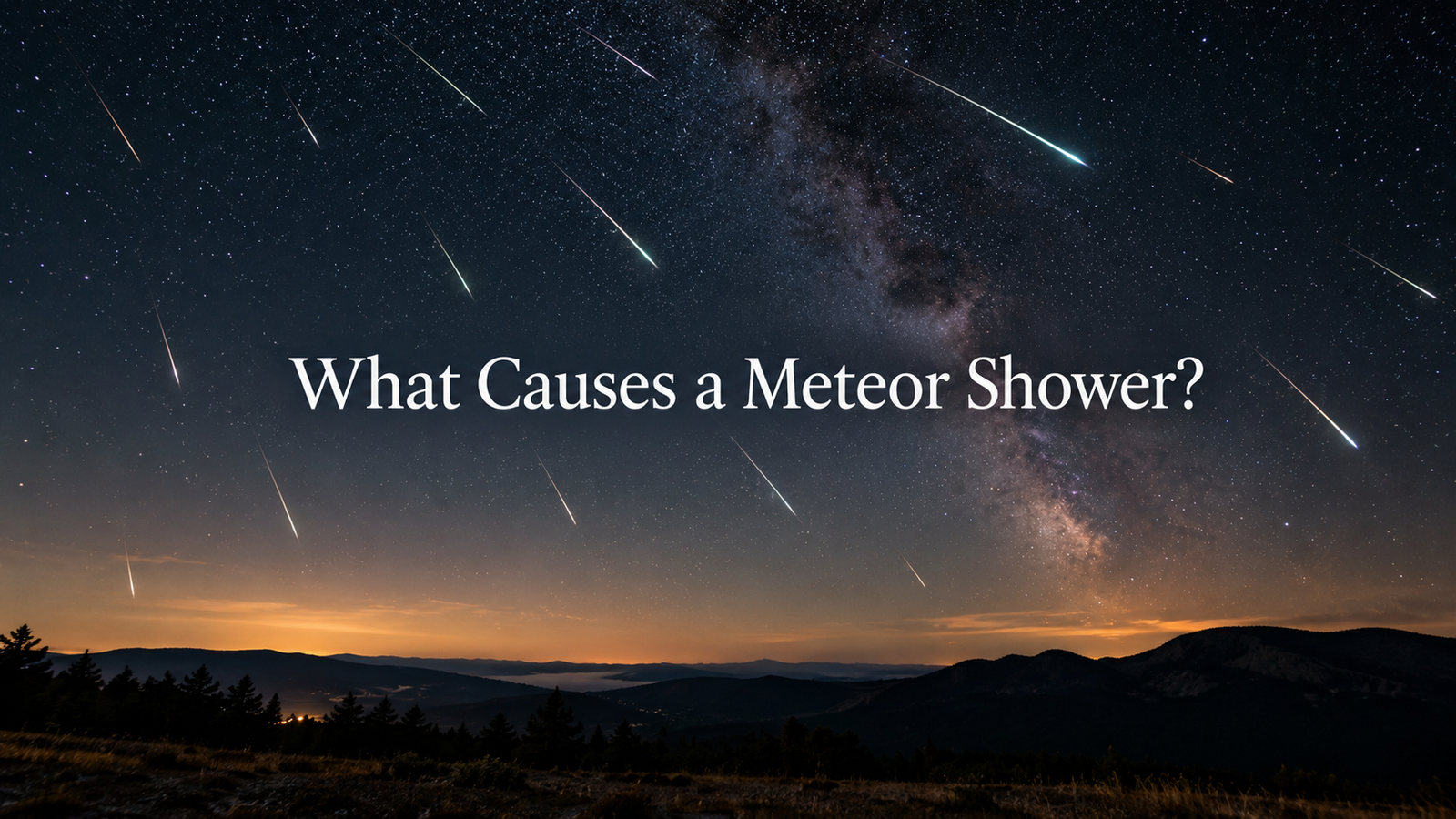
Looking up at the night sky during a meteor shower can be one of the most exciting experiences in astronomy. For a few minutes or even several hours, bright streaks of light appear across the sky. Some meteors are faint, while others are so bright that they seem to light up the darkness around them. When I first learned about meteor showers, I thought they were caused by stars falling toward Earth. After reading more about astronomy, I learned that the real explanation is much more interesting.
A meteor shower happens when Earth passes through a stream of dust and small pieces of rock left behind by a comet or, in some cases, an asteroid. These tiny particles enter Earth’s atmosphere at very high speeds. As they move through the air, they heat the surrounding gases and produce the glowing streaks that we call meteors.
Understanding what causes a meteor shower becomes easier when we first understand the difference between meteoroids, meteors, and meteorites.
What Is a Meteor?
Space contains many small pieces of rock, metal, and dust. While these objects are still traveling through space, they are generally called meteoroids.
A meteoroid may be extremely small, sometimes no larger than a grain of sand. Others may be much larger. When one of these objects enters Earth’s atmosphere, it moves through the air at tremendous speed.
The air in front of the object becomes compressed and extremely hot. This causes the meteoroid and the surrounding atmosphere to glow. The bright streak of light that we see in the sky is called a meteor.
If part of the object survives its journey through the atmosphere and reaches the ground, the remaining piece is known as a meteorite.
Most meteors seen during meteor showers are caused by very small particles. Even something the size of a grain of sand can produce a surprisingly bright streak because it is traveling so quickly.
What Causes a Meteor Shower?
The main cause of a meteor shower is Earth passing through a trail of debris in space.
Most of these debris trails are created by comets.
Comets are made from a mixture of frozen gases, dust, rock, and other materials. They travel around the Sun in long orbits. When a comet approaches the Sun, its surface begins to warm.
Some of the frozen material turns into gas and escapes into space. As this happens, dust and rocky particles are also released from the comet.
These particles remain along the comet’s orbit.
Over many trips around the Sun, a comet can leave behind a long stream of debris.
Earth also travels around the Sun. At certain times of the year, Earth crosses the path of one of these debris streams. Thousands of tiny particles then enter our atmosphere.
When many meteors become visible during a relatively short period, we call the event a meteor shower.
Why Do Meteor Showers Happen at the Same Time Every Year?
One of the most interesting things about meteor showers is that many of them return at almost the same time every year.
This happens because Earth follows a regular orbit around the Sun.
A comet’s debris trail also remains in roughly the same region of space along its orbit. Every year, Earth reaches the point where its path crosses that stream of particles.
For example, if Earth passes through a particular debris stream every August, people can expect a meteor shower around the same period each year.
The exact strength of a meteor shower may change from one year to another. Sometimes Earth passes through a dense part of the debris stream, producing many meteors. In other years, the number may be lower.
Still, the general timing of major meteor showers is predictable because Earth follows a regular path around the Sun.
Why Do Meteors Look Like They Come From One Point?
During a meteor shower, many meteors appear to come from the same area of the sky.
This point is called the radiant.
The meteors are actually traveling along almost parallel paths. However, because of perspective, they seem to spread outward from one location.
A similar effect can be seen when driving along a straight road. The edges of the road appear to meet at a distant point even though they are actually parallel.
Astronomers usually name meteor showers after the constellation located near their radiant.
For example, the Perseid meteor shower appears to come from the direction of the constellation Perseus.
The Leonid meteor shower appears to radiate from the constellation Leo.
The Geminid meteor shower gets its name from Gemini.
The constellation itself does not produce the meteors. It simply helps astronomers identify the direction from which the meteors appear to originate.
The Role of Comets in Meteor Showers
Comets are responsible for many of the best known meteor showers.
A comet spends most of its journey far from the Sun, where temperatures are extremely cold. As it moves closer to the Sun, heat begins to affect its icy surface.
Gas and dust are released, creating the bright cloud around the comet known as the coma. Solar radiation and the solar wind push some of this material away, producing the comet’s tail.
Not all released material becomes part of the visible tail. Small dust and rock particles can remain along the comet’s orbital path.
Over hundreds or even thousands of years, these particles can spread over a large section of the orbit.
When Earth crosses this dusty region, a meteor shower occurs.
This connection between comets and meteor showers shows how events happening far out in the solar system can create beautiful sights in Earth’s atmosphere.
Can Asteroids Cause Meteor Showers?
Although comets are responsible for many meteor showers, not every meteor shower comes from a comet.
Some are associated with asteroids.
One famous example is the Geminid meteor shower. It is connected with an object called 3200 Phaethon, which is usually classified as an asteroid, although it shares some characteristics with comets.
Particles released from such objects can create streams of debris in space just like comet dust.
When Earth passes through these streams, meteor activity increases.
This means that the basic cause of a meteor shower is always similar. Earth encounters a concentration of small particles while traveling around the Sun.
The original source of those particles may be a comet, an asteroid, or another small object in the solar system.
Why Do Meteors Burn in the Atmosphere?
People often say that meteors burn because of friction with the atmosphere. Friction contributes to the process, but the full explanation involves the rapid compression of air.
A meteoroid can enter Earth’s atmosphere at speeds of many kilometers per second.
At such speeds, the air in front of the object cannot move out of the way quickly enough. It becomes strongly compressed.
Compressed air heats rapidly.
This heat causes gases around the meteoroid to glow and can also heat the surface of the incoming particle.
The glowing path is what we see as a meteor.
Most particles involved in meteor showers are so small that they completely disappear high in the atmosphere. They usually never reach the ground.
This is why watching a normal meteor shower is generally safe.
How High Do Meteor Showers Occur?
Most visible meteors appear high above Earth’s surface.
They usually begin glowing at altitudes of roughly 80 to 120 kilometers, although the exact height depends on their speed, size, and composition.
At these heights, the atmosphere is much thinner than it is near the ground.
However, a fast moving meteoroid still encounters enough gas molecules to produce intense heating and visible light.
Many meteors disappear within a second or two.
Larger objects may stay visible longer and can sometimes create exceptionally bright meteors known as fireballs.
Why Are Some Meteor Showers Stronger Than Others?
Not every meteor shower produces the same number of meteors.
Several factors affect the strength of a meteor shower.
The first is the density of the debris stream.
If Earth passes through an area containing many particles, observers may see a large number of meteors. If the stream is thin, only a few may appear.
The size of the particles also matters. Larger particles can produce brighter meteors.
Earth’s exact path through the stream can also change from year to year.
The gravitational influence of planets, especially Jupiter, can slowly alter the position of debris streams.
A comet may also recently have passed near the Sun and added fresh particles to its orbit.
Because of these factors, some years produce unusually strong meteor activity.
What Is a Meteor Storm?
A meteor storm is an unusually intense meteor shower.
During a normal meteor shower, observers may see several meteors each hour. During a strong shower, dozens or sometimes more than one hundred may be visible under ideal conditions.
A meteor storm can produce hundreds or even thousands of meteors per hour.
These events are much rarer.
Meteor storms usually happen when Earth passes through an especially dense concentration of particles left behind by a comet.
Historical records describe nights when the sky seemed filled with falling stars.
Today, astronomers study the location of debris streams to predict when unusually strong meteor activity might occur.
Famous Meteor Showers
Several major meteor showers attract attention every year.
The Perseids are among the most popular. They usually become active during July and August and often produce bright, fast meteors. Their particles are associated with Comet Swift Tuttle.
The Leonids usually occur during November. They are connected with Comet Tempel Tuttle. The Leonids are especially famous because they have produced spectacular meteor storms in the past.
The Geminids usually appear in December and are known for producing many bright meteors. Their parent object is 3200 Phaethon.
The Orionids are associated with Halley’s Comet and are usually visible in October.
Another meteor shower connected with Halley’s Comet is the Eta Aquariids, which can be observed during another part of Earth’s yearly orbit.
These examples show that one comet can leave a debris trail that Earth crosses at different locations.
What Is the Best Way to Watch a Meteor Shower?
Watching a meteor shower does not require a telescope.
In fact, using a telescope can make meteor watching more difficult because a telescope shows only a small area of the sky.
The best method is usually to find a dark location away from bright city lights.
Give your eyes around twenty to thirty minutes to adjust to the darkness.
Try to keep a wide view of the sky rather than looking at only one spot.
Meteor showers are often easier to observe after midnight because the side of Earth facing forward in its orbit encounters more incoming particles.
Weather is also important. Clouds can completely block the view, even during a strong meteor shower.
Moonlight can reduce visibility as well. A bright Moon may make faint meteors difficult to see.
Patience is important because meteor activity can be irregular. Several meteors may appear within a few minutes, followed by a quiet period.
Are Meteor Showers Dangerous?
Normal meteor showers are not considered dangerous to people on the ground.
Most meteor shower particles are extremely small and disappear high in the atmosphere.
They are very different from large asteroids capable of reaching Earth’s surface.
Even when hundreds of meteors are visible, the particles causing them may only be tiny grains of dust.
However, spacecraft and satellites can sometimes face slightly increased risks during particularly dense meteor streams because even tiny particles moving at high speeds can cause damage.
For people watching from Earth, meteor showers are mainly an astronomical event to enjoy.
Why Meteor Showers Are Important to Science
Meteor showers are not only beautiful. They also provide useful scientific information.
By studying meteors, astronomers can learn about the material that exists between planets.
Meteor showers also help scientists study comets and asteroids.
When researchers identify the orbit of a meteor stream, they can often connect it with the object that created the particles.
The brightness, speed, and color of meteors can also provide clues about their composition.
Scientists use cameras, radar systems, and other instruments to track meteor activity.
This information helps researchers understand how material moves through the solar system and how comets change over time.
Why Meteor Showers Are So Fascinating
A meteor shower connects many different parts of astronomy.
It begins with a comet or asteroid traveling through space.
That object leaves behind tiny particles.
Earth continues its yearly journey around the Sun.
Eventually, our planet crosses the path of those particles.
The particles enter the atmosphere at tremendous speed, causing the air around them to glow.
For a brief moment, we see a streak of light across the night sky.
The entire process can involve material that has been traveling through the solar system for hundreds or thousands of years.
That is one reason meteor showers feel so special. A short flash in the sky can be the final visible moment of a particle that has spent an enormous amount of time traveling through space.
Final Thoughts
So, what causes a meteor shower? A meteor shower occurs when Earth passes through a stream of small dust and rock particles left behind mainly by comets and sometimes by asteroids. These particles enter Earth’s atmosphere at extremely high speeds. The air around them becomes intensely heated and glows, creating the bright streaks that we see as meteors.
Meteor showers often return around the same time each year because Earth crosses the same debris streams during its regular orbit around the Sun.
Most of the particles are very small and disappear high above Earth, making meteor showers safe and enjoyable astronomical events.
The next time you see several meteors moving across the night sky, you are not watching stars fall. You are watching tiny pieces of ancient solar system material meet Earth’s atmosphere. It is a simple event to observe, but the science behind it tells a much larger story about comets, planets, gravity, motion, and the constantly changing environment of our solar system.