When we look at the night sky, stars appear as tiny points of light scattered across the darkness. Some look bright, while others are so faint that they are difficult to see without a telescope. Although stars may look small from Earth, they are actually enormous balls of extremely hot gas. Many stars are far larger than our planet, and some are even much larger than the Sun.
One of the most interesting questions in astronomy is this: How do stars produce light and heat?
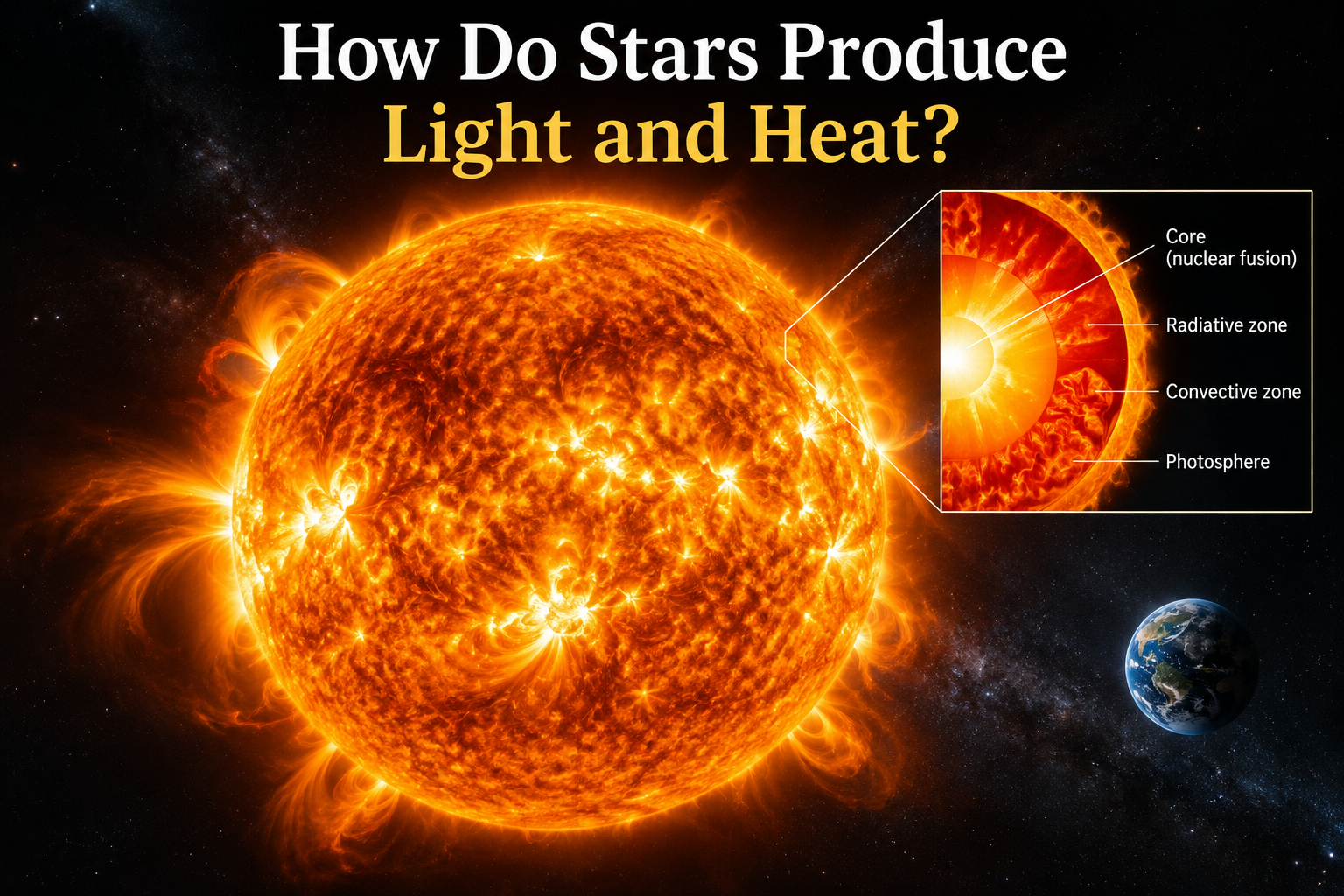
Stars produce light and heat mainly through a process called nuclear fusion. Deep inside a star, extremely high temperatures and enormous pressure cause hydrogen atoms to combine and form helium. During this process, a small amount of matter is converted into energy. That energy slowly travels from the center of the star toward its surface, where it is released into space as light and heat.
Understanding how stars produce light and heat helps us understand the Sun, the life cycle of stars, and even how many elements in the universe were created.
Stars Are Huge Balls of Hot Gas
A star is mainly made of gases, especially hydrogen and helium. However, the conditions inside a star are so hot that the gases exist in a special state called plasma.
Plasma forms when temperatures become high enough to separate electrons from atoms. Because stars contain incredibly hot plasma, their material behaves differently from ordinary gases found on Earth.
The Sun is the closest star to Earth. Its surface temperature is about 5,500 degrees Celsius, while the temperature at its center reaches around 15 million degrees Celsius.
Other stars can have different temperatures. Some are cooler than the Sun, while others are much hotter.
The tremendous temperature inside a star is essential because nuclear fusion cannot easily happen under ordinary conditions.
Nuclear Fusion Is the Main Source of Stellar Energy
The main answer to the question of how stars produce light and heat is nuclear fusion.
Nuclear fusion happens when the nuclei of small atoms join together to create a larger nucleus.
In most stars, including our Sun, hydrogen is the main fuel.
Inside the core of the Sun, hydrogen nuclei are moving at extremely high speeds because of the enormous temperature. The gravitational force of the Sun also creates intense pressure in the core.
Under these conditions, hydrogen nuclei can collide with enough energy to overcome the electrical forces that normally keep them apart.
Eventually, several hydrogen nuclei combine through a series of reactions and form helium.
During this transformation, a tiny amount of mass disappears. It is not simply lost. Instead, the mass is converted into energy.
This relationship between mass and energy is described by Albert Einstein’s famous equation:
E = mc²
In this equation, E represents energy, m represents mass, and c represents the speed of light.
Because the speed of light is extremely large, even a very small amount of mass can produce an enormous amount of energy.
This is why stars can shine continuously for billions of years.
What Happens Inside the Core of a Star?
The core is the central region of a star, and it is where most of the star’s energy is produced.
Gravity pulls all the material in a star inward toward the center. This creates enormous pressure.
At the same time, nuclear fusion produces energy that pushes outward.
A stable star exists because these forces remain balanced.
Gravity tries to compress the star, while the energy produced by nuclear fusion creates pressure that pushes material outward.
This balance is called hydrostatic equilibrium.
Without this balance, a star would either collapse inward or expand dramatically.
As long as enough hydrogen is available for fusion, a star can remain relatively stable for a very long time.
The Sun has been producing energy for about 4.6 billion years and still has a large amount of hydrogen remaining in its core.
How Does Energy Travel Through a Star?
Energy created in the center of a star does not immediately escape into space.
It must first travel through different layers of the star.
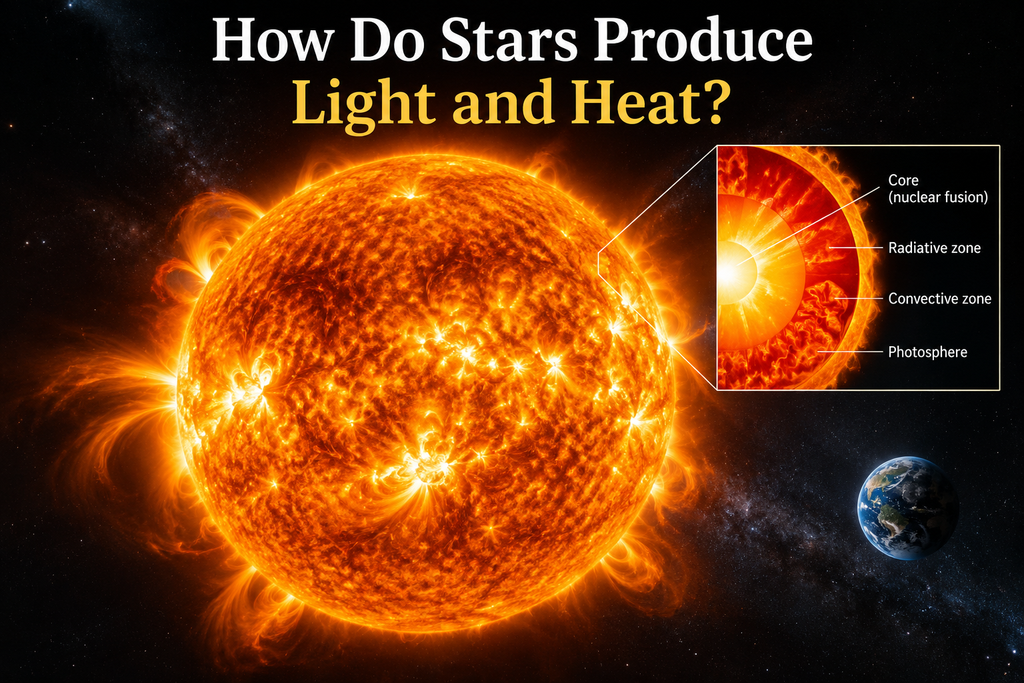
In the Sun, the first major region outside the core is known as the radiative zone.
In this area, energy mainly moves through radiation. Light particles called photons carry energy outward.
However, this journey can be extremely slow.
Photons are constantly absorbed and released by particles inside the Sun. Instead of traveling in a straight line from the core to the surface, they move through countless interactions.
Scientists estimate that energy produced in the core may take thousands or even hundreds of thousands of years to reach the outer parts of the Sun.
After traveling through the radiative zone, the energy reaches another region called the convection zone.
The Role of Convection
In the convection zone, energy is transported by the movement of hot material.
Hot plasma rises toward the surface because it is less dense.
As the plasma moves upward, it releases some of its energy and becomes cooler.
The cooler material then sinks back downward, where it is heated again.
This continuous movement creates convection currents.
A simple example of convection can be seen when water is heated in a pot. Warm water rises, while cooler water moves downward.
The same basic idea happens inside the outer layers of the Sun, although the temperatures and pressures are far more extreme.
Eventually, the energy reaches the visible surface of the Sun.
How Does a Star Produce Light?
Once energy reaches the surface of a star, much of it escapes into space as electromagnetic radiation.
Visible light is one form of electromagnetic radiation.
Stars also release other forms of radiation, including infrared radiation, ultraviolet radiation, radio waves, and X rays.
The type and amount of radiation depend partly on the temperature of the star.
Hotter stars often appear blue or white because they release more energy at shorter wavelengths.
Cooler stars may appear orange or red because more of their visible energy is released at longer wavelengths.
The Sun appears mostly yellowish white to human eyes, although sunlight actually contains many different colors.
When sunlight passes through a prism, it separates into a rainbow of colors.
This shows that the light from our Sun contains a wide range of wavelengths.
How Do Stars Produce Heat?
The heat that we experience from the Sun also comes from the energy generated by nuclear fusion.
When electromagnetic radiation from the Sun reaches Earth, it transfers energy to the atmosphere, land, oceans, buildings, plants, and living organisms.
Much of the warmth we feel from sunlight comes from visible and infrared radiation.
Infrared radiation is especially associated with heat.
The Sun does not warm Earth by sending hot air through space. Space contains very little matter, so heat cannot travel in the same way that it moves through air.
Instead, solar energy travels through space as electromagnetic radiation.
When that radiation reaches Earth’s surface, it is absorbed and converted into thermal energy.
This process helps keep our planet warm enough for life.
Why Does Nuclear Fusion Need Such High Temperatures?
Atomic nuclei contain positively charged particles called protons.
Positive charges naturally repel other positive charges.
This means hydrogen nuclei normally push away from one another.
To create nuclear fusion, hydrogen nuclei must come extremely close together.
At very high temperatures, particles move faster and collide more strongly.
The enormous pressure created by gravity also forces particles closer together.
When the conditions become extreme enough, nuclear forces can overcome the electrical repulsion, allowing fusion to occur.
This is one reason stars need to contain enormous amounts of matter.
Their gravity creates the pressure required for fusion.
Why Do Stars Shine for So Long?
At first, it may seem surprising that stars can continue shining for billions of years.
The reason is that nuclear fusion is incredibly efficient compared with ordinary chemical reactions.
Burning wood, coal, or gasoline releases energy through chemical reactions involving electrons.
Nuclear fusion changes atomic nuclei themselves and releases far more energy.
A star like the Sun contains an enormous supply of hydrogen.
Every second, the Sun converts hundreds of millions of tons of hydrogen into helium.
Although that sounds like a huge amount, the Sun is so massive that it can continue this process for billions of years.
The Sun is currently in a stable stage of its life known as the main sequence.
During this stage, hydrogen fusion in its core provides most of its energy.
Do All Stars Produce Energy in the Same Way?
Most stars spend the majority of their lives producing energy by converting hydrogen into helium.
However, stars can change as they age.
When a star begins running out of hydrogen in its core, its internal structure changes.
A star like the Sun eventually expands into a red giant.
During later stages, helium can begin fusing into heavier elements such as carbon and oxygen.
More massive stars can reach even higher temperatures and fuse heavier elements.
They may produce elements such as neon, magnesium, silicon, and eventually iron.
Fusion involving iron does not provide the same useful energy for supporting the star.
When a very massive star develops a large iron core, it can become unstable and collapse.
This collapse may produce a powerful explosion called a supernova.
Stars Help Create the Elements Around Us
Nuclear fusion inside stars does more than produce light and heat.
It also helps create many of the chemical elements found throughout the universe.
The early universe mainly contained hydrogen, helium, and small amounts of other light elements.
Inside stars, fusion gradually created heavier elements.
Massive stars and stellar explosions created and distributed many additional elements into space.
Over time, this material became part of new stars, planets, and other objects.
Many of the atoms found in Earth and the human body were formed through processes connected with earlier generations of stars.
Carbon, oxygen, calcium, and iron are all examples of elements whose cosmic history is closely connected to stars.
In this sense, stars are not only sources of light. They are also important factories for many of the materials found in the universe.
Why Are Some Stars Brighter Than Others?
When looking at the night sky, some stars appear brighter than others.
Several factors affect how bright a star looks.
One factor is distance.
A nearby star may appear brighter than a much more powerful star located far away.
Another factor is the actual amount of energy the star produces.
Large, hot stars can release enormous amounts of energy.
Smaller or cooler stars usually produce less visible light.
Astronomers distinguish between apparent brightness and luminosity.
Apparent brightness describes how bright a star looks from Earth.
Luminosity describes the total amount of energy a star produces.
This distinction helps astronomers compare stars more accurately.
Why Do Stars Have Different Colors?
A star’s color gives scientists important information about its temperature.
Cooler stars usually appear red or orange.
Stars with moderate surface temperatures may appear yellow or white.
Very hot stars often appear blue or blue white.
This may seem unusual because we often associate red with heat in everyday life. However, in astronomy, blue stars usually have much higher surface temperatures than red stars.
By studying the light from stars, astronomers can learn about their temperatures, chemical composition, motion, and many other properties.
A tool called a spectroscope separates starlight into different wavelengths.
The resulting spectrum can reveal specific elements in the star’s atmosphere.
What Keeps a Star From Exploding or Collapsing?
A normal star remains stable because inward and outward forces are balanced.
Gravity pulls the star inward.
The hot gas and radiation produced by fusion create pressure that pushes outward.
As long as nuclear fusion continues at a suitable rate, the star can maintain this balance.
If the core becomes slightly hotter, fusion may increase, creating more outward pressure.
The star can then expand slightly, which lowers the temperature.
If the core cools too much, gravity can compress it, raising the temperature again.
This natural regulation helps stars remain stable for millions or billions of years.
Eventually, however, the available fuel changes, and the star enters another stage of its life cycle.
Why Is the Sun’s Energy Important for Earth?
The Sun’s light and heat are essential for life on Earth.
Sunlight provides energy for photosynthesis, the process plants use to create food.
Plants form the foundation of many food chains.
Solar energy also affects Earth’s climate, weather, oceans, and water cycle.
Sunlight heats Earth’s surface unevenly, helping create winds and atmospheric circulation.
The Sun also powers evaporation, which contributes to cloud formation and rainfall.
Without the Sun’s steady supply of energy, Earth would become extremely cold and most forms of life would not survive.
Final Thoughts
So, how do stars produce light and heat? The answer begins deep inside their cores.
Gravity creates enormous pressure and temperature, allowing hydrogen nuclei to combine through nuclear fusion. During this process, some mass is converted into a huge amount of energy.
That energy slowly moves through the star before reaching the surface and escaping into space as light, heat, and other forms of electromagnetic radiation.
The same process that makes stars shine also helps create many of the elements found throughout the universe.
Every point of light we see in the night sky is a reminder of powerful physical processes happening across enormous distances.
Stars may appear peaceful from Earth, but inside them, matter is constantly being transformed under extraordinary conditions. Their nuclear reactions can continue for billions of years, lighting galaxies, warming planets, and shaping the chemical history of the universe.
By learning how stars produce light and heat, we gain a clearer understanding of the Sun, the universe, and the natural processes that make life on Earth possible.