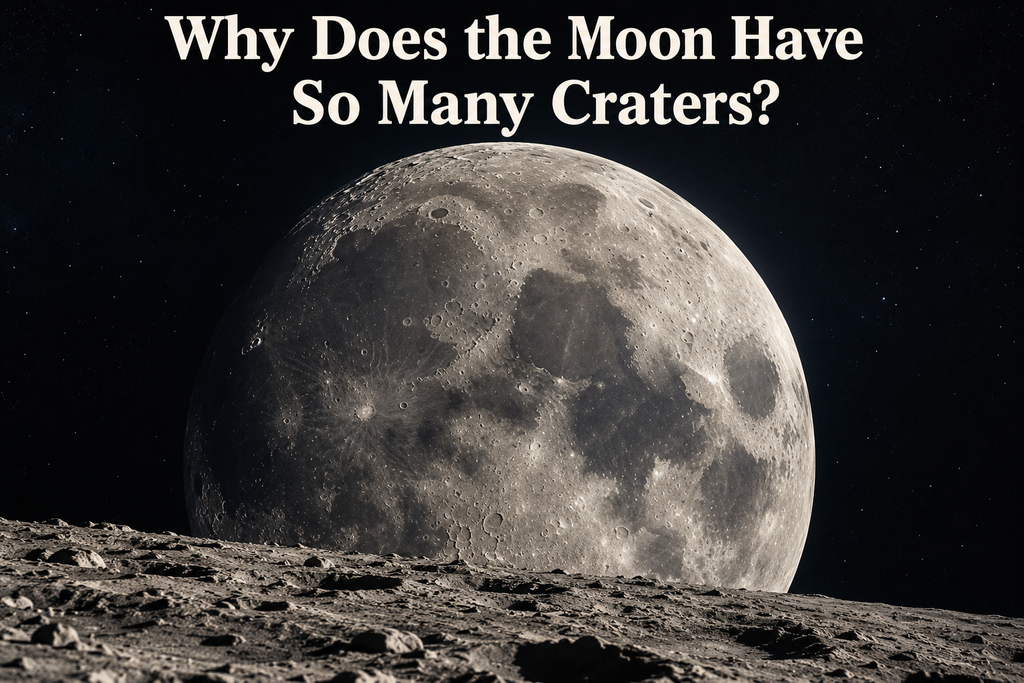
When we look at the Moon on a clear night, its surface does not appear smooth. Even without a telescope, we can notice light and dark areas across it. With a telescope or a detailed photograph, something becomes even more obvious. The Moon is covered with thousands of craters of different sizes. Some are small and difficult to notice, while others are enormous and stretch for hundreds of kilometers.
This naturally raises an interesting question. Why does the Moon have so many craters while Earth does not look nearly as damaged?
The simple answer is that the Moon has been hit by countless rocks from space over billions of years, and most of the marks left by those impacts have remained almost unchanged. Unlike Earth, the Moon has very little weather, no flowing rivers, no oceans, and almost no geological activity that could erase those ancient scars.
Understanding why the Moon has so many craters gives us a fascinating look into the history of the solar system.
Moon Craters Were Created by Impacts
Most craters on the Moon were formed when asteroids, meteoroids, and other rocky objects crashed into the lunar surface.
The solar system contains much more than planets and moons. There are also millions of smaller objects moving through space. Some of them are tiny pieces of rock, while others are large asteroids.
When one of these objects travels toward the Moon, there is almost nothing to slow it down. The Moon has an extremely thin atmosphere, which means space rocks can strike the surface at very high speeds.
When a fast moving object hits the Moon, the impact releases a huge amount of energy. The force blasts material away from the impact point and creates a circular depression in the ground.
That depression is what we call an impact crater.
Some impacts are relatively small, while others are powerful enough to produce enormous basins.
Why the Moon Has More Visible Craters Than Earth
Earth has also been hit by many objects from space throughout its history. However, most ancient impact craters on Earth are difficult to see today.
The main reason is that Earth is constantly changing.
Rain wears down rocks. Rivers carry soil and sediment. Wind slowly reshapes landscapes. Oceans cover large parts of the planet. Plants grow over damaged areas. Glaciers move across the land. Volcanoes create new surfaces, and movements inside Earth slowly reshape the crust.
All of these natural processes can hide or destroy old impact craters.
The Moon is very different.
Its surface changes extremely slowly. There is no normal rainfall, no rivers, no oceans, and almost no wind. Once a crater forms, it can remain visible for millions or even billions of years.
This is one of the main reasons the Moon appears to have so many craters.
The Moon Has Almost No Atmosphere
Earth’s atmosphere gives our planet important protection from many smaller objects coming from space.
When a meteoroid enters Earth’s atmosphere, friction and pressure heat the object. Many small meteoroids burn up before reaching the surface.
We often see these burning objects as meteors or shooting stars.
The Moon does not have a thick atmosphere like Earth. Its atmosphere is extremely thin and provides almost no protection.
Because of this, even relatively small space rocks can reach the lunar surface without being destroyed.
Every successful impact has the potential to produce another crater.
Over billions of years, this has helped create the heavily cratered landscape we see today.
The Moon’s Surface Is Very Old
Another important reason the Moon has so many craters is the age of its surface.
Many parts of the lunar surface are extremely ancient.
Scientists estimate that the Moon formed around 4.5 billion years ago. During the early history of the solar system, collisions between objects were much more common than they are today.
The young Moon was repeatedly struck by large and small objects.
These impacts created countless craters.
Because the Moon has very little geological activity compared with Earth, many of those ancient craters still exist.
In a way, the Moon acts like a record of the early solar system.
By studying its craters, scientists can learn about events that happened billions of years ago.
The Early Solar System Was a Violent Place
Today, the solar system may seem calm, but its early history was far more chaotic.
After the Sun and planets began forming, huge amounts of leftover rock and dust remained in space.
These objects traveled in different orbits and frequently collided with planets and moons.
The Moon experienced an especially intense period of impacts during its early history.
Scientists believe that large numbers of asteroids and other objects struck the Moon during the first several hundred million years after its formation.
Some scientists use the term Late Heavy Bombardment to describe a period when large impacts may have been especially common.
Many of the Moon’s largest craters and impact basins probably formed during these ancient collisions.
Why Most Moon Craters Are Round
An interesting feature of lunar craters is that most of them are nearly circular.
You might expect a rock striking the Moon at an angle to create a long or oval hole. However, most impacts release so much energy that the explosion of material spreads outward in almost every direction.
The extreme speed of the impact is more important than the shape of the incoming object.
When an asteroid strikes the Moon at several kilometers per second, the energy can behave somewhat like an explosion.
This produces the familiar circular shape of most lunar craters.
Only extremely shallow impacts may create noticeably stretched or unusual crater shapes.
Large Moon Craters Can Have Mountains in the Center
Some of the largest lunar craters contain central peaks or mountain like structures.
These features form because of the enormous forces involved in a large impact.
When a massive object hits the surface, the ground is deeply compressed. Soon afterward, some of the material beneath the impact area can rebound upward.
This movement may create a peak near the center of the crater.
It may seem surprising that a collision can create a mountain, but large impacts involve tremendous energy and complex movement of rock.
Scientists study these central peaks because they can expose material that originally existed deeper beneath the Moon’s surface.
What Is Ejecta Around a Crater?
When an object crashes into the Moon, material from the surface is thrown outward.
This material is known as ejecta.
Ejecta can include dust, broken rocks, and larger pieces of lunar material.
Around some craters, bright lines can be seen stretching far across the Moon’s surface. These lines are called rays.
Crater rays form when material from an impact is thrown over long distances.
One famous example is Tycho crater, which has bright rays that extend across a large part of the Moon.
These rays make some relatively young craters especially easy to recognize.
Why Some Moon Craters Look Newer Than Others
Not all craters on the Moon are the same age.
Some are extremely ancient, while others formed much more recently.
Scientists can often estimate the relative age of different parts of the Moon by counting craters.
An area with many overlapping craters is generally older because it has been exposed to impacts for a longer time.
A smoother area with fewer craters is usually younger.
This method is called crater counting.
Scientists use it not only on the Moon but also on Mars, Mercury, and other rocky worlds.
What Are the Dark Areas on the Moon?
The dark regions visible from Earth are called lunar maria.
The word maria comes from a Latin word meaning seas.
Early astronomers once thought these dark regions might contain water, but we now know they are broad plains formed mostly by ancient volcanic activity.
Long ago, some large impacts created enormous basins in the Moon’s crust.
Later, molten rock from inside the Moon rose through cracks and filled parts of these basins.
When the lava cooled, it formed dark volcanic plains.
Because these surfaces are younger than the surrounding highlands, they generally contain fewer craters.
That difference helps scientists understand the sequence of events in lunar history.
Why Lunar Highlands Have More Craters
The brighter areas of the Moon are known as the lunar highlands.
These regions are generally older than the dark maria.
Because they have existed for a longer time, they have been exposed to more impacts.
As a result, the highlands are heavily covered with craters.
In some locations, craters overlap so much that younger impacts have partly destroyed older ones.
This creates the rough and heavily damaged appearance seen in many photographs of the Moon.
Can New Craters Still Form on the Moon?
Yes, new craters can still form today.
Objects continue to travel through the solar system, and some eventually strike the Moon.
Most of these modern impacts involve relatively small objects.
Spacecraft and telescopes have occasionally observed bright flashes on the Moon caused by impacts.
Scientists can also compare high resolution lunar images taken at different times to search for newly formed craters.
This shows that crater formation is not just something that happened billions of years ago.
The process continues today, although major impacts are much less common.
Why Craters Do Not Disappear Quickly
On Earth, an exposed crater may slowly disappear because of erosion.
The Moon has almost no traditional weather.
There is no rain falling on crater walls. There are no rivers cutting through the ground. There are no forests covering the surface.
However, the Moon does experience extremely slow surface changes.
Tiny particles from space constantly strike the lunar soil. Over very long periods, these small impacts can gradually soften sharp surface features.
Larger impacts can also destroy or partly cover older craters.
Even so, these processes are much slower than the erosion seen on Earth.
That is why ancient lunar craters can remain recognizable for an enormous amount of time.
Moon Craters Help Scientists Study the Solar System
Lunar craters are more than just interesting surface features. They are important scientific records.
Each crater provides evidence of an impact event.
By studying the number, size, shape, and location of craters, scientists can learn about the history of objects moving through the inner solar system.
The Moon is especially useful because its surface has preserved ancient evidence that Earth has mostly lost.
Earth’s active geology constantly recycles its surface.
The Moon does not recycle its crust in the same way.
For this reason, studying lunar craters can help scientists understand what Earth and the rest of the solar system may have experienced billions of years ago.
Some Craters Are Enormous
Many people imagine lunar craters as small holes, but some impact structures are incredibly large.
The South Pole Aitken Basin is one of the largest known impact basins in the solar system.
It stretches for thousands of kilometers across the far side of the Moon.
An impact powerful enough to create such a basin would have involved an enormous amount of energy.
Large impact basins are especially useful to scientists because they can expose material from deeper layers of the Moon.
Studying these areas may provide clues about how the Moon formed and how its interior developed.
Why the Far Side of the Moon Also Has Many Craters
The far side of the Moon is the side that normally faces away from Earth.
It was not photographed in detail until spacecraft reached the Moon during the twentieth century.
When scientists finally saw it, they discovered that the far side was also heavily cratered.
In fact, much of the far side contains older, rougher terrain with fewer large dark maria than the side visible from Earth.
The large number of craters shows that impacts have affected the entire Moon throughout its history.
Craters Are Natural History Books
One of the most interesting ways to think about lunar craters is to imagine them as pages in a very old history book.
Each crater represents an event.
Some record small impacts. Others reveal enormous collisions that changed large sections of the lunar surface.
When one crater overlaps another, scientists can determine which one formed later.
When lava covers part of a crater, researchers know that volcanic activity happened after the impact.
By carefully studying these relationships, scientists can reconstruct parts of the Moon’s geological history.
What the Moon Can Teach Us About Earth
The Moon and Earth formed during roughly the same period of solar system history.
Both worlds were struck by asteroids and other objects.
However, Earth has hidden much of that evidence through erosion, plate tectonics, and other geological processes.
The Moon preserved far more of its ancient surface.
This means lunar craters can give scientists valuable clues about the environment around Earth billions of years ago.
Studying the Moon may even help researchers better understand how frequently large objects struck the early Earth.
Conclusion
So, why does the Moon have so many craters?
The main reason is that the Moon has been struck by asteroids, meteoroids, and other space rocks for billions of years. Because it has almost no atmosphere, many of these objects can reach the surface without burning up.
The Moon also lacks the strong erosion and geological recycling that constantly reshape Earth. There is no rain, no flowing water, no ocean waves, and very little activity capable of erasing ancient impact marks.
As a result, craters can remain visible for billions of years.
These craters make the Moon look rough and damaged, but they also make it scientifically valuable. They preserve a record of the early solar system that has largely disappeared from Earth.
The next time you look at the Moon, those countless craters can be seen as more than just holes in the surface. They are ancient records of collisions, geological changes, and events that have shaped our cosmic neighborhood for billions of years.