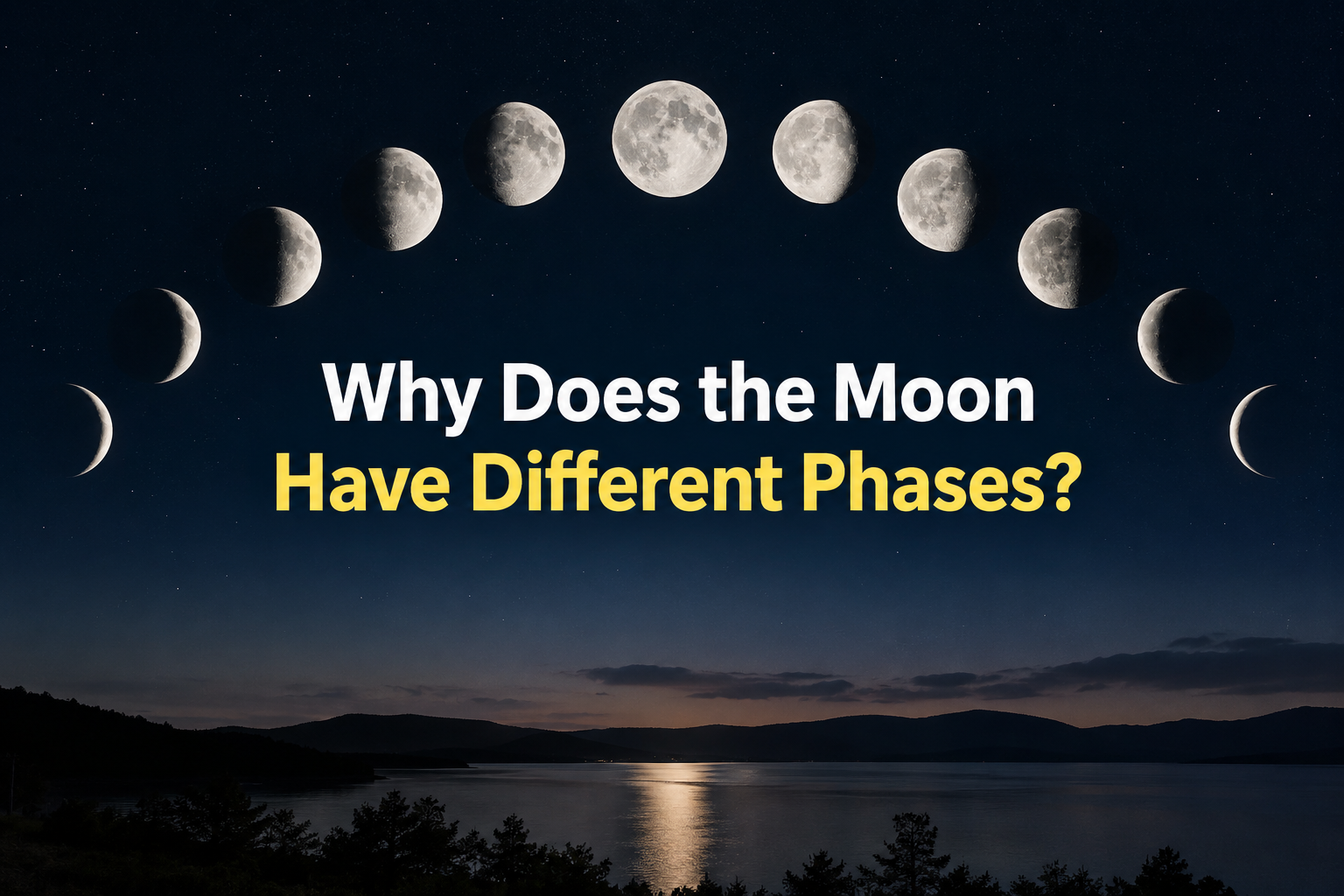
The Moon is one of the most familiar objects in the night sky, yet its appearance seems to change almost every night. Sometimes it looks like a thin curved line. On other nights, half of the Moon is visible. At certain times, it becomes a bright full circle. These changing shapes are called the phases of the Moon.
The Moon does not actually change its shape. It is always a nearly spherical object moving around Earth. The different phases happen because of the changing positions of the Moon, Earth, and Sun. As the Moon travels around our planet, we see different portions of its sunlit side.
Understanding why the Moon has different phases becomes much easier once we understand how sunlight reaches the Moon and how the Moon moves around Earth.
What Are the Phases of the Moon?
The phases of the Moon are the different shapes of the illuminated part of the Moon that we can see from Earth.
The Moon does not produce its own visible light. The bright surface we see at night is sunlight reflected from the Moon. At any moment, the Sun lights approximately half of the Moon, just as it lights one side of Earth.
However, we do not always see the entire illuminated half.
As the Moon moves through its orbit around Earth, the angle between the Sun, Earth, and Moon changes. This causes us to see different amounts of the bright side.
This simple relationship between light and movement creates the lunar phases.
Why Does the Moon Have Different Phases?
The Moon has different phases because it orbits Earth while the Sun continuously lights one half of its surface.
From Earth, our view of the illuminated half changes as the Moon moves around us.
Imagine holding a ball in a room while a lamp shines on it. No matter where you move the ball, the lamp always lights one side. However, someone watching the ball from another position may see different amounts of the illuminated surface.
The same principle applies to the Moon.
The Sun acts like the lamp, the Moon is like the ball, and Earth is where we observe it from.
During some parts of the Moon’s orbit, most of the illuminated side faces Earth. During other parts, only a small portion faces us. Sometimes the illuminated side is mostly facing away from Earth.
These changing viewing angles produce the familiar Moon phases.
The Moon’s Orbit Around Earth
The Moon travels around Earth in an orbit that takes about one month to complete.
A complete cycle of Moon phases takes approximately 29.5 days. This period is called the synodic month.
During this cycle, the Moon moves through several recognizable phases.
The main phases are the new moon, first quarter, full moon, and third quarter. Between these major stages are crescent and gibbous phases.
Although we often describe eight main phases, the Moon actually changes appearance gradually every day.
New Moon
The lunar cycle begins with the new moon.
During this phase, the Moon is positioned roughly between Earth and the Sun.
The side of the Moon that is illuminated by sunlight mostly faces away from Earth. The side facing Earth receives very little direct sunlight.
As a result, the Moon becomes difficult or impossible to see in the night sky.
The Moon is still present, but its bright side is facing mostly toward the Sun rather than toward us.
This phase marks the beginning of a new lunar cycle.
Waxing Crescent Moon
After the new moon, the Moon continues moving around Earth.
A small portion of the sunlit side gradually becomes visible.
This produces the waxing crescent phase.
The word waxing means that the visible illuminated portion is increasing.
Each evening, the bright crescent becomes slightly larger.
During this period, the Moon may appear as a thin curved shape shortly after sunset.
The waxing crescent continues until approximately half of the visible Moon becomes illuminated.
First Quarter Moon
About one week after the new moon, the Moon reaches the first quarter phase.
At this stage, approximately half of the Moon’s visible surface appears illuminated.
The name first quarter does not mean that one quarter of the Moon is visible. It refers to the Moon being about one quarter of the way through its orbit around Earth.
From our viewpoint, one half appears bright while the other half appears dark.
The first quarter Moon is an excellent example of how viewing angle creates the phases.
Waxing Gibbous Moon
After the first quarter, more than half of the Moon’s visible surface becomes illuminated.
This stage is called the waxing gibbous phase.
Gibbous means that more than half of the visible surface is bright but the Moon is not yet completely full.
During several nights, the bright area continues increasing.
Eventually, almost the entire visible surface becomes illuminated.
This leads to one of the most noticeable phases of the lunar cycle.
Full Moon
A full moon occurs when Earth is positioned roughly between the Sun and the Moon.
At this time, the side of the Moon facing Earth is almost completely illuminated by sunlight.
This makes the Moon appear as a bright circular disk.
The full moon usually rises around sunset and remains visible for much of the night.
Because so much of its surface is illuminated from our viewpoint, it appears much brighter than during crescent or quarter phases.
However, a full moon does not normally cause a lunar eclipse.
The Moon’s orbit is slightly tilted compared with Earth’s orbit around the Sun, so the Moon usually passes above or below Earth’s shadow.
Waning Gibbous Moon
After the full moon, the illuminated portion begins to decrease.
This period is called the waning gibbous phase.
The word waning means that the visible bright portion is becoming smaller.
During this stage, more than half of the Moon is still illuminated, but the bright area decreases night by night.
The Moon also tends to rise later in the evening as it continues moving through its orbit.
Eventually, the Moon reaches another important stage.
Third Quarter Moon
The third quarter Moon appears when approximately half of the visible lunar surface is illuminated again.
This phase is sometimes called the last quarter.
The Moon has now completed about three quarters of its journey through the lunar cycle.
Although it may look similar to the first quarter Moon, the illuminated side appears on the opposite portion of the lunar disk.
The third quarter Moon is commonly visible during the late night and morning hours.
After this stage, the illuminated area continues shrinking.
Waning Crescent Moon
The final major stage before the next new moon is the waning crescent.
Only a thin portion of the illuminated side remains visible from Earth.
Each day, the crescent becomes smaller.
The Moon can often be seen in the early morning sky before sunrise.
Eventually, the bright portion becomes so small that it disappears from view.
The Moon then returns to the new moon phase, and the entire cycle begins again.
Why Does the Moon Change Shape Every Night?
The Moon seems to change shape because our viewing angle changes.
The Moon itself does not physically grow, shrink, or change form.
Sunlight always illuminates approximately half of it.
What changes is the amount of that illuminated half that is visible from Earth.
Because the Moon moves continuously through its orbit, the angle changes a little every day.
This is why the Moon’s appearance changes gradually instead of suddenly moving from one phase to another.
The phases are part of one continuous cycle.
Does Earth’s Shadow Cause Moon Phases?
A common misunderstanding is that Earth’s shadow causes the phases of the Moon.
This is not correct.
Earth’s shadow only plays a major role during a lunar eclipse.
Normal Moon phases are caused by the position of the Moon relative to Earth and the Sun.
During a crescent Moon, for example, the dark portion is not being covered by Earth’s shadow. That part of the Moon simply is not receiving sunlight in a way that is visible from our position.
This difference is important for understanding basic astronomy.
Why Do Moon Phases Repeat?
Moon phases repeat because the Moon follows a regular orbit around Earth.
After approximately 29.5 days, the Moon returns to nearly the same position relative to Earth and the Sun.
The same lighting conditions occur again.
Because this cycle is predictable, people have observed lunar phases for thousands of years.
Many traditional calendars were based partly or entirely on the Moon’s changing appearance.
Even today, lunar calendars are used in many cultures and religious traditions.
Why Does the Moon Sometimes Appear During the Day?
Many people associate the Moon only with nighttime, but it can often be seen during daylight.
The Moon is visible whenever it is above the horizon and bright enough to be noticed against the sky.
Depending on its phase and position in orbit, it may rise during the day, evening, night, or early morning.
For example, a first quarter Moon is often visible in the afternoon and evening.
A third quarter Moon may appear in the morning.
The Moon does not disappear during the day. Its visibility simply depends on its location in the sky and the brightness of sunlight.
Why Does the Moon Look Different From Different Places?
People in different parts of Earth generally see the same lunar phase on the same day.
However, the Moon may appear tilted or rotated depending on the observer’s location.
Someone in the Northern Hemisphere may see the illuminated portion arranged differently from someone in the Southern Hemisphere.
This happens because people are viewing the Moon from different orientations on Earth’s curved surface.
The lunar phase itself remains the same.
How Sunlight Creates the Phases
Sunlight is the key reason Moon phases are visible.
The Sun is extremely bright and continuously illuminates one side of the Moon.
Since the Moon is spherical, there is always a boundary between its illuminated side and its dark side.
Astronomers call this boundary the terminator.
The terminator can often be seen clearly through binoculars or a small telescope.
Near this boundary, sunlight strikes the lunar surface at a low angle, creating long shadows from mountains and craters.
This makes the area especially interesting for observing lunar features.
How Long Does Each Moon Phase Last?
The entire lunar phase cycle lasts about 29.5 days.
The commonly named phases do not each occupy only one night. Instead, the Moon gradually moves from one stage to another.
For example, the Moon may look nearly full for more than one night, but astronomically there is a specific moment when it reaches its fullest illumination.
The same is true for the new moon and quarter phases.
Because the Moon moves continuously, its illuminated appearance changes slightly from one day to the next.
Why Are Moon Phases Important?
Moon phases have been important throughout human history.
Before modern clocks and calendars, people used the Moon to track time.
Farmers observed lunar cycles while planning seasonal activities. Travelers and sailors used the night sky for navigation. Religious and cultural events were often connected with particular Moon phases.
The Moon also affects ocean tides through its gravitational pull.
The strongest tidal ranges usually occur around the new moon and full moon, when the gravitational effects of the Sun and Moon combine more strongly.
Although tides and Moon phases are different phenomena, they are both related to the positions of Earth, the Moon, and the Sun.
Observing the Moon Yourself
One of the best ways to understand why the Moon has different phases is simply to observe it regularly.
Try looking at the Moon every evening or morning for several weeks.
Notice how its shape changes.
Also notice where it appears in the sky and what time it rises or sets.
You may see a thin crescent become wider over several nights. Later, the Moon may become half illuminated, then nearly full, and finally a bright full circle.
After that, the illuminated area will gradually shrink again.
By following the Moon for an entire month, the lunar cycle becomes much easier to understand.
Final Thoughts
So, why does the Moon have different phases? The answer comes from the movement of the Moon around Earth and the sunlight that illuminates its surface.
The Sun always lights approximately half of the Moon. As the Moon travels through its orbit, we see different portions of that illuminated half. These changing viewing angles create the new moon, crescent moon, quarter moon, gibbous moon, and full moon phases.
Earth’s shadow does not normally create these phases. Instead, the phases are a natural result of the changing positions of the Sun, Earth, and Moon.
The lunar cycle is simple once we understand the relationship between light and motion. Yet it creates one of the most beautiful and familiar patterns in the night sky. By watching the Moon over several weeks, anyone can observe this regular cycle and see astronomy taking place directly above us.