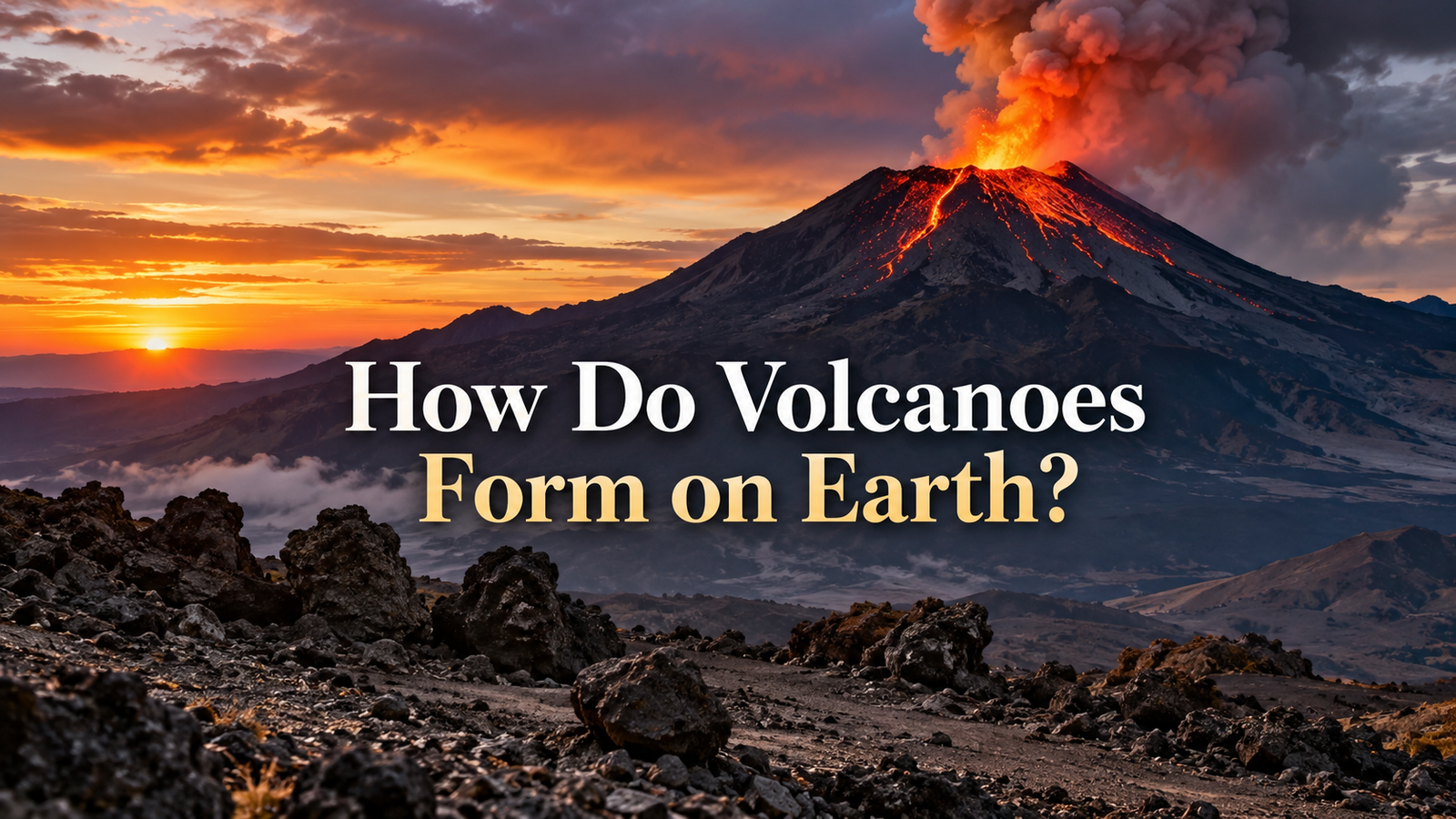
Volcanoes are among the most powerful and fascinating natural features on our planet. They can create mountains, form new islands, reshape landscapes, and release enormous amounts of heat from deep inside Earth. For centuries, people have watched volcanic eruptions with a mixture of fear and curiosity. Today, scientists understand much more about how volcanoes form on Earth, why they erupt, and where they are most likely to appear.
The formation of volcanoes is closely connected to the structure of Earth, the movement of tectonic plates, and the presence of hot molten rock beneath the surface. Although volcanoes may seem like isolated mountains, they are actually part of a much larger geological system that has been shaping Earth for millions of years.
Understanding how volcanoes form helps us learn more about the changing nature of our planet and the forces working beneath its surface.
What Is a Volcano?
A volcano is an opening in Earth’s crust through which molten rock, gases, ash, and other materials can escape from below the surface.
The molten rock beneath Earth is called magma. When magma reaches the surface, it is called lava. Over time, repeated eruptions can cause layers of lava, ash, and rock to build up around the opening. These layers can eventually form a volcanic mountain.
Some volcanoes are tall and steep, while others are broad and gently sloping. Their shape depends largely on the type of magma they contain and the style of eruptions they produce.
Volcanoes can remain quiet for long periods and then suddenly become active. Some erupt frequently, while others may stay inactive for thousands of years.
The Structure of Earth
To understand how volcanoes form on Earth, it is useful to know a little about the internal structure of our planet.
Earth is made of several major layers. The outermost layer is called the crust. This is the solid surface where we live. Beneath the crust is the mantle, which is made mostly of hot rock. Deeper still is the outer core and inner core.
The mantle is not completely liquid, but some parts of it are hot enough to flow slowly over long periods of time.
Heat from deep inside Earth causes movement in the mantle. This movement plays an important role in shifting the large pieces of Earth’s crust known as tectonic plates.
What Are Tectonic Plates?
Earth’s crust is divided into large sections called tectonic plates.
These plates are constantly moving, although the movement is usually very slow. They may move only a few centimeters each year, but over millions of years this movement can greatly change the surface of Earth.
Tectonic plates can move toward each other, move away from each other, or slide past one another.
Many volcanoes form near the boundaries where these plates meet.
The movement of tectonic plates can create cracks, pressure, and pathways that allow magma to rise toward the surface.
How Magma Forms
Magma is one of the most important parts of volcanic formation.
Deep beneath Earth’s surface, temperatures are extremely high. Under certain conditions, solid rock can begin to melt.
Rock may melt because of increased temperature, reduced pressure, or changes in the amount of water present within the rock.
When rock melts, it forms magma.
Magma is usually less dense than the solid rock surrounding it. Because of this difference in density, magma tends to move upward through cracks and weak areas in Earth’s crust.
If enough magma collects beneath the surface, it may eventually create the conditions needed for a volcanic eruption.
How Volcanoes Form at Convergent Plate Boundaries
Many volcanoes form where two tectonic plates move toward each other. These locations are known as convergent plate boundaries.
In some cases, one plate is forced beneath another plate. This process is called subduction.
When an oceanic plate moves beneath another plate, it sinks deeper into Earth. As it descends, heat and pressure increase.
Water and other materials released from the sinking plate can help lower the melting point of nearby rock. This causes some of the rock in the mantle to melt and form magma.
The magma then rises toward the surface.
Over time, repeated movement of magma and volcanic eruptions can build large volcanic mountains.
Many famous volcanic regions have formed in this way.
The Pacific Ring of Fire
One of the best known volcanic regions on Earth is the Pacific Ring of Fire.
This area surrounds much of the Pacific Ocean and contains a very large number of the world’s active volcanoes.
The Ring of Fire exists because many tectonic plates meet around the edges of the Pacific Ocean. In several places, one plate is being pushed beneath another.
This creates ideal conditions for magma formation and volcanic activity.
Countries such as Japan, Indonesia, the Philippines, Chile, and parts of the United States have many volcanoes because they are located near active plate boundaries.
The Ring of Fire is also known for frequent earthquakes because earthquakes and volcanoes are often connected to tectonic plate movement.
How Volcanoes Form at Divergent Plate Boundaries
Volcanoes can also form where tectonic plates move away from each other.
These areas are called divergent plate boundaries.
When plates separate, pressure on the rock below them decreases. This reduced pressure can allow parts of the mantle to melt and form magma.
The magma rises through the space created between the moving plates.
As it reaches the surface and cools, it forms new rock.
Much of this activity takes place deep beneath the oceans along long underwater mountain ranges known as mid ocean ridges.
These underwater volcanic systems are responsible for creating large amounts of new oceanic crust.
In some places, volcanic activity along divergent boundaries can rise above sea level and form islands.
How Volcanic Islands Form
Some islands are created almost entirely by volcanic activity.
When underwater volcanoes erupt repeatedly, lava builds up on the ocean floor.
Over many thousands or millions of years, layers of cooled lava can grow higher and higher.
Eventually, the volcanic mountain may rise above the surface of the ocean and become an island.
Some island chains have formed through this process.
Volcanic islands provide clear evidence that Earth’s surface is constantly being created and reshaped by geological forces.
What Are Hotspot Volcanoes?
Not all volcanoes form at the edges of tectonic plates.
Some form above areas known as hotspots.
A hotspot is a region where unusually hot material rises from deep within the mantle.
This hot material can partially melt rock and create magma.
The magma rises through the crust and may eventually form a volcano.
As a tectonic plate slowly moves over a hotspot, new volcanoes may form one after another.
This can create a chain of volcanic islands or mountains.
The Hawaiian Islands are a famous example of volcanoes formed by hotspot activity.
The hotspot remains in roughly the same location while the tectonic plate moves above it.
How Pressure Builds Inside a Volcano
Magma does not always rise smoothly to the surface.
It may collect in an underground area called a magma chamber.
A magma chamber is a region beneath a volcano where molten rock can gather.
Magma contains dissolved gases such as water vapor, carbon dioxide, and sulfur dioxide.
Deep underground, high pressure keeps many of these gases dissolved in the magma.
As magma rises toward the surface, pressure decreases.
The gases begin to expand and form bubbles.
If the pressure becomes strong enough, it can force magma upward through cracks and openings.
Eventually, the pressure may lead to an eruption.
What Happens During a Volcanic Eruption?
During a volcanic eruption, materials from beneath Earth’s surface are released.
These materials may include lava, volcanic ash, gases, rocks, and other fragments.
Some eruptions are relatively calm. Lava may flow slowly from the volcano and spread across the surrounding land.
Other eruptions can be highly explosive.
Explosive eruptions can send ash and rock high into the atmosphere.
The behavior of an eruption depends strongly on the type of magma inside the volcano.
Why Some Volcanoes Erupt Gently
Some magma is thin and flows easily.
This type of magma allows gases to escape more easily.
When gases can leave the magma without becoming trapped, pressure is less likely to build suddenly.
As a result, eruptions may produce steady lava flows instead of powerful explosions.
These types of eruptions often create broad volcanoes with gentle slopes.
Such volcanoes are known as shield volcanoes.
They can become extremely large because lava can travel long distances before cooling.
Why Some Volcanoes Explode
Other types of magma are thick and sticky.
Thick magma can trap gases inside it.
As gas pressure continues to increase, the volcano may become unstable.
Eventually, the pressure can be released in a violent explosion.
Explosive eruptions may produce clouds of ash, hot gases, and broken rock.
These eruptions can be dangerous because volcanic material can travel quickly and affect large areas.
Volcanoes with explosive eruptions often have steep sides.
The Main Types of Volcanoes
Scientists classify volcanoes into several major types.
Shield volcanoes are broad and have gentle slopes. They usually form from repeated flows of runny lava.
Stratovolcanoes, also called composite volcanoes, are tall and steep. They are built from alternating layers of lava and volcanic material.
Cinder cone volcanoes are usually smaller. They form when small pieces of volcanic rock fall around a volcanic opening and build up over time.
Each type of volcano develops in a slightly different way, but all are connected to the movement of magma from below Earth’s surface.
How Long Does It Take for a Volcano to Form?
Volcanoes usually do not form quickly.
Large volcanoes may take thousands or even millions of years to develop.
Each eruption can add another layer of lava or volcanic material.
Gradually, these layers build a larger structure.
Some volcanic mountains grow during long periods of repeated activity.
Others may stop growing if the supply of magma changes or if tectonic activity shifts.
This slow process shows how powerful geological changes can happen over very long periods of time.
Are All Volcanoes Active?
Volcanoes are often described as active, dormant, or extinct.
An active volcano is one that is erupting or has shown signs that it may erupt again.
A dormant volcano is not currently erupting but may become active in the future.
An extinct volcano is generally considered unlikely to erupt again because its magma supply has ended.
However, classifying volcanoes is not always simple.
Some volcanoes can remain quiet for extremely long periods before becoming active again.
For this reason, scientists carefully monitor volcanoes that may still have active magma systems beneath them.
How Scientists Study Volcanoes
Scientists who study volcanoes are known as volcanologists.
They use many different tools to understand what is happening below the surface.
They may measure small earthquakes around a volcano, study changes in the shape of the ground, and monitor gases escaping from volcanic vents.
They also use satellites to observe changes in volcanic areas.
A sudden increase in small earthquakes or changes in gas emissions may suggest that magma is moving underground.
These observations can sometimes help scientists identify signs of an approaching eruption.
Why Volcanoes Are Important to Earth
Volcanoes can be dangerous, but they are also an important part of Earth’s natural system.
Volcanic activity has helped shape much of the planet’s surface.
Lava creates new land when it cools and becomes solid rock.
Volcanic materials can also produce fertile soils over time.
Many farming regions around the world benefit from nutrients found in volcanic soils.
Volcanoes also help scientists understand what is happening deep inside Earth.
The materials brought to the surface during eruptions provide valuable information about the planet’s interior.
Can Volcanoes Create New Land?
Yes, volcanoes can create completely new land.
When lava reaches the surface, it eventually cools and becomes solid rock.
Repeated lava flows can expand coastlines, build mountains, and form islands.
Underwater eruptions can slowly build volcanic structures from the ocean floor.
If enough material accumulates, the volcano can eventually rise above sea level.
This process has created many islands throughout Earth’s history.
It is one of the clearest examples of how volcanic activity can physically change the shape of our planet.
Why Volcanoes Form in Certain Places
Volcanoes are not randomly distributed across Earth.
Most are located in areas where geological conditions allow magma to reach the surface.
These locations commonly include convergent plate boundaries, divergent plate boundaries, and hotspots.
Plate movement creates cracks and pressure changes that allow molten rock to rise.
Hotspots provide another pathway for magma to move through the crust.
This explains why some parts of the world have many volcanoes while others have very few.
How Volcanoes Continue to Shape Earth
Volcanic activity has been occurring for billions of years and continues today.
Every eruption is part of the ongoing geological development of our planet.
Volcanoes destroy some landscapes, but they also create new ones.
They can build mountains, form islands, produce fertile soils, and reveal clues about Earth’s interior.
The processes that create volcanoes are closely connected to plate tectonics, mantle movement, magma formation, and heat deep inside Earth.
These forces work slowly most of the time, but volcanic eruptions remind us that Earth is still an active and changing planet.
Conclusion
Volcanoes form when magma from deep inside Earth rises through cracks or weak areas in the crust. This process is often connected to the movement of tectonic plates, especially where plates collide or move apart. Volcanoes can also form above hotspots where unusually hot material rises from the mantle.
As magma moves upward, it may collect beneath the surface, build pressure, and eventually erupt. Repeated eruptions create layers of lava and volcanic material that can grow into mountains or even entire islands.
Learning how volcanoes form on Earth gives us a better understanding of the powerful geological forces that continue to shape our planet. Volcanoes are more than dramatic natural events. They are part of the long and ongoing process that creates, changes, and rebuilds Earth’s surface.