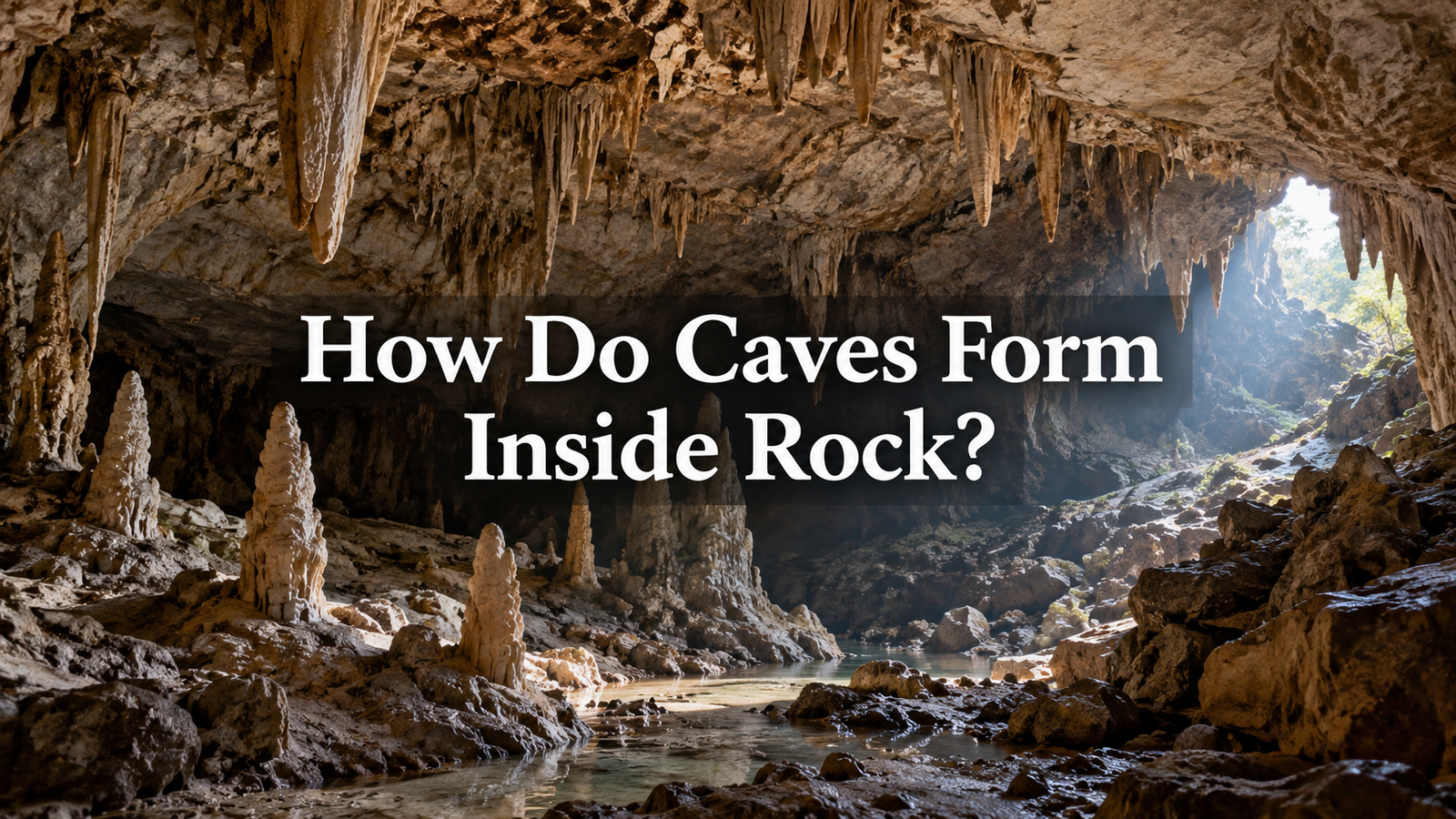
Caves are some of the most fascinating natural features found on Earth. They can look like hidden rooms beneath mountains, long tunnels inside limestone hills, or deep openings that continue far below the ground. When we see a cave, it can be difficult to imagine how such a large empty space could form inside solid rock. The process may look mysterious, but caves usually develop through natural changes that happen slowly over thousands or even millions of years.
Understanding how caves form inside rock helps us understand the power of water, weather, minerals, and geological processes. Most caves do not appear suddenly. They are created little by little as water moves through cracks, dissolves certain types of rock, carries minerals away, and gradually makes the openings larger.
What Is a Cave?
A cave is a natural hollow space inside the ground or within rock. For an opening to be called a cave, it is usually large enough for a person to enter, although some cave systems contain very narrow passages.
Caves can form in several different types of rock, but many of the world’s largest and most famous caves develop in limestone. Limestone is especially important because it can slowly dissolve when it comes into contact with slightly acidic water.
Some caves are short and simple, while others form enormous underground systems with chambers, tunnels, underground rivers, and unusual rock formations.
How Do Caves Form Inside Rock?
The most common process of cave formation begins with water.
Rainwater falls onto the ground and absorbs a small amount of carbon dioxide from the air. It can absorb even more carbon dioxide as it moves through soil containing decaying plants and organic material.
When water mixes with carbon dioxide, it forms a weak natural acid known as carbonic acid. This acid is not strong enough to burn skin, but it can slowly dissolve certain minerals found in limestone.
Limestone contains large amounts of calcium carbonate. When slightly acidic water reaches limestone, a chemical reaction begins. Small amounts of the rock dissolve into the water.
At first, the effect is extremely small. However, water may continue flowing through the same cracks for thousands of years. As more limestone dissolves, the cracks become wider.
Eventually, tiny cracks may turn into small channels. Those channels can become tunnels, and some tunnels may grow into enormous underground chambers.
This is one of the main ways caves form inside rock.
Cracks in Rock Are Important
Water cannot usually move straight through solid rock. It needs small openings.
Most rocks contain natural cracks called joints and fractures. These cracks may develop because of pressure, movement in the Earth’s crust, temperature changes, or other geological forces.
Rainwater and groundwater enter these cracks.
Once water begins moving through them, it slowly dissolves the limestone around the edges. The cracks become wider and allow even more water to pass through.
This creates a cycle.
More water enters the crack, more rock dissolves, and the opening becomes larger.
Over a very long period, these small cracks may develop into a complete cave system.
Why Limestone Caves Are So Common
Limestone is one of the best known cave forming rocks because it reacts easily with weak acidic water.
Many limestone regions contain underground drainage systems rather than large rivers on the surface. Water enters holes and cracks in the ground and travels through the rock below.
Landscapes that develop through the dissolving of limestone are often called karst landscapes.
Karst areas may contain caves, sinkholes, underground rivers, natural springs, and disappearing streams.
The presence of limestone does not automatically mean that a large cave will form. Several other conditions are usually needed, including enough rainfall, natural cracks, suitable groundwater movement, and a long period of time.
The Role of Groundwater
Groundwater plays a major role in many cave systems.
Below the surface, there is often a level where spaces in soil and rock are completely filled with water. This area is called the saturated zone.
In many limestone regions, groundwater moves slowly through cracks and openings underground.
As the water travels, it continues dissolving limestone.
Over time, underground water channels may become larger. Some of these channels may eventually form tunnels.
If the water table later drops, the tunnels may become partly or completely empty. Water may continue flowing along the bottom of the cave as an underground stream.
This is why many caves contain evidence of both old and modern water flow.
How Underground Chambers Develop
A cave does not usually begin as a giant underground room.
Large chambers often develop when smaller passages slowly become wider or when several passages connect.
Water may dissolve more rock in places where several cracks meet. These locations can gradually become larger than the surrounding passages.
Sometimes parts of the cave ceiling may also collapse after the rock becomes unstable. The fallen material can make the chamber appear even larger.
This combination of chemical dissolving and physical collapse can create impressive underground spaces.
Some cave chambers are large enough to contain buildings, roads, or huge groups of people.
How Stalactites Form
Once a cave becomes partly filled with air, another beautiful process may begin.
Water continues entering the cave from the surface. As it travels through limestone, it carries dissolved calcium carbonate.
When a drop of water reaches the cave ceiling, some carbon dioxide may escape into the cave air. This causes a tiny amount of calcium carbonate to be deposited.
The deposit may be almost invisible at first.
However, drop after drop continues arriving in the same area.
Over hundreds or thousands of years, the mineral deposit grows downward from the ceiling.
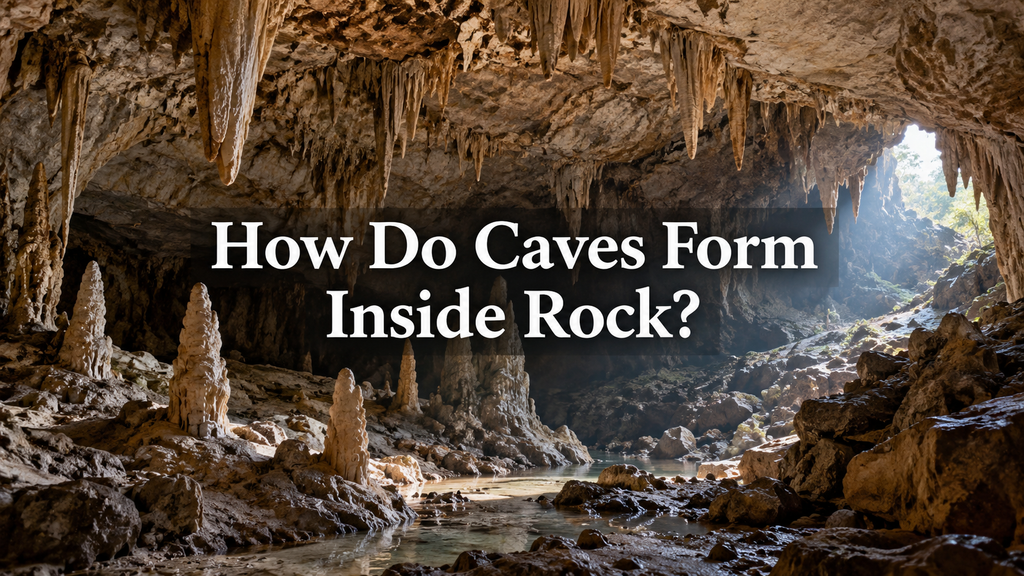
This formation is called a stalactite.
A simple way to remember it is that stalactites hang from the ceiling.
How Stalagmites Form
Water dripping from a stalactite often falls onto the cave floor.
When the drop hits the ground, another small amount of calcium carbonate may be left behind.
Over time, these mineral deposits slowly build upward.
This creates a stalagmite.
Stalagmites usually grow from the cave floor toward the ceiling.
If a stalactite and stalagmite continue growing for a very long time, they may eventually meet and form a solid column.
These structures help make limestone caves some of the most visually impressive natural places on Earth.
Caves Can Form in Other Types of Rock
Although limestone caves are very common, caves can form through several other geological processes.
Volcanic areas may contain lava tubes. These form when the surface of flowing lava cools and becomes solid while hotter lava continues moving underneath. When the lava drains away, it may leave behind a hollow tunnel.
Sea caves form when ocean waves repeatedly strike cliffs. The force of the water enters weak areas and cracks in the rock. Over time, erosion makes the opening larger.
Glaciers can also contain cave like tunnels when flowing water melts pathways through ice.
Some sandstone caves develop through erosion, weathering, and the removal of weaker material.
This means not every cave forms through the same process.
How Sea Caves Form
Sea caves usually develop along rocky coastlines.
Ocean waves constantly hit cliffs. When waves enter natural cracks, they create pressure.
Small pieces of rock may break away.
Sand, stones, and other material carried by the waves can also scrape against the cliff.
This repeated action slowly enlarges the cracks.
Over many years, a small opening can become a large cave.
If erosion continues from both sides of a narrow headland, the caves may eventually meet and form a natural arch.
How Lava Tubes Form
Lava tubes are very different from limestone caves.
During a volcanic eruption, lava may flow across the ground like a river.
The outer surface of the lava begins cooling first because it is exposed to the air. It can form a hard crust while liquid lava continues flowing underneath.
Eventually, the supply of lava decreases.
The remaining molten lava may drain out of the tunnel, leaving the hardened outer shell behind.
The empty passage becomes a lava tube.
Some lava tubes are wide enough for people to walk through, while others extend for several kilometres.
Cave Formation Takes a Very Long Time
One of the most important things to understand about caves is the amount of time involved.
A large cave system usually does not form within a few years or centuries.
The process often takes hundreds of thousands or millions of years.
The speed of cave formation depends on many factors, including the type of rock, amount of rainfall, temperature, acidity of the water, number of fractures, and speed of groundwater movement.
Even though the chemical process may appear weak, it becomes powerful when it continues for an extremely long period.
This shows how small natural changes can create enormous geological features.
Why Some Caves Have Underground Rivers
Many caves contain flowing water because the cave itself may have developed along an underground drainage path.
Water entering through rain, streams, or sinkholes follows gravity downward.
In limestone regions, the water may disappear from the surface and enter underground cracks.
As those cracks become larger, they can carry more water.
Eventually, an underground river may form.
These rivers can travel through cave systems before returning to the surface at natural springs.
Some underground rivers continue for many kilometres.
Why Cave Ceilings Sometimes Collapse
Not every part of a cave remains stable forever.
As water dissolves rock, the ceiling above a passage may become thinner or weaker.
Gravity constantly pulls on the rock.
If the ceiling can no longer support its own weight, part of it may collapse.
The broken rock collects on the cave floor.
Large collapses can create bigger chambers. In some cases, the collapse reaches the Earth’s surface and creates a depression called a sinkhole.
Sinkholes are especially common in limestone landscapes where underground cavities are present.
What Can Be Found Inside Caves?
Caves may contain much more than empty rock passages.
Scientists sometimes find fossils, ancient animal bones, minerals, underground lakes, insects, bats, and evidence of early human activity.
Some caves also preserve information about past climates.
Mineral formations such as stalagmites can contain chemical records of rainfall and environmental conditions from thousands of years ago.
This makes caves important not only for geology but also for archaeology, biology, and climate research.
Why Caves Are Important for Nature
Caves create unique habitats.
Many animals use caves for shelter, breeding, or protection.
Bats are among the best known cave animals, but caves may also contain insects, fish, spiders, salamanders, and microorganisms.
Some species spend their entire lives underground.
Animals that live permanently in dark caves may develop unusual features. Some have very small eyes or no functional eyes at all. Others rely strongly on touch, smell, or vibration.
Because cave environments are sensitive, pollution and human disturbance can easily damage these ecosystems.
Why Every Cave Looks Different
No two cave systems develop in exactly the same way.
The final shape of a cave depends on the structure of the rock and how water moves through it.
Some caves contain long straight passages because water followed major fractures.
Others contain twisting tunnels, narrow openings, deep shafts, and enormous chambers.
Changes in groundwater level can also create passages at different heights.
Mineral deposits add even more variety by forming curtains, columns, flowstone, stalactites, and stalagmites.
This is why cave exploration can reveal completely different landscapes even within the same region.
Final Thoughts
So, how do caves form inside rock? In many cases, the answer begins with something as ordinary as rainwater.
Rainwater mixes with carbon dioxide and becomes slightly acidic. It enters natural cracks in limestone and slowly dissolves the rock. Over thousands or millions of years, these small cracks become wider. They may develop into passages, tunnels, underground rivers, and enormous chambers.
After the cave becomes partly empty, dripping mineral rich water can create stalactites, stalagmites, and other beautiful formations.
Other caves develop through volcanic activity, ocean erosion, glaciers, or weathering, but all of them show how powerful natural processes can become when they continue over long periods.
A cave may look like an empty hole inside solid stone, but it is actually the result of a long geological story involving water, chemistry, pressure, erosion, and time. Every chamber and passage provides evidence of how the Earth continues to change, even deep beneath the surface where we cannot normally see it.