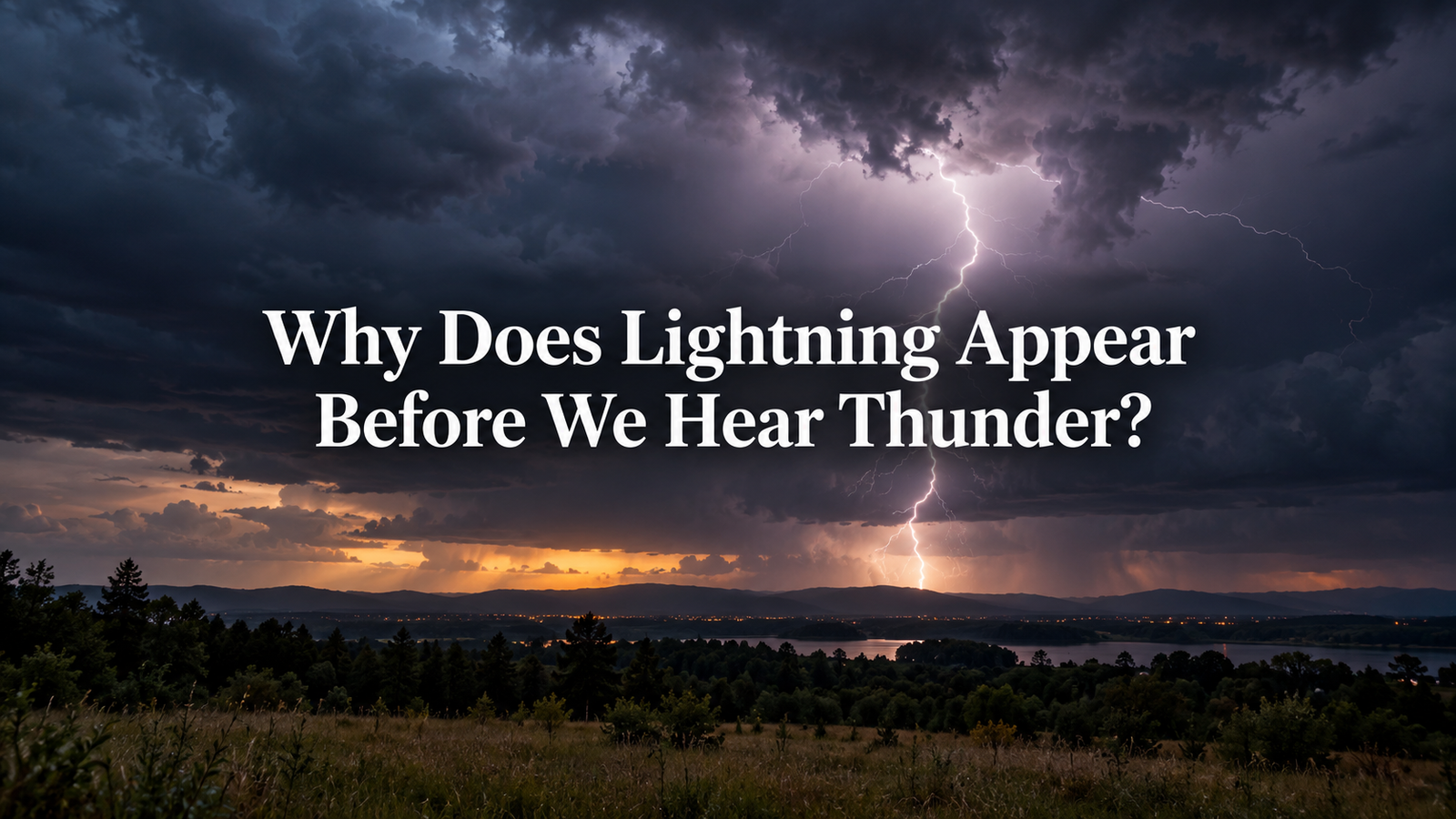
Have you ever watched a storm and noticed a bright flash of lightning, followed a few seconds later by the sound of thunder? This is one of the most familiar sights and sounds of stormy weather. Even though lightning and thunder happen at almost the same moment, we usually see the lightning first and hear the thunder later.
The reason is surprisingly simple. Light travels much faster than sound.
Understanding why lightning appears before we hear thunder gives us a useful way to learn about light, sound, storms, and the atmosphere around us. It also helps explain why thunder sometimes sounds like a sharp crack and at other times like a long, distant rumble.
Lightning and Thunder Happen Together
Lightning is a powerful electrical discharge that takes place inside a cloud, between clouds, or between a cloud and the ground. During a thunderstorm, electrical charges build up inside storm clouds. When the difference between these charges becomes large enough, electricity suddenly moves through the air.
That electrical discharge creates an extremely bright flash that we call lightning.
At the same time, the air around the lightning channel becomes extremely hot. The sudden heating causes the air to expand very quickly. This rapid expansion produces a pressure wave that moves through the atmosphere.
We hear that pressure wave as thunder.
So lightning and thunder are not separate events that happen several seconds apart. They are two results of the same event. The flash is the light produced by the electrical discharge, while thunder is the sound produced by the rapidly expanding air.
The delay happens because light and sound travel at very different speeds.
Light Travels Extremely Fast
Light is one of the fastest things in nature. In empty space, light travels at about 300,000 kilometers per second.
Even when light passes through the atmosphere, its speed remains extremely high.
This means that the light from a lightning flash reaches our eyes almost instantly, especially when the storm is only a few kilometers away.
For everyday distances on Earth, the travel time of light is so short that we do not notice it.
If lightning strikes several kilometers away, the light still reaches us in only a tiny fraction of a second.
That is why the flash seems immediate.
Sound Travels Much More Slowly
Sound behaves very differently.
Sound is not a form of light. It is a mechanical wave that travels by causing particles in a material to vibrate.
When thunder moves through the atmosphere, air molecules push against nearby air molecules. This transfer of energy continues from one group of particles to the next until the sound reaches our ears.
At normal atmospheric conditions, sound travels through air at roughly 343 meters per second.
That is fast compared with many everyday movements, but it is incredibly slow compared with the speed of light.
Because sound travels much more slowly, thunder takes noticeable time to reach us.
This is the main reason why lightning appears before we hear thunder.
A Simple Example
Imagine that lightning strikes about one kilometer away from you.
The light from the flash reaches your eyes almost immediately.
The sound of thunder, however, travels at only a few hundred meters per second. It therefore takes around three seconds to travel one kilometer.
You may see the flash first and then hear the thunder about three seconds later.
If the lightning is farther away, the delay becomes longer.
For example, if a storm is around three kilometers away, you may wait roughly nine seconds before hearing the thunder.
This difference between the arrival of light and sound allows us to estimate how far away a thunderstorm may be.
Counting the Seconds Between Lightning and Thunder
Many people use a simple method to estimate the distance of lightning.
After seeing a flash of lightning, start counting the seconds until you hear thunder.
A common rough estimate is that about three seconds of delay represents approximately one kilometer of distance.
If you see lightning and hear thunder three seconds later, the lightning may be about one kilometer away.
If the delay is six seconds, it may be roughly two kilometers away.
If the delay is twelve seconds, it may be around four kilometers away.
This is only an estimate because the exact speed of sound can change with temperature, humidity, wind, and other atmospheric conditions.
Still, it gives a useful general idea of how far away the lightning occurred.
Why Sound Needs Air but Light Does Not
Another important difference between light and sound is the way they travel.
Light can travel through empty space.
This is why sunlight can cross the enormous distance between the Sun and Earth even though much of space contains very little matter.
Sound cannot travel through a complete vacuum.
It needs a material such as air, water, metal, or another substance because sound depends on particles vibrating and passing energy to neighboring particles.
Thunder reaches us because sound waves move through the air.
If there were no atmosphere, lightning could still produce light, but we would not hear thunder traveling through empty space.
This difference helps show how completely different light and sound really are.
Why Thunder Can Sound Like a Crack
Sometimes thunder sounds like a sudden, sharp crack.
This often happens when lightning is relatively close.
Because the sound has not traveled very far, different parts of the sound wave reach us within a short period of time.
Nearby lightning can therefore produce a strong and sudden sound.
The closer the lightning is, the shorter the delay between the flash and the thunder.
If the thunder seems to follow almost immediately after the lightning, the storm may be very close.
Why Thunder Sometimes Rumbles for a Long Time
Distant thunder often sounds like a long rumble rather than a single sharp sound.
One reason is that a lightning channel can be several kilometers long.
Different parts of the channel may be at different distances from the listener. Sound from the nearest section reaches us first, while sound from more distant sections arrives later.
This creates a rolling or rumbling effect.
The sound can also reflect from clouds, hills, buildings, and different layers of the atmosphere.
These reflections may cause the thunder to continue for several seconds.
That is why one lightning flash can sometimes produce a surprisingly long sound.
How Temperature Affects the Speed of Sound
The speed of sound is not exactly the same under all conditions.
Temperature has an important effect.
Sound generally travels faster through warmer air than through colder air.
Air temperature can therefore slightly change the amount of time between seeing lightning and hearing thunder.
During a warm summer storm, sound may travel somewhat faster than it would in colder conditions.
However, these differences are usually small enough that the simple three seconds per kilometer estimate remains useful for everyday observation.
How Wind Can Affect Thunder
Wind can also influence how thunder reaches us.
If the wind is blowing from the storm toward you, it may help carry the sound in your direction.
If the wind is blowing strongly away from you, the thunder may sound weaker or more distant.
Wind can also change the path of sound waves through the atmosphere.
This can make thunder seem louder in one place and quieter in another, even when both places are similar distances from the lightning.
The lightning flash itself is much less affected by these conditions because light travels so quickly.
Why We Can Sometimes See Lightning but Not Hear Thunder
There are times when people see distant flashes of lightning but hear no thunder at all.
This can happen when the storm is very far away.
The light is bright enough to travel over long distances and remain visible.
Thunder becomes weaker as it travels through the atmosphere. The sound energy spreads out, and some of it is absorbed or redirected.
If the storm is far enough away, the thunder may become too weak for us to hear even though the lightning remains visible.
People sometimes refer to distant visible lightning as heat lightning, although it is usually normal lightning from a thunderstorm beyond the listener’s hearing range.
Why We Never Hear Thunder Before Seeing Lightning
Under normal conditions, we do not hear thunder before we see the lightning that caused it.
Light moves so much faster than sound that the flash always reaches us first.
The difference is enormous.
Light can travel around the Earth several times in a single second.
Sound would take many hours to cover a similar distance.
That huge difference explains why the order is always the same.
First we see the lightning.
Then we hear the thunder.
What Happens Inside a Thundercloud
Thunderstorms develop when warm, moist air rises into the atmosphere.
As the air rises, it cools and forms large clouds.
Inside a powerful thunderstorm, strong upward and downward air currents move water droplets, ice particles, and hail around the cloud.
Collisions between these particles help separate electrical charges.
Different parts of the cloud can develop different electrical charges.
When the electrical difference becomes strong enough, the air can no longer keep the charges separated.
An electrical discharge occurs.
This is lightning.
The lightning channel can heat the surrounding air to temperatures much hotter than the surface of the Sun for a very short time.
The heated air expands rapidly, creating the shock wave that becomes thunder.
Why Lightning Looks Instant
Human vision also affects how we experience lightning.
A lightning flash may last only a small fraction of a second, although several electrical discharges can occur along the same path.
Because light reaches us almost instantly, the flash appears sudden and immediate.
Thunder is different because the sound arrives later and can continue for several seconds.
This difference between a quick flash and a delayed rumble makes thunderstorms feel dramatic.
Lightning Can Travel Through Different Paths
Not all lightning reaches the ground.
Some lightning occurs entirely within a single cloud.
Other lightning travels between two clouds.
Cloud to ground lightning is the type most commonly associated with visible strikes on the surface.
No matter where the lightning occurs, the same basic rule applies.
The light reaches our eyes long before the sound reaches our ears.
The farther away the lightning is, the more noticeable the delay becomes.
Why Understanding the Delay Is Useful
Knowing why lightning appears before thunder is not only an interesting science lesson.
It can also help people understand how close a storm may be.
A very short delay means the lightning is relatively close.
A long delay usually means it is farther away.
However, lightning can still be dangerous even when a storm seems distant.
If you can hear thunder, lightning may be close enough to pose a risk.
The safest choice during a thunderstorm is to move indoors or into a substantial enclosed shelter and stay away from exposed outdoor areas.
A Simple Way to Remember the Science
The easiest way to remember why lightning appears before thunder is to think about the speed difference.
Lightning produces both light and sound.
The light travels extremely fast.
The sound travels much more slowly through air.
Your eyes receive the light first.
Your ears receive the thunder later.
The event happens at almost the same time, but the signals reach you at different times.
Final Thoughts
The question of why lightning appears before we hear thunder has a simple scientific answer, but it reveals a lot about how the natural world works.
Lightning and thunder are created by the same electrical event inside a storm. Lightning produces a bright flash, while the rapid heating and expansion of surrounding air produces thunder.
We see the lightning first because light travels at an enormous speed, reaching our eyes almost immediately.
Thunder takes longer because sound travels through air much more slowly.
The delay becomes longer as the distance between us and the lightning increases.
This is why a nearby storm may produce thunder only a second or two after a flash, while a distant storm may leave us waiting for many seconds.
The next time you watch a thunderstorm from a safe place, you can use the time between the flash and the thunder to better understand what is happening in the sky. What may seem like a mysterious delay is actually a clear example of one of the most important differences between light and sound.