Have you ever wondered why some months of the year are hot while others are cold? Why do we experience long sunny days in summer, cool evenings in autumn, cold weather in winter, and fresh new growth in spring?
The answer is connected to the way the Earth moves around the Sun and the way our planet is tilted.
Many people think that summer happens when the Earth is closer to the Sun and winter happens when it is farther away. This sounds reasonable, but it is not the main reason for the seasons. The real explanation is much more interesting.
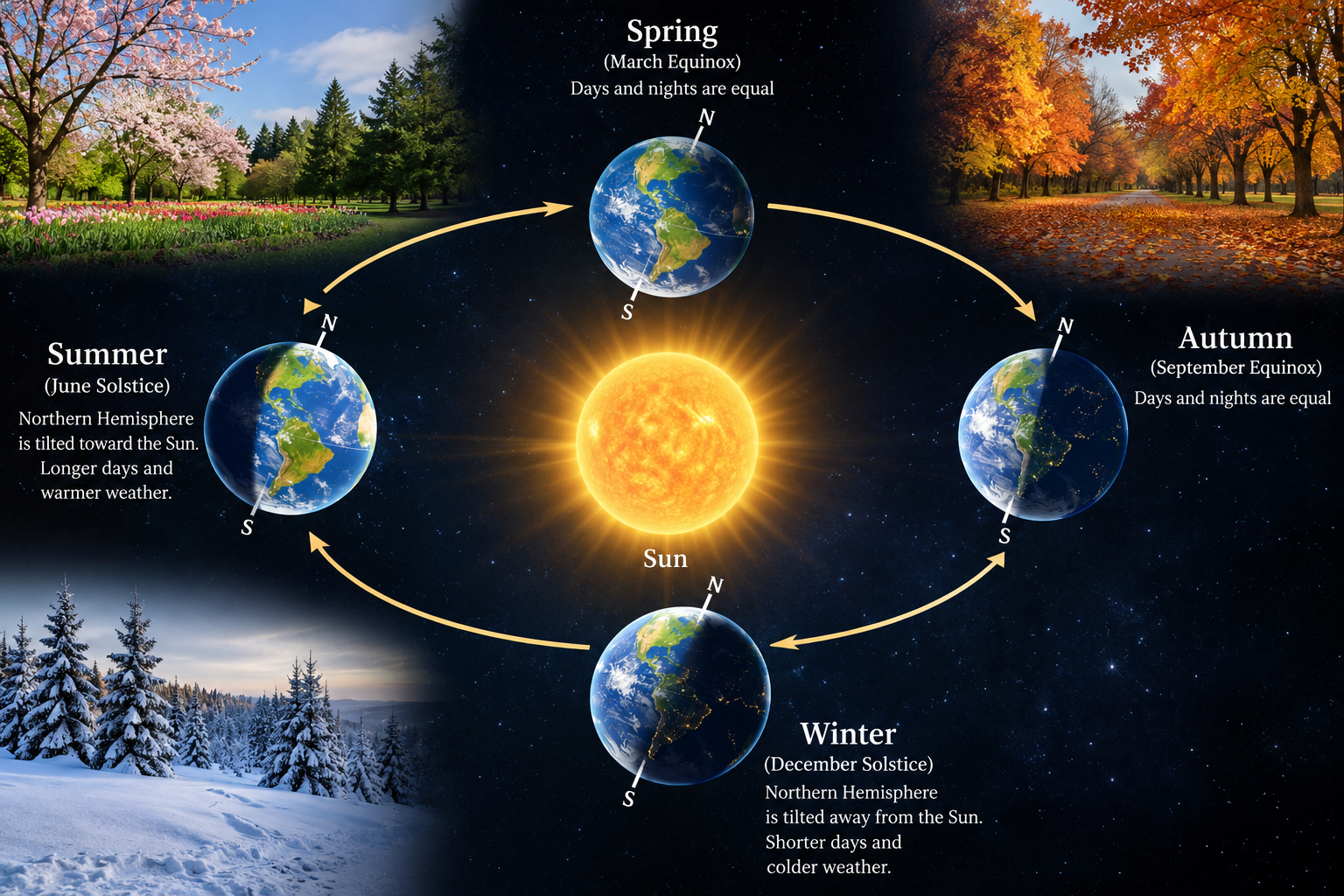
The Earth has different seasons because its axis is tilted while it travels around the Sun. This tilt changes how directly sunlight reaches different parts of the planet during the year.
Understanding this simple idea helps explain summer, winter, spring, and autumn.
What Are Seasons?
Seasons are periods of the year that have different weather conditions, temperatures, and lengths of daylight.
In many parts of the world, the year is commonly divided into four seasons.
Spring is usually associated with warmer weather, new plant growth, and longer days.
Summer is normally the warmest part of the year and has long hours of daylight.
Autumn is the season when temperatures begin to fall and many trees lose their leaves.
Winter is usually the coldest season and has shorter days and longer nights.
However, not every place on Earth experiences these four seasons in the same way.
Some tropical regions mainly experience wet and dry seasons. Areas near the poles can have very long periods of daylight in summer and very long periods of darkness in winter.
The pattern depends mainly on latitude and the amount of sunlight an area receives.
The Earth’s Axis Is Tilted
The most important reason for the seasons is the tilt of the Earth’s axis.
The Earth rotates around an imaginary line called its axis. This line runs through the planet from the North Pole to the South Pole.
The Earth’s axis is not perfectly straight compared with its orbit around the Sun. It is tilted by about 23.5 degrees.
This tilt may not sound very large, but it has a major effect on our climate.
As the Earth travels around the Sun, different parts of the planet are tilted toward or away from the Sun.
When a hemisphere is tilted toward the Sun, it receives more direct sunlight and has longer days. This produces warmer temperatures and summer conditions.
When the same hemisphere is tilted away from the Sun, it receives less direct sunlight and has shorter days. This creates cooler temperatures and winter conditions.
This change happens gradually throughout the year.
How the Earth Moves Around the Sun
The Earth takes approximately 365 days to complete one full journey around the Sun. This journey is called an orbit or revolution.
During this yearly journey, the direction of the Earth’s tilt remains almost the same in space.
This is very important.
Imagine holding a tilted globe and slowly moving it around a lamp. The globe stays tilted in the same direction while it travels around the lamp.
At one point, the northern half of the globe will lean toward the lamp. Six months later, the northern half will lean away from it.
The same thing happens to Earth as it moves around the Sun.
This movement produces the repeating cycle of the seasons.
Why Summer Is Warmer
Summer occurs when one hemisphere of the Earth is tilted toward the Sun.
During this period, sunlight hits the surface at a more direct angle.
Direct sunlight concentrates more solar energy on a smaller area of land or water. This makes heating more effective.
The Sun also remains above the horizon for a longer period each day.
Longer daylight means the ground has more time to absorb heat from sunlight.
For example, during summer in the Northern Hemisphere, countries in North America, Europe, and much of Asia experience longer days and shorter nights.
The combination of direct sunlight and longer daylight hours creates warmer summer temperatures.
Why Winter Is Colder
Winter happens when a hemisphere is tilted away from the Sun.
During winter, sunlight reaches the ground at a lower angle.
Instead of being concentrated over a smaller area, the Sun’s energy is spread across a larger surface.
This means the ground receives less energy in each area.
Winter also brings shorter days.
Because there are fewer daylight hours, the land and atmosphere have less time to warm up.
The longer nights also allow more heat to escape.
Together, these factors cause winter temperatures to become much colder than summer temperatures.
Why the Northern and Southern Hemispheres Have Opposite Seasons
One of the most interesting facts about the seasons is that the Northern Hemisphere and Southern Hemisphere experience opposite seasons.
When the Northern Hemisphere is tilted toward the Sun, it experiences summer.
At the same time, the Southern Hemisphere is tilted away from the Sun, so it experiences winter.
Around six months later, the situation is reversed.
The Southern Hemisphere is tilted toward the Sun and experiences summer, while the Northern Hemisphere experiences winter.
This is why December can be cold in countries such as Canada and the United Kingdom while it is warm in countries such as Australia and parts of South America.
Similarly, June is a summer month in much of the Northern Hemisphere but a winter month in much of the Southern Hemisphere.
What Happens During Spring?
Spring is a transition season between winter and summer.
After winter, a hemisphere gradually begins to receive more sunlight.
The days become longer and temperatures slowly rise.
Plants respond to increasing warmth and sunlight by beginning new growth.
Trees develop fresh leaves, flowers begin to bloom, and many animals become more active.
Spring is not caused by a sudden change in the Earth’s position. Instead, it happens gradually as the angle of sunlight changes while Earth continues along its orbit.
The exact weather of spring depends on location.
Some regions experience mild temperatures and frequent rain, while others may have very short spring seasons.
What Happens During Autumn?
Autumn is the transition between summer and winter.
During autumn, a hemisphere gradually becomes tilted farther away from the Sun.
The days become shorter and sunlight becomes less direct.
Temperatures begin to fall.
In many places, trees prepare for colder weather by reducing the production of chlorophyll, the green pigment found in leaves.
As the green color fades, yellow, orange, red, and brown pigments become easier to see.
Eventually, many trees lose their leaves.
Autumn is therefore a visible reminder that the amount of sunlight reaching a region is changing.
What Are Solstices?
Solstices are important points in the seasonal cycle.
There are two solstices each year.
One occurs around June 20 or June 21.
The other occurs around December 21 or December 22.
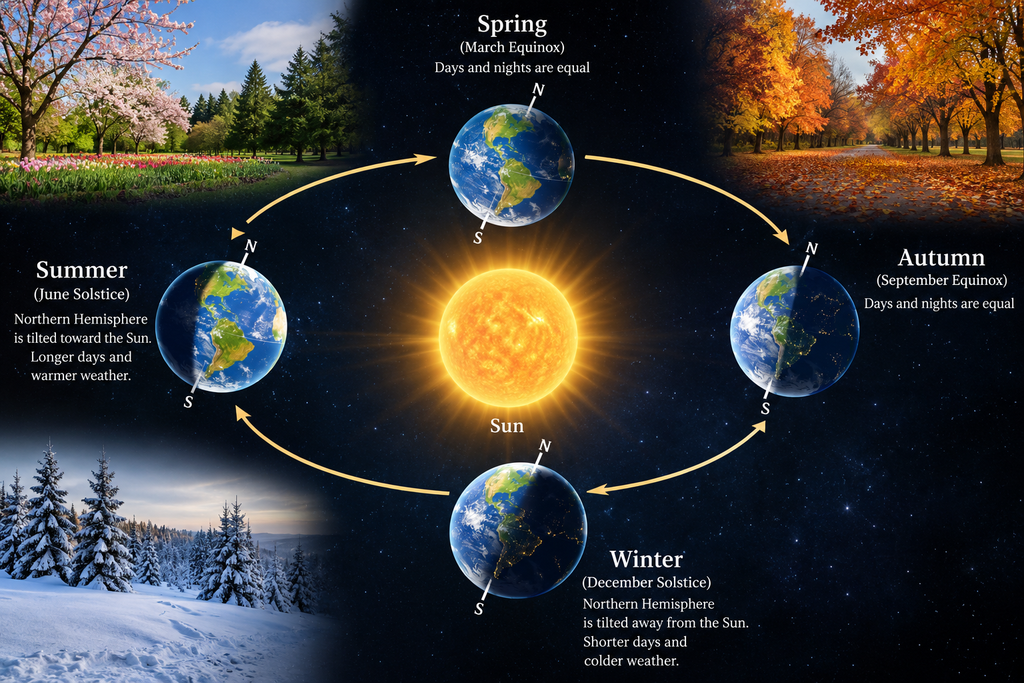
During the June solstice, the Northern Hemisphere is tilted most directly toward the Sun.
This produces the longest day of the year in the Northern Hemisphere and marks the beginning of astronomical summer.
At the same time, the Southern Hemisphere experiences its shortest day and the beginning of astronomical winter.
During the December solstice, the opposite happens.
The Southern Hemisphere is tilted more directly toward the Sun, while the Northern Hemisphere is tilted away from it.
These solstices mark the greatest differences in daylight during the year.
What Are Equinoxes?
The equinoxes occur between the two solstices.
They happen around March 20 and September 22 or September 23.
During an equinox, neither hemisphere is strongly tilted toward or away from the Sun.
Day and night are close to equal in length across much of the Earth.
The March equinox marks the beginning of astronomical spring in the Northern Hemisphere and autumn in the Southern Hemisphere.
The September equinox marks the beginning of astronomical autumn in the Northern Hemisphere and spring in the Southern Hemisphere.
The word equinox comes from Latin words connected with the idea of equal night.
Is the Earth Closer to the Sun in Summer?
A common misunderstanding is that summer happens because the Earth moves closer to the Sun.
This is not correct.
The Earth’s orbit is slightly elliptical, which means it is not a perfect circle.
Because of this, the distance between Earth and the Sun changes slightly throughout the year.
Interestingly, the Earth is actually closest to the Sun in early January.
January is winter in the Northern Hemisphere.
The Earth is farthest from the Sun in early July, which is summer in the Northern Hemisphere.
This clearly shows that distance from the Sun is not the main cause of the seasons.
The tilt of the Earth’s axis is much more important.
Why the Angle of Sunlight Matters
The angle at which sunlight reaches Earth strongly affects temperature.
Imagine shining a flashlight directly onto a wall.
The light forms a small, bright circle because the energy is concentrated in one place.
Now tilt the flashlight so the light hits the wall at an angle.
The same amount of light spreads across a larger area and appears less intense.
Sunlight behaves in a similar way.
During summer, sunlight reaches the ground more directly.
During winter, sunlight arrives at a lower angle.
That lower angle spreads the Sun’s energy over a larger area, which reduces heating.
This is one of the simplest ways to understand why summer is warmer than winter.
Why Day Length Changes With the Seasons
The Earth’s tilt also changes the length of daylight.
In summer, the Sun rises earlier and sets later.
This creates longer days.
In winter, the Sun rises later and sets earlier, producing shorter days.
The difference becomes greater as you travel farther away from the equator.
Near the equator, day and night remain close to twelve hours throughout most of the year.
Near the Arctic and Antarctic regions, daylight changes dramatically.
Some places experience almost twenty four hours of sunlight during part of the summer.
During winter, those same regions can experience very long periods of darkness.
Why Seasons Are Mild Near the Equator
Regions near the equator do not usually experience large temperature changes between summer and winter.
This happens because the equator receives relatively direct sunlight throughout the year.
Day length also changes very little.
As a result, temperatures remain warm during most months.
Instead of four strong temperature based seasons, many tropical areas experience rainy and dry seasons.
Rainfall patterns become more important than temperature changes.
This is why tropical forests can remain warm and green throughout the year.
Why Seasons Are Stronger Near the Poles
The farther a location is from the equator, the greater the seasonal difference in sunlight usually becomes.
Areas closer to the poles can have very long summer days and extremely short winter days.
The Sun also remains low in the sky during winter.
These factors produce much stronger seasonal temperature changes.
Places in northern Canada, Scandinavia, Alaska, and Siberia can experience large differences between summer and winter.
Polar regions experience some of the most extreme seasonal changes on Earth.
Do All Countries Have Four Seasons?
No.
The traditional four seasons are most noticeable in temperate regions.
Tropical countries may mainly have a rainy season and a dry season.
Desert regions may experience extremely hot summers and cooler winters but very little rainfall.
Mountain areas can have local seasonal patterns because temperature changes with elevation.
Monsoon regions may organize the year according to rainfall patterns.
So, while the Earth’s axial tilt affects the entire planet, local geography also influences how people experience the seasons.
How Oceans Affect the Seasons
Oceans play an important role in seasonal temperatures.
Water heats and cools more slowly than land.
Because of this, coastal areas often experience milder seasonal temperature changes than inland areas.
During summer, oceans absorb large amounts of heat.
During winter, they slowly release some of this stored heat.
This helps reduce extreme temperature changes near coastlines.
Cities located far inland can experience hotter summers and colder winters than coastal locations at similar latitudes.
How Mountains Affect Seasonal Weather
Mountains can also influence seasonal conditions.
Higher areas are usually cooler because air temperature generally decreases with altitude.
Mountains can block air movement and change rainfall patterns.
One side of a mountain range may receive large amounts of rain or snow, while the opposite side may remain much drier.
Snow can also remain on mountain peaks long after winter has ended in nearby lowland areas.
For this reason, seasonal weather can vary greatly even between places that are relatively close together.
Why Seasons Are Important for Plants and Animals
The changing seasons are extremely important for life on Earth.
Plants use seasonal changes in sunlight and temperature to control growth, flowering, and seed production.
Many trees lose their leaves during colder months to save energy and water.
Animals also respond to seasonal changes.
Some birds migrate over long distances to find warmer climates or better food supplies.
Some animals grow thicker fur during winter.
Others hibernate or reduce their activity when food becomes difficult to find.
Breeding cycles are also often connected to seasonal changes.
In this way, the Earth’s tilt affects not only temperature but also the behavior of living organisms.
Seasons and Agriculture
Farmers depend heavily on seasonal patterns.
Different crops require different temperatures, rainfall levels, and amounts of sunlight.
Some crops grow best during warm weather, while others prefer cooler conditions.
Farmers carefully choose planting and harvesting times according to local seasons.
Seasonal rainfall is especially important in areas that depend on natural rain rather than irrigation.
Understanding the seasons has therefore been important to human societies for thousands of years.
Ancient civilizations observed the movement of the Sun and stars to help predict seasonal changes.
Would Earth Have Seasons Without Its Tilt?
If the Earth’s axis were not tilted, the seasons would be very different.
The amount of sunlight received at each latitude would remain almost the same throughout the year.
Day length would also change very little.
Areas near the equator would remain warm, while the poles would remain cold, but the yearly cycle of spring, summer, autumn, and winter would be much weaker.
The 23.5 degree tilt of the Earth’s axis is therefore essential for the seasons we experience today.
Does the Earth’s Tilt Ever Change?
The Earth’s tilt is not completely fixed forever.
Over extremely long periods of time, the angle of the Earth’s axis changes slightly.
These changes happen over thousands of years.
They can influence long term climate patterns.
However, these slow changes are not responsible for the normal seasons we experience each year.
Our yearly seasons are created by the Earth’s current tilt combined with its orbit around the Sun.
Why Understanding the Seasons Matters
Learning why the Earth has different seasons helps us understand many other natural processes.
It explains why daylight changes.
It helps us understand temperature patterns.
It explains why farming calendars vary around the world.
It also helps us understand animal migration, plant growth, rainfall patterns, and human activities.
The seasons are part of a much larger relationship between the Earth and the Sun.
A small tilt in our planet’s axis creates major changes in the environment throughout the year.
Frequently Asked Questions
What is the main reason the Earth has seasons?
The main reason is the tilt of the Earth’s axis. The Earth is tilted by about 23.5 degrees as it orbits the Sun.
Does distance from the Sun cause the seasons?
No. The Earth’s changing distance from the Sun is not the main cause of the seasons. The angle of sunlight and the length of daylight are much more important.
Why is it summer in one hemisphere and winter in the other?
When one hemisphere is tilted toward the Sun, the other is tilted away from it. This causes opposite seasons.
Why are days longer in summer?
A hemisphere tilted toward the Sun remains exposed to sunlight for a longer part of each day.
Why are equatorial regions warm all year?
The equator receives relatively direct sunlight throughout the year and experiences only small changes in day length.
Why are winters colder near the poles?
Polar regions receive sunlight at very low angles during winter and may experience extremely short days or even long periods without direct sunlight.
Final Thoughts
The Earth has different seasons because our planet is tilted while it travels around the Sun.
This simple tilt changes both the angle of sunlight and the number of daylight hours different regions receive during the year.
When a hemisphere tilts toward the Sun, it experiences more direct sunlight, longer days, and warmer temperatures. This creates summer.
When it tilts away from the Sun, sunlight becomes less direct, days become shorter, and temperatures fall. This creates winter.
Spring and autumn appear during the gradual transitions between these two conditions.
The seasons show how even a small feature of our planet can influence weather, ecosystems, agriculture, and everyday human life.
Once we understand the Earth’s tilt and its journey around the Sun, the changing seasons become much easier to understand.