Mountains are some of the most impressive natural features on Earth. They rise high above surrounding land, shape weather patterns, provide homes for wildlife, store fresh water, and influence the way people live. When we stand in front of a huge mountain range, it may look permanent and unchanging. In reality, mountains have long and complicated histories.
Most mountains did not appear suddenly. They formed through geological processes that took millions of years. Deep beneath our feet, the surface of Earth is constantly moving. Large pieces of the planet’s crust slowly push against each other, pull apart, slide past one another, or allow molten rock to rise from below. Over enormous periods of time, these movements can lift land thousands of meters into the air.
Understanding how mountains form helps us understand the history of Earth itself. Every folded rock layer, volcanic peak, deep valley, and steep cliff can provide clues about events that happened millions of years ago.
In this article, we will explore how mountains form over millions of years, the role of tectonic plates, the different types of mountains, and why mountains continue to change even today.
What Is a Mountain?
A mountain is a natural landform that rises significantly above the surrounding landscape. Mountains usually have steep slopes, high elevations, and clearly defined peaks or ridges.
There is no single worldwide height that automatically makes a landform a mountain. Different countries and scientific organizations may use different definitions. However, mountains are generally larger and steeper than hills.
Mountains can appear alone, but they are often found together in long groups called mountain ranges.
The Himalayas in Asia, the Andes in South America, the Rocky Mountains in North America, and the Alps in Europe are famous examples of mountain ranges.
Each of these ranges has its own geological story.
The Earth Is Not Completely Still
To understand mountain formation, we first need to understand the structure of Earth.
Earth may appear solid and motionless from the surface, but deep inside the planet there is tremendous heat and movement.
The outermost solid layer of Earth is called the crust. Beneath the crust is a thick layer called the mantle. The upper part of the mantle and the crust together form a rigid outer shell known as the lithosphere.
The lithosphere is broken into several large and small pieces called tectonic plates.
These plates move extremely slowly across the softer material beneath them.
Most tectonic plates move only a few centimeters each year. That might sound insignificant, but geological time is incredibly long.
Imagine a plate moving only five centimeters per year. In one million years, it could travel around fifty kilometers.
Over tens of millions of years, even tiny yearly movements can completely reshape continents and create enormous mountain ranges.
Plate Tectonics and Mountain Formation
Plate tectonics is one of the most important ideas in modern geology.
According to plate tectonic theory, Earth’s outer shell is divided into moving plates. These plates interact at their boundaries.
There are three main types of plate boundaries.
At convergent boundaries, plates move toward each other.
At divergent boundaries, plates move away from each other.
At transform boundaries, plates slide past one another.
Most of the world’s largest mountain ranges form near convergent boundaries, where tectonic plates collide.
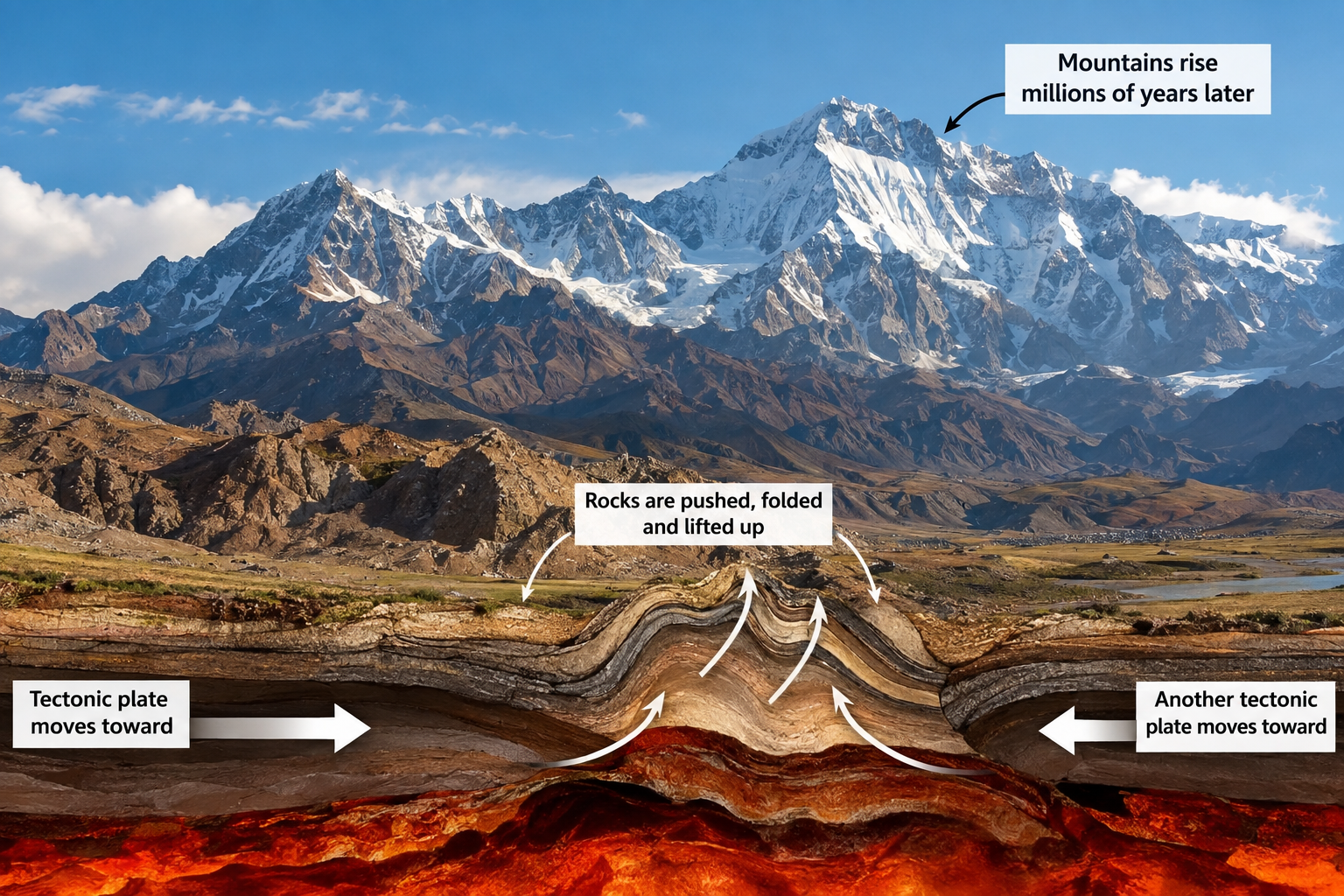
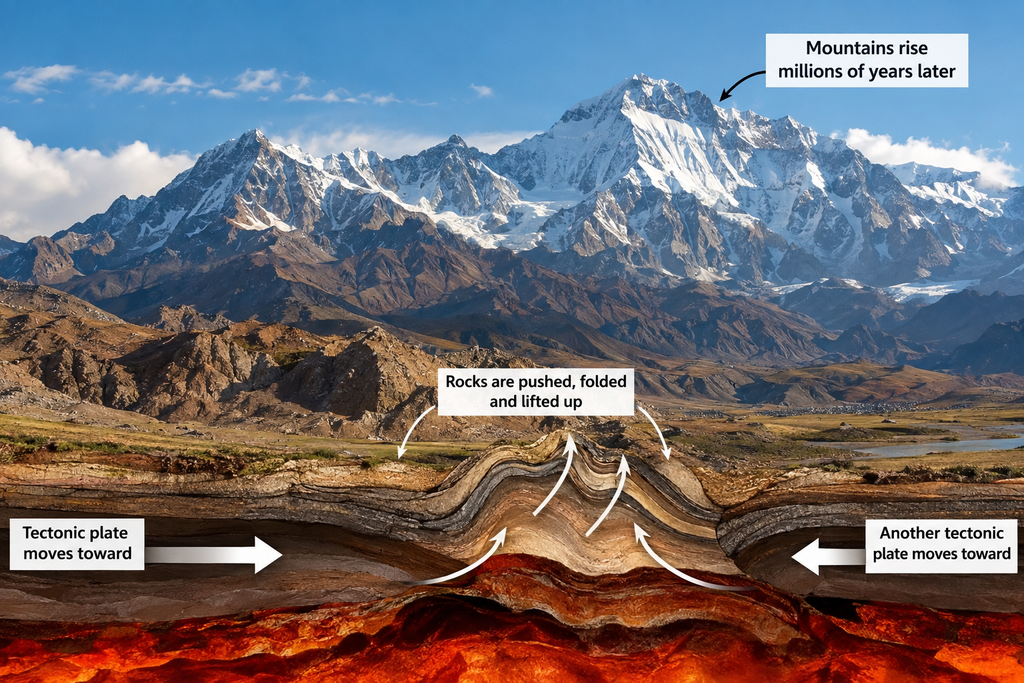
When two plates push against each other, the crust can become compressed, folded, cracked, and lifted upward.
This process is extremely slow, but after millions of years it can produce enormous mountains.
How Fold Mountains Form
Fold mountains are among the largest and most common types of mountains on Earth.
They form mainly when two tectonic plates move toward each other and compress layers of rock.
Imagine placing a thick rug on the floor and pushing it from both ends. The rug begins to wrinkle and fold upward.
Something similar happens to layers of rock during mountain formation.
The forces involved are much greater, and the process takes millions of years.
As the crust is squeezed, layers of sedimentary rock may bend and fold. Eventually, large sections of the crust rise above the surrounding landscape.
This creates fold mountains.
The Himalayas are one of the world’s best examples.
How the Himalayas Formed
The formation of the Himalayas began tens of millions of years ago.
The Indian tectonic plate was moving northward toward the Eurasian plate.
Before the collision, a large ocean known as the Tethys Ocean existed between the two landmasses.
Over time, the Indian plate continued moving north. The ocean gradually became smaller until the Indian continental crust finally collided with the Eurasian continental crust.
Continental crust is relatively light compared with oceanic crust, so neither continent easily sank deep into the mantle.
Instead, enormous pressure caused the crust to crumple, fold, thicken, and rise.
This slow collision created the Himalayas and the Tibetan Plateau.
The process has not completely stopped. The Indian plate is still moving toward Eurasia today.
As a result, the Himalayas are still geologically active.
Earthquakes in the region are another sign that powerful forces continue to operate beneath the surface.
Mountains Created by Subduction
Mountains can also form when an oceanic plate collides with a continental plate.
Oceanic crust is usually denser than continental crust.
When the two meet, the oceanic plate may be forced beneath the continental plate. This process is called subduction.
As the oceanic plate sinks deeper into Earth, heat and pressure affect the rocks.
Some material melts and forms magma.
The magma may rise through cracks in the crust. If it reaches the surface, it can produce volcanic eruptions.
Over millions of years, repeated volcanic activity and crustal uplift can build large mountain chains.
The Andes Mountains along the western side of South America are a major example.
The Andes formed largely because the Nazca Plate has been moving beneath the South American Plate.
This process has caused both mountain building and volcanic activity.
How Volcanic Mountains Form
Not every mountain is created mainly by folding or continental collision.
Some mountains are built by volcanoes.
Volcanic mountains form when magma rises from beneath Earth’s surface and erupts through a vent.
Once magma reaches the surface, it is called lava.
During an eruption, lava, ash, rock fragments, and other volcanic materials may accumulate around the opening.
One eruption may add only a small amount of material.
However, if eruptions continue over thousands or millions of years, layer after layer can gradually build a large volcanic mountain.
Some volcanic mountains are tall and cone shaped.
Mount Fuji in Japan is a famous example.
Mount Kilimanjaro in Tanzania is another well known volcanic mountain.
Volcanoes can also form enormous mountains beneath the ocean.
If an underwater volcano grows high enough to reach above sea level, it can eventually become an island.
The Hawaiian Islands were created through volcanic activity of this kind.
How Fault Block Mountains Form
Another type of mountain is called a fault block mountain.
These mountains form when large sections of Earth’s crust move along cracks called faults.
The movement of tectonic plates creates stress inside the crust.
When the rocks can no longer bend enough to absorb the stress, they may break.
Large blocks of crust can then move upward, downward, or sideways.
In some regions, one block is pushed upward while another block drops downward.
The raised blocks may become mountains.
The lowered areas may become valleys or basins.
This process can create landscapes with steep mountain fronts and broad valleys.
The Sierra Nevada in the western United States contains features associated with fault block mountain formation.
Fault block mountains show how breaking and movement within Earth’s crust can reshape huge areas of land.
How Dome Mountains Form
Dome mountains form in a different way.
Sometimes magma rises toward Earth’s surface but does not actually erupt.
Instead, it becomes trapped beneath layers of rock.
As more magma collects, it pushes the rocks above it upward.
The surface begins to bulge into a rounded shape, much like bread rising while baking.
The magma may eventually cool underground without reaching the surface.
Later, erosion can remove the upper layers of rock and expose the structure beneath.
The result can be a rounded mountainous region called a dome mountain.
Dome mountains are less dramatic than some huge folded mountain ranges, but they are another example of how forces beneath Earth’s surface shape the landscape.
How Long Does It Take for Mountains to Form?
There is no single amount of time required to create a mountain.
Mountain formation depends on many factors, including the speed of tectonic movement, the type of crust involved, volcanic activity, erosion, and the strength of surrounding rocks.
Some volcanic mountains can grow noticeably during relatively short geological periods.
Large continental mountain ranges usually take much longer.
A major range may develop over tens of millions of years.
The Himalayas, for example, began forming roughly fifty million years ago and continue changing today.
This means mountain formation is often not a single event.
It is an ongoing process.
A mountain range can rise, erode, fracture, and rise again as geological forces continue working.
Why Mountain Building Is So Slow
Humans usually think in years, decades, or centuries.
Geologists often think in millions and billions of years.
This difference in scale can make geological change difficult to imagine.
Tectonic plates often move at approximately the speed that human fingernails grow.
If we watched a mountain for a day, a year, or even an entire lifetime, we might see very little change.
Yet those tiny movements accumulate.
A few centimeters of movement each year becomes many kilometers of movement over millions of years.
The same principle applies to erosion.
A river may remove only a small amount of rock each year. Rain may slowly wear down exposed surfaces. Ice may widen cracks by tiny amounts.
Over millions of years, however, these processes can carve enormous valleys and dramatically change entire mountain ranges.
The Role of Pressure in Mountain Formation
Pressure is one of the most important forces involved in mountain building.
When tectonic plates collide, enormous amounts of pressure build inside the crust.
Rocks that seem solid and unbendable to us can behave differently deep underground.
High temperatures and intense pressure can allow rock layers to bend slowly without immediately breaking.
This creates folds.
Other rocks may fracture and move along faults.
In some mountain ranges, geologists can see layers of rock that were originally horizontal but are now tilted, curved, or almost vertical.
These rock formations provide evidence of the enormous forces that shaped the mountains.
Mountains Can Contain Ancient Sea Fossils
One of the most fascinating pieces of evidence for mountain formation comes from fossils.
Scientists have discovered fossils of marine organisms high in certain mountain ranges.
At first, this may seem strange.
How could remains of sea creatures end up thousands of meters above sea level?
The explanation is plate tectonics.
Sediments originally deposited on ancient ocean floors can eventually be compressed and pushed upward when tectonic plates collide.
The rocks containing marine fossils become part of a mountain range.
Some rocks in the Himalayas, for example, formed from sediments deposited in an ancient ocean.
Their presence at high elevations shows just how dramatically Earth’s surface can change over geological time.
Erosion Begins as Soon as Mountains Rise
Mountain building is only part of the story.
At the same time that tectonic forces push mountains upward, erosion begins wearing them down.
Rain, rivers, glaciers, wind, ice, and changes in temperature slowly break rocks apart and carry material away.
This creates an ongoing competition between uplift and erosion.
If uplift happens faster than erosion, mountains may grow higher.
If erosion becomes stronger than uplift, mountains may gradually become lower and smoother.
Older mountain ranges are often more rounded because erosion has had a much longer time to wear away sharp peaks.
Younger mountains may have steeper slopes and more dramatic peaks.
How Glaciers Shape Mountains
Glaciers can have an enormous influence on mountain landscapes.
A glacier is a large body of ice that slowly moves under its own weight.
In cold mountain regions, snow can accumulate year after year and eventually become compressed into glacial ice.
As a glacier moves, it scrapes and pulls rock from the mountain.
Over long periods, this process can carve deep valleys.
Glacial valleys often have a broad U shape.
Glaciers can also create sharp ridges, steep cliffs, mountain lakes, and pointed peaks.
Some of the most dramatic mountain landscapes on Earth were strongly shaped by glaciers.
The mountains themselves may have formed because of tectonic activity, but glaciers later sculpted their appearance.
Rivers Also Change Mountain Landscapes
Rivers are another powerful force of erosion.
Water flows downhill through cracks, valleys, and channels.
As it moves, it carries sand, gravel, and rock fragments.
These materials help wear away the riverbed.
Over millions of years, rivers can cut deep valleys and even enormous canyons through mountainous regions.
Material eroded from mountains is eventually carried to lower ground, where it may be deposited in plains, lakes, or oceans.
This means mountain erosion also helps create other landscapes.
Are Mountains Still Forming Today?
Yes.
Mountain formation is not something that only happened in the distant past.
Tectonic plates continue moving today.
Some mountain ranges are still being uplifted.
The Himalayas remain active because the Indian and Eurasian plates continue pushing against each other.
The Andes are also still affected by subduction along the western side of South America.
At the same time, new volcanic mountains can form wherever magma repeatedly reaches Earth’s surface.
However, measuring mountain growth is complicated because erosion, earthquakes, landslides, and crustal movement can all affect elevation.
A mountain might experience uplift in one area while another part is being worn away.
Why Earthquakes Often Occur Near Mountains
Many major mountain ranges are located near tectonic plate boundaries.
These areas often experience earthquakes.
When plates move, rocks may become locked together because of friction.
Stress slowly builds.
Eventually, the rocks move suddenly, releasing stored energy.
This produces an earthquake.
In mountainous regions created by active plate collision, earthquakes can be evidence that mountain building is still taking place.
Earthquakes can also change mountains directly by causing landslides, cracking rock, or shifting sections of the crust.
Why Mountains Matter
Mountains are more than impressive geological structures.
They are extremely important to life on Earth.
Many rivers begin in mountain regions.
Snow and ice stored at high elevations provide fresh water to millions of people.
Mountains also influence rainfall because they force moving air upward. As the air rises, it cools, and moisture may fall as rain or snow.
Mountain ecosystems provide habitats for many plants and animals.
Humans have also depended on mountains for minerals, forests, farming, tourism, transportation routes, and cultural traditions.
Understanding how mountains form therefore helps us understand both geology and human life.
What Mountains Tell Us About Earth’s History
Mountains can be viewed as natural history books made of rock.
Geologists study their rock layers, minerals, fossils, faults, and folds to reconstruct events from the distant past.
A mountain may contain evidence of an ancient ocean, volcanic eruptions, continental collisions, glaciers, earthquakes, and millions of years of erosion.
By studying mountains, scientists can learn where continents once existed and how they moved.
They can also understand how climates changed and how ancient environments developed.
A rock exposed near a mountain peak today may have started its history beneath an ocean hundreds of millions of years ago.
That is one of the most remarkable things about geology.
Why Mountains Do Not Last Forever
Even enormous mountain ranges are temporary when viewed on a geological timescale.
Tectonic activity can create mountains, but erosion slowly destroys them.
Eventually, if uplift stops, rain, rivers, glaciers, wind, and chemical weathering will continue wearing the mountains down.
Over tens or hundreds of millions of years, a once massive mountain range can become a region of low hills.
Later, new tectonic activity may create new mountains somewhere else.
Earth’s surface is constantly being recycled and reshaped.
Continents move.
Oceans open and close.
Mountains rise and disappear.
The planet we see today is only one stage in a history that stretches back billions of years.
Final Thoughts
So, how do mountains form over millions of years?
Most mountains form because Earth’s tectonic plates are constantly moving. When plates collide, they can compress, fold, break, and lift the crust. In other places, one plate sinks beneath another, causing volcanic activity and mountain building. Mountains can also form through fault movement or when magma pushes rock upward from below.
These processes happen slowly, often over tens of millions of years.
At the same time, erosion begins shaping the mountains almost as soon as they rise. Rain, rivers, glaciers, wind, and changing temperatures gradually carve valleys, sharpen peaks, move sediment, and reduce mountain height.
The mountains we see today are therefore the result of two powerful forces working together. One builds the land upward, while the other slowly wears it away.
Perhaps the most interesting lesson is that Earth is never truly still. A landscape that looks permanent during a human lifetime may be undergoing enormous changes when viewed across geological time.
Mountains remind us that our planet has a long and active history. Every ridge, valley, folded rock layer, fossil, and volcanic peak tells part of that story.
Frequently Asked Questions
How are mountains formed?
Mountains usually form through movements of tectonic plates. Plate collisions can fold and lift the crust, while volcanic activity, fault movement, and underground magma can create other types of mountains.
How many years does it take for a mountain to form?
Large mountain ranges often take tens of millions of years to develop. Some continue growing and changing long after their initial formation.
What are the main types of mountains?
The major types include fold mountains, volcanic mountains, fault block mountains, and dome mountains.
Why do tectonic plates create mountains?
When plates push against each other, enormous pressure can compress, fold, thicken, and lift Earth’s crust. This uplift can eventually create mountains.
Are mountains still growing?
Some mountains are still experiencing geological uplift today. The Himalayas, for example, remain tectonically active because the Indian and Eurasian plates continue interacting.
Why are some mountains sharper than others?
Younger mountains often have sharper peaks because erosion has had less time to wear them down. Older mountains are often smoother and more rounded after millions of years of erosion.
Can mountains disappear?
Yes. If mountain building stops, erosion can gradually wear a mountain range down over millions of years.
Why are fossils found in mountains?
Some mountain rocks were once sediments beneath ancient oceans. Tectonic activity later pushed these rocks upward, carrying marine fossils to high elevations.
SEO Information
Focus Keyword: How do mountains form over millions of years
Secondary Keywords: mountain formation, how mountains are formed, tectonic plates and mountains, types of mountains, fold mountain formation, volcanic mountains, plate tectonics, mountain building process
Meta Description: Learn how mountains form over millions of years through tectonic plate movement, continental collisions, volcanoes, faults, uplift, and erosion in this simple and detailed guide.