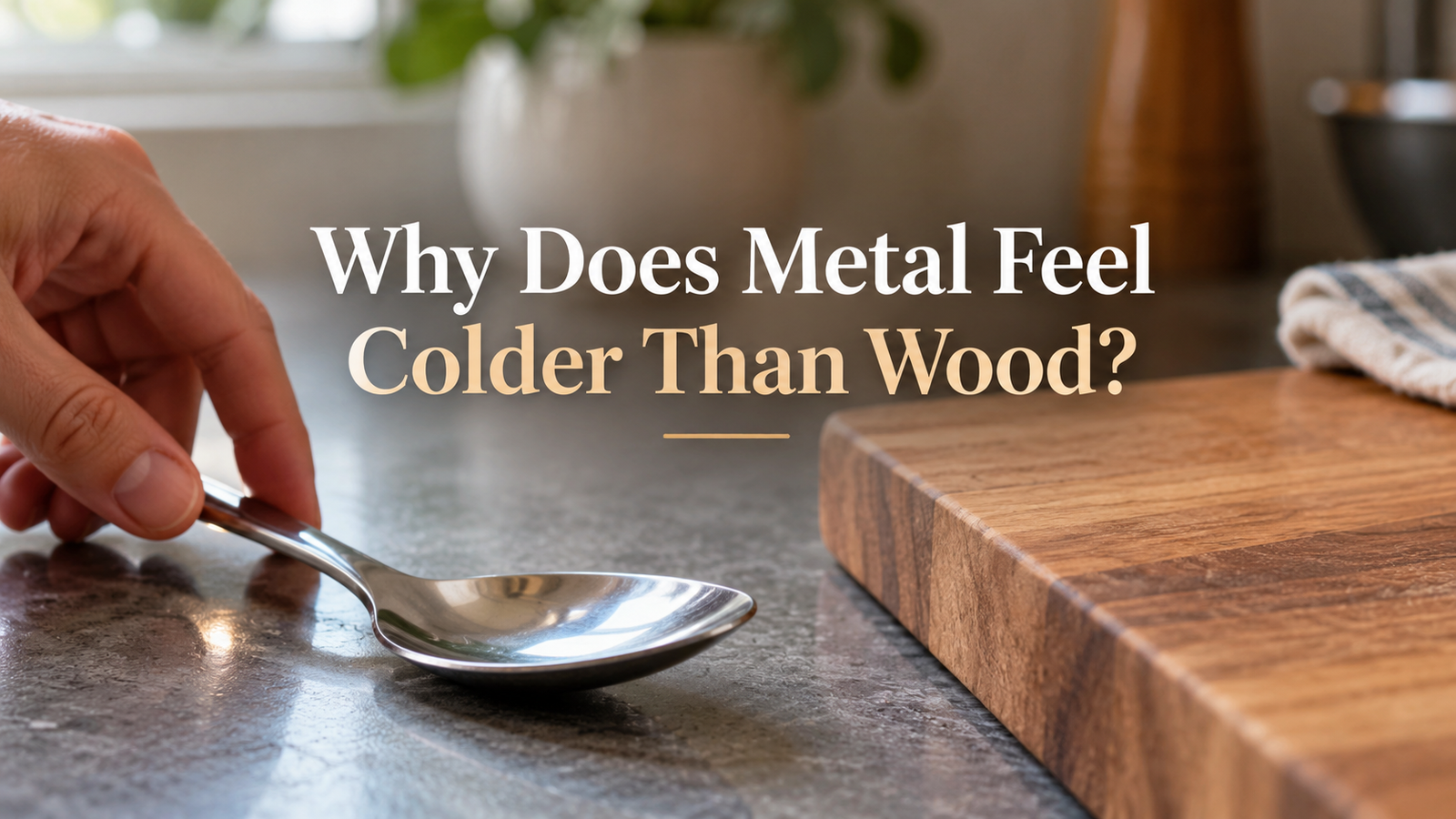
Have you ever touched a metal spoon and a wooden table in the same room and noticed that the metal feels much colder? This is a simple everyday experience, but it has an interesting scientific explanation. In most cases, the metal and the wood are actually at the same room temperature. The difference is in how quickly each material transfers heat from your hand.
The reason metal feels colder than wood is mainly connected to thermal conductivity. Metal is a good conductor of heat, while wood is a poor conductor. When you touch metal, heat leaves your warm hand quickly and moves into the metal. Your skin senses this rapid heat loss, so the metal feels cold. Wood removes heat from your hand much more slowly, so it feels warmer even when both materials are at exactly the same temperature.
Understanding this simple idea can help us learn a lot about heat transfer, insulation, materials, and even the way our sense of touch works.
Metal and Wood Can Be the Same Temperature
One of the most important things to understand is that something can feel colder without actually being colder.
Imagine a metal chair and a wooden chair sitting in the same room for several hours. If the room temperature is 22 degrees Celsius, both chairs will eventually become close to 22 degrees Celsius. However, when you touch them, the metal chair will probably feel much colder.
This happens because your skin does not directly measure the temperature of an object in the same way a thermometer does. Instead, your skin is very sensitive to the movement of heat.
Your body is usually warmer than room temperature. Human skin is often around 30 to 35 degrees Celsius depending on the surrounding conditions. When you touch an object that is cooler than your skin, heat begins to move from your hand into that object.
The faster this heat moves away from your skin, the colder the object feels.
What Is Thermal Conductivity?
Thermal conductivity is the ability of a material to transfer heat.
Materials with high thermal conductivity allow heat to move through them quickly. Materials with low thermal conductivity slow down the movement of heat.
Metals such as aluminum, copper, steel, and iron usually have relatively high thermal conductivity. This means heat can move through them easily.
Wood has much lower thermal conductivity. Heat moves through wood slowly.
When your hand touches metal, the heat from your skin is quickly carried away into the metal. New cooler parts of the metal continue receiving heat from your hand, so your skin keeps losing heat.
When you touch wood, the surface of the wood warms up near your hand. Because heat does not move through wood very quickly, the area touching your skin soon becomes warmer. This slows down further heat loss from your hand.
As a result, the wood feels warmer.
Why Does Our Skin Interpret Heat Loss as Cold?
Our skin contains temperature receptors that help us detect changes in temperature.
These receptors are part of the nervous system. They send signals to the brain when the skin becomes warmer or cooler.
When you touch a cool metal object, heat leaves your skin quickly. The temperature of the skin at the point of contact drops rapidly. Cold receptors respond to this change and send signals to your brain.
Your brain interprets those signals as a feeling of cold.
With wood, the skin temperature changes more slowly. Because heat is not removed as rapidly, the cold receptors are less strongly activated.
This is why the difference between metal and wood feels much greater than their actual temperature difference.
In many situations, there may be no temperature difference at all.
Why Is Metal Such a Good Conductor of Heat?
To understand why metal transfers heat so well, we need to look at its internal structure.
Metals contain electrons that can move relatively freely through the material. These mobile electrons help carry thermal energy from one region to another.
When one part of a metal object becomes warmer, energy spreads quickly through the metal.
This ability is one reason metals are useful in cooking equipment.
Pots and pans are often made from metals such as aluminum, copper, or stainless steel because heat can travel from the stove through the pan and into the food.
The same property that makes metal useful for cooking is also the reason it feels cold when you touch it in a cool room.
It quickly carries heat away from your hand.
Why Is Wood a Poor Conductor of Heat?
Wood has a very different structure.
It contains many tiny spaces that can trap air. Air is a poor conductor of heat. These air spaces reduce the speed at which thermal energy moves through the wood.
Wood is also made from organic materials such as cellulose, which do not transfer heat as efficiently as most metals.
Because of this, wood acts more like an insulator.
An insulator is a material that slows down heat transfer.
This is why wooden handles are commonly used on certain kitchen tools. A wooden handle does not transfer heat from a hot pot or utensil as quickly as a metal handle would.
The same property also makes wood feel less cold when you touch it.
A Simple Experiment You Can Try
You can easily test this idea at home.
Find a wooden object and a metal object that have been sitting in the same room for several hours. A metal spoon and a wooden spoon are good examples.
Touch each object with the same hand.
The metal spoon will probably feel colder than the wooden spoon.
Now use a room thermometer or another suitable temperature measuring device if available. You may find that both objects have almost the same temperature.
This simple experiment shows that our sense of temperature depends not only on the actual temperature of an object but also on the rate of heat transfer.
Heat Always Moves From Warmer to Cooler Areas
Heat naturally moves from a warmer region toward a cooler region.
If your hand is warmer than an object, thermal energy moves from your hand into the object.
If the object is warmer than your hand, heat moves from the object into your skin.
This explains another interesting effect.
Metal can also feel hotter than wood when both materials are heated to the same temperature.
Imagine a metal bench and a wooden bench sitting in strong sunlight.
If both become very warm, the metal can feel more painfully hot because it transfers heat into your skin faster.
So metal does not always feel colder.
It simply transfers heat more quickly.
When metal is cooler than your skin, it removes heat quickly and feels very cold.
When metal is hotter than your skin, it delivers heat quickly and feels very hot.
The Difference Between Temperature and Heat Transfer
Temperature and heat transfer are related, but they are not the same thing.
Temperature tells us about the thermal condition of a material. Heat transfer describes the movement of thermal energy from one place to another.
Two objects can have the same temperature but transfer heat at different speeds.
This is exactly what happens with metal and wood.
A thermometer gives us information about actual temperature.
Our skin gives us information about how rapidly our skin is gaining or losing heat.
This difference is one reason touch is not always a reliable method for measuring temperature.
Why Does Tile Also Feel Cold?
You may notice the same effect when walking barefoot on different floor surfaces.
A tile floor often feels colder than a carpet, even if both have been in the same room all night.
Tile conducts heat away from your feet much faster than carpet.
Carpet contains fibers and trapped air that act as insulation. Heat remains closer to your skin.
Tile, stone, and concrete are better heat conductors than carpet, so they remove heat from your feet more quickly.
The science is very similar to the reason metal feels colder than wood.
Why Does Carpet Feel Warm?
Carpet feels warm because it slows heat transfer.
The fibers in carpet trap small pockets of air. Air has low thermal conductivity, so heat does not escape from your feet very quickly.
This is also why blankets, jackets, and other insulating materials often contain trapped air.
They are not creating heat.
Instead, they reduce the rate at which heat leaves your body.
Wood behaves in a somewhat similar way compared with metal. It is not as insulating as thick fabric, but it still conducts heat much more slowly than most metals.
Why Does Metal Feel Especially Cold in Winter?
Metal often feels even colder during winter because surrounding temperatures are lower.
If a metal object is outside on a cold day, its temperature may be far below the temperature of your skin.
When you touch it, heat flows rapidly from your hand into the metal.
Because metal has high thermal conductivity, the heat loss can be very fast.
This produces a strong feeling of cold.
Wood at the same outdoor temperature will usually feel less cold because it removes heat from your skin more slowly.
This is one reason wooden surfaces can feel more comfortable than metal surfaces in cold environments.
Why Are Metal Tools Uncomfortable in Cold Weather?
People who work outdoors often notice that metal tools become uncomfortable to hold in winter.
A metal handle quickly pulls heat from the hand.
This is why many tools have handles covered with rubber, plastic, wood, or another insulating material.
These materials reduce heat transfer and make the tool more comfortable to hold.
Gloves work in a similar way. They create an insulating layer between your skin and the metal surface.
Instead of touching the metal directly, your hand is separated from it by materials that slow down heat loss.
How Insulation Changes What We Feel
Insulation plays a major role in our daily lives.
Wood, foam, fabric, rubber, and many plastics are useful because they reduce heat transfer.
Buildings often use insulating materials in walls and roofs to reduce unwanted heat movement.
In winter, insulation slows the escape of heat from inside the building.
In summer, it helps reduce the movement of outside heat into cooler indoor areas.
The principle is similar to what happens when you touch wood.
Slow heat transfer makes the surface feel less extreme.
Why Cooking Pans Are Usually Made of Metal
The high thermal conductivity of metal is very useful in the kitchen.
When a metal pan is placed on a hot stove, thermal energy moves quickly through the base and spreads across the pan.
This allows food to cook more evenly.
Some cookware uses aluminum or copper layers because these metals transfer heat very efficiently.
However, the handles of pans are often made from materials with lower thermal conductivity.
Plastic, silicone, or wood can reduce the amount of heat that reaches the hand.
This shows how different materials are chosen depending on whether fast or slow heat transfer is needed.
Does Every Metal Feel Equally Cold?
Not all metals conduct heat at exactly the same rate.
Copper is an excellent conductor of heat.
Aluminum is also a very good conductor.
Steel generally conducts heat less efficiently than copper or aluminum, but it still conducts heat much better than wood.
Because of these differences, different metals may feel slightly different when touched under the same conditions.
However, most metals still feel noticeably colder than wood at normal room temperature.
Can Wood Ever Feel Colder Than Metal?
Yes, under certain conditions.
If a piece of wood is actually colder than a piece of metal, the wood could feel colder.
For example, imagine wood kept in a freezer and metal kept inside a warm room. The frozen wood would obviously feel colder.
The common comparison between metal and wood assumes both objects are at approximately the same temperature.
Under equal temperature conditions, metal usually feels colder because it removes heat from the skin more quickly.
Why Touch Is Not a Perfect Thermometer
Our sense of touch is very useful, but it is not designed to provide an exact temperature reading.
The feeling of hot or cold depends on several factors, including the material, skin temperature, moisture, contact area, and speed of heat transfer.
For example, wet skin may feel colder because water can increase heat loss.
Wind can also increase cooling by carrying heat away from the body.
This is why scientific temperature measurements require thermometers rather than human touch.
A thermometer responds in a controlled way and gives a numerical reading.
Your skin mainly tells you how your body is interacting with the surrounding environment.
Everyday Examples of Thermal Conductivity
Once you understand why metal feels colder than wood, you can notice the same principle in many places.
Metal door handles often feel colder than wooden doors.
Stone countertops feel colder than wooden countertops.
Ceramic cups may feel cooler than foam cups.
Metal furniture feels colder than fabric covered furniture.
Concrete floors feel colder than rugs.
In all of these examples, the sensation depends strongly on how quickly heat moves between your skin and the material.
Final Thoughts
So, why does metal feel colder than wood?
The main reason is thermal conductivity.
Metal transfers heat much faster than wood. When you touch a metal object that is cooler than your skin, the metal quickly draws heat away from your hand. Your skin temperature falls rapidly, and your temperature receptors send strong cold signals to your brain.
Wood conducts heat much more slowly. The area touching your hand warms up quickly, which reduces further heat loss. Because your skin does not cool as rapidly, the wood feels warmer.
The interesting part is that the metal and wood may actually be at exactly the same temperature.
What you feel is not simply the temperature of the object. You are also feeling the speed at which heat moves between your body and the material.
This everyday experience is a simple but powerful example of how physics works around us. From metal spoons and wooden tables to tile floors and warm carpets, thermal conductivity helps explain why different materials can feel so different even when they share the same temperature.