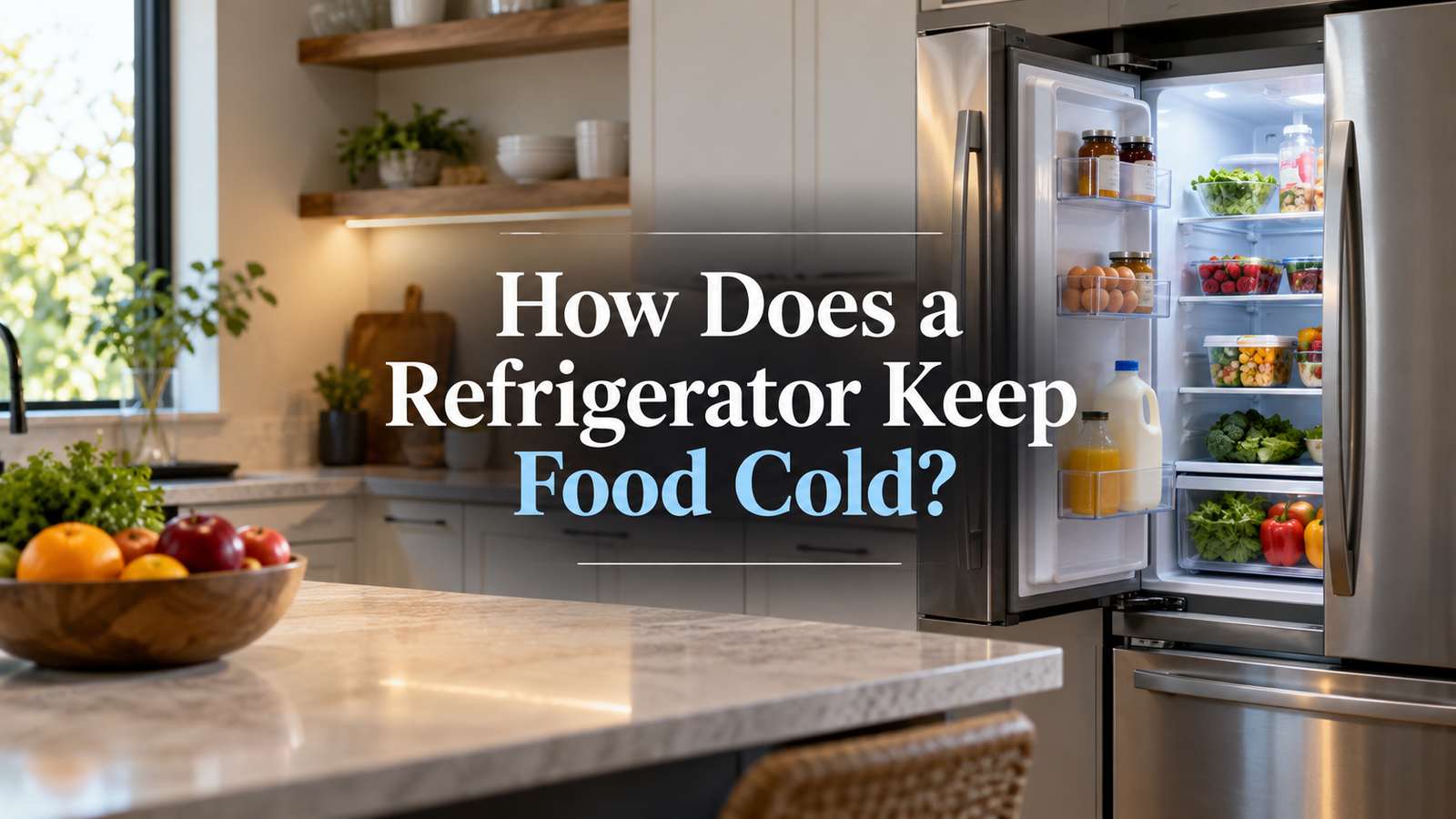
A refrigerator is one of the most useful appliances in everyday life. We open it many times a day to store milk, vegetables, fruits, cooked meals, drinks, eggs, and many other foods. It feels simple from the outside. We place food inside, close the door, and after some time everything becomes cold. But the science behind this process is more interesting than it may appear.
A refrigerator does not actually create cold air in the way people often imagine. Instead, it removes heat from inside the refrigerator and releases that heat into the surrounding room. This continuous movement of heat is the main reason a refrigerator can keep food cold.
Understanding how a refrigerator keeps food cold becomes easier when we look at the basic parts of the cooling system and the way they work together.
The Basic Idea Behind Refrigeration
Heat naturally moves from a warmer place to a cooler place. For example, if you place a warm glass of water in a cool room, the water gradually loses heat until its temperature becomes closer to the room temperature.
A refrigerator does something more difficult. It moves heat from a cold space to a warmer space. To make this happen, it uses electricity and a special cooling system.
The refrigerator takes heat from the food and air inside the cabinet. It then carries this heat through a closed system of pipes and releases it outside the refrigerator.
This process continues again and again as long as cooling is needed.
The Main Parts of a Refrigerator
Most modern refrigerators use a system known as the vapor compression refrigeration cycle. This system contains several important parts that work together.
The main components are the compressor, condenser coils, expansion device, evaporator coils, refrigerant, thermostat, and fans.
Each part has a specific role in moving heat from inside the refrigerator to the outside.
The Refrigerant Plays an Important Role
The refrigerant is a special substance that moves through pipes inside the refrigerator.
Its main purpose is to absorb and release heat as it changes between liquid and gas.
The ability of refrigerant to change state at useful temperatures makes it ideal for cooling systems.
When refrigerant evaporates, it absorbs heat. When it condenses back into a liquid, it releases heat.
This simple physical property is at the center of how a refrigerator works.
The Compressor Starts the Cooling Cycle
The compressor is often called the heart of the refrigerator.
It is usually located near the bottom at the back of the appliance. The compressor uses electricity to compress the refrigerant gas.
When the refrigerant enters the compressor, it is usually a low pressure gas. The compressor squeezes this gas into a smaller space.
As the gas is compressed, both its pressure and temperature increase.
The refrigerant then leaves the compressor as a hot, high pressure gas.
You may sometimes hear a humming sound from your refrigerator. This sound often comes from the compressor running.
The Condenser Releases Heat
After leaving the compressor, the hot refrigerant moves into the condenser coils.
These coils are usually found on the back of older refrigerators or underneath newer models.
The purpose of the condenser is to release heat into the surrounding room.
As the hot refrigerant travels through the condenser coils, heat moves from the refrigerant into the surrounding air.
The refrigerant gradually cools down.
As it loses heat, it changes from a high pressure gas into a high pressure liquid.
This is one reason the back or sides of a refrigerator may sometimes feel warm. The appliance is releasing heat that was removed from inside the refrigerator.
The Expansion Device Reduces Pressure
The liquid refrigerant then moves toward a small component known as the expansion valve or capillary tube.
This part creates a sudden drop in pressure.
When the pressure of the refrigerant falls, its temperature also decreases.
The refrigerant becomes a very cold mixture of liquid and vapor.
It is now ready to enter the part of the system where actual cooling takes place.
The Evaporator Absorbs Heat
The cold refrigerant next enters the evaporator coils.
These coils are usually located inside or behind the walls of the refrigerator and freezer compartments.
The air and food inside the refrigerator are warmer than the cold refrigerant.
Because of this temperature difference, heat moves from the refrigerator interior into the evaporator coils.
The refrigerant absorbs this heat and begins to evaporate.
As it changes from liquid into gas, it carries heat away from the refrigerator interior.
This is the main cooling stage of the refrigeration cycle.
The cold air produced around the evaporator is then distributed through the refrigerator compartment.
Fans Help Move Cold Air
Many modern refrigerators use fans to circulate air.
A fan near the evaporator moves cold air through vents into different parts of the refrigerator.
This helps maintain a more even temperature.
Without proper airflow, some parts of the refrigerator could become much colder than others.
The circulation of air is especially important in frost free refrigerators and large refrigerator freezer combinations.
When food containers block air vents, cooling may become less effective because the cold air cannot move freely.
The Refrigeration Cycle Repeats
After the refrigerant absorbs heat in the evaporator, it becomes a low pressure gas again.
This gas returns to the compressor.
The compressor compresses it once more, and the complete refrigeration cycle begins again.
The process can be summarized simply.
The compressor raises the pressure of the refrigerant.
The condenser releases heat outside the refrigerator.
The expansion device lowers the refrigerant pressure and temperature.
The evaporator absorbs heat from inside the refrigerator.
The refrigerant then returns to the compressor.
This cycle can repeat many times throughout the day.
How the Thermostat Controls Temperature
A refrigerator does not need to cool continuously.
A thermostat or electronic temperature sensor monitors the temperature inside the refrigerator.
When the temperature rises above the selected level, the cooling system switches on.
The compressor begins working and heat is removed from the refrigerator.
Once the desired temperature is reached, the thermostat tells the compressor to stop.
The refrigerator remains off until the temperature begins rising again.
This automatic control helps save electricity and prevents the refrigerator from becoming unnecessarily cold.
Why Food Stays Fresh Longer in a Refrigerator
Keeping food cold slows many of the natural processes that cause food to spoil.
Microorganisms such as bacteria and molds grow more slowly at low temperatures.
Chemical reactions inside food also occur more slowly.
For example, fruits and vegetables continue to undergo biological changes after they are harvested. Refrigeration slows these processes and helps preserve freshness for a longer period.
Cold storage does not completely stop spoilage, but it can slow it considerably.
This is why food should still be stored properly and used within a reasonable period.
Why the Refrigerator Door Is Important
The refrigerator door helps separate the cold interior from the warmer room.
Around the edge of the door there is usually a flexible rubber seal known as a gasket.
This gasket prevents warm air from entering and cold air from escaping.
If the gasket becomes damaged or loose, the refrigerator may need to work harder.
Warm air entering the cabinet also carries moisture. This moisture can lead to frost or condensation inside the appliance.
Keeping the door closed as much as possible improves cooling efficiency.
What Happens When You Open the Refrigerator Door?
Every time the refrigerator door opens, some cold air escapes and warmer room air enters.
The temperature inside begins to rise slightly.
The thermostat detects this change and may turn the compressor on again.
If the door is opened frequently or left open for a long period, the refrigerator uses more energy to restore the correct temperature.
This is why quickly taking out what you need can help improve energy efficiency.
Why a Refrigerator Feels Warm on the Outside
People are sometimes surprised when the sides or back of a refrigerator feel warm.
This is usually normal.
Remember that the refrigerator is removing heat from inside and releasing it outside.
The condenser coils must give off this heat.
Some newer refrigerators place condenser tubing inside the outer walls of the appliance. Because of this design, the sides may feel slightly warm during operation.
The warmth is evidence that heat is being transferred out of the refrigerator.
The Difference Between a Refrigerator and a Freezer
A refrigerator and freezer use the same basic cooling principle.
The main difference is temperature.
A refrigerator normally keeps food cool enough to slow spoilage while preventing most foods from freezing.
A freezer operates at a much lower temperature so that water inside food freezes.
Freezing slows biological and chemical activity even more than refrigeration.
In many appliances, one refrigeration system provides cooling for both the freezer and refrigerator compartments.
Airflow controls help distribute the correct amount of cold air to each section.
How Frost Free Refrigerators Work
Older refrigerators sometimes develop thick layers of ice around the freezer coils.
Modern frost free refrigerators reduce this problem by using an automatic defrost system.
A heater periodically warms the evaporator coils just enough to melt frost.
The melted water flows into a small drain and usually collects in a tray near the bottom of the refrigerator.
Heat from the compressor and surrounding air causes this water to evaporate gradually.
The cooling cycle then starts again.
This automatic process helps keep air passages clear and maintains good cooling performance.
Why Refrigerator Temperature Matters
Food safety depends partly on proper temperature.
If the refrigerator becomes too warm, bacteria can grow more quickly.
If it becomes too cold, some foods may freeze or lose their texture.
A well functioning refrigerator maintains a stable cool environment.
The exact temperature may vary slightly depending on the model and settings, but the goal is to keep food consistently cold without unnecessary freezing in the main refrigerator compartment.
The freezer is kept much colder so that frozen foods remain solid.
Why Overloading a Refrigerator Can Reduce Cooling
A refrigerator needs proper airflow to work efficiently.
If every shelf is completely packed, cold air may have difficulty moving between food containers.
Some areas may stay warmer than others.
Leaving small spaces between items can improve air circulation.
At the same time, a completely empty refrigerator can also experience faster temperature changes when the door opens.
A reasonable amount of stored food can help maintain a more stable internal temperature.
Why Hot Food Affects Refrigerator Cooling
Placing a large amount of very hot food inside the refrigerator adds extra heat.
The cooling system must remove this heat before the internal temperature can return to normal.
This causes the compressor to run longer.
Food should still be stored safely, but allowing extremely hot dishes to cool slightly before refrigeration can reduce the immediate cooling load.
The important point is not to leave perishable food at room temperature for an unsafe period.
How Insulation Helps Keep Food Cold
The walls of a refrigerator contain insulating material.
Insulation slows the movement of heat from the room into the cold refrigerator compartment.
Without insulation, outside heat would enter very quickly, and the compressor would need to operate almost continuously.
Good insulation allows the refrigerator to maintain a cold temperature using less energy.
The thick walls of the appliance therefore play an important role in energy efficiency.
Why Cleaning the Refrigerator Coils Can Help
Dust can collect around condenser coils, especially when they are located underneath or behind the refrigerator.
A thick layer of dust can reduce the ability of the coils to release heat.
When heat cannot escape easily, the refrigerator may need to work harder.
Keeping the area around the condenser clean can support efficient operation.
The exact cleaning method depends on the refrigerator design, so the manufacturer’s instructions should always be followed.
Why Refrigerators Use Electricity
Electricity mainly powers the compressor, fans, lights, sensors, and control system.
The compressor requires the largest share of energy because it must increase the pressure of the refrigerant.
The refrigerator does not convert electricity directly into cold.
Instead, electrical energy allows the system to move heat against its natural direction.
This is an important difference.
A refrigerator is essentially a heat moving machine.
Simple Example of How Refrigeration Works
Imagine you place a bowl of warm fruit inside a refrigerator.
The fruit contains heat.
Air around the fruit absorbs some of this heat and becomes warmer.
The warm air moves toward the evaporator area.
The cold refrigerant inside the evaporator absorbs the heat.
The refrigerant then travels through the system and carries that heat outside.
The condenser releases the heat into your kitchen.
After enough heat has been removed, the fruit becomes cold.
The refrigerator has not added coldness to the fruit. It has simply removed heat from it.
Final Thoughts
A refrigerator keeps food cold by continuously moving heat from inside the appliance to the surrounding room.
The process depends on a refrigerant that travels through a closed system.
The compressor increases refrigerant pressure. The condenser releases heat. The expansion device lowers pressure and temperature. The evaporator absorbs heat from food and air inside the refrigerator.
Fans circulate cool air, insulation slows outside heat from entering, and the thermostat controls when the cooling system operates.
All of these parts work together in a repeating cycle.
Once the basic idea is understood, the refrigerator becomes much easier to explain. It does not produce cold in the ordinary sense. Instead, it removes heat from a protected space and sends that heat somewhere else.
That simple principle is what allows a refrigerator to keep food cold, slow spoilage, preserve freshness, and safely store many of the foods we use every day.