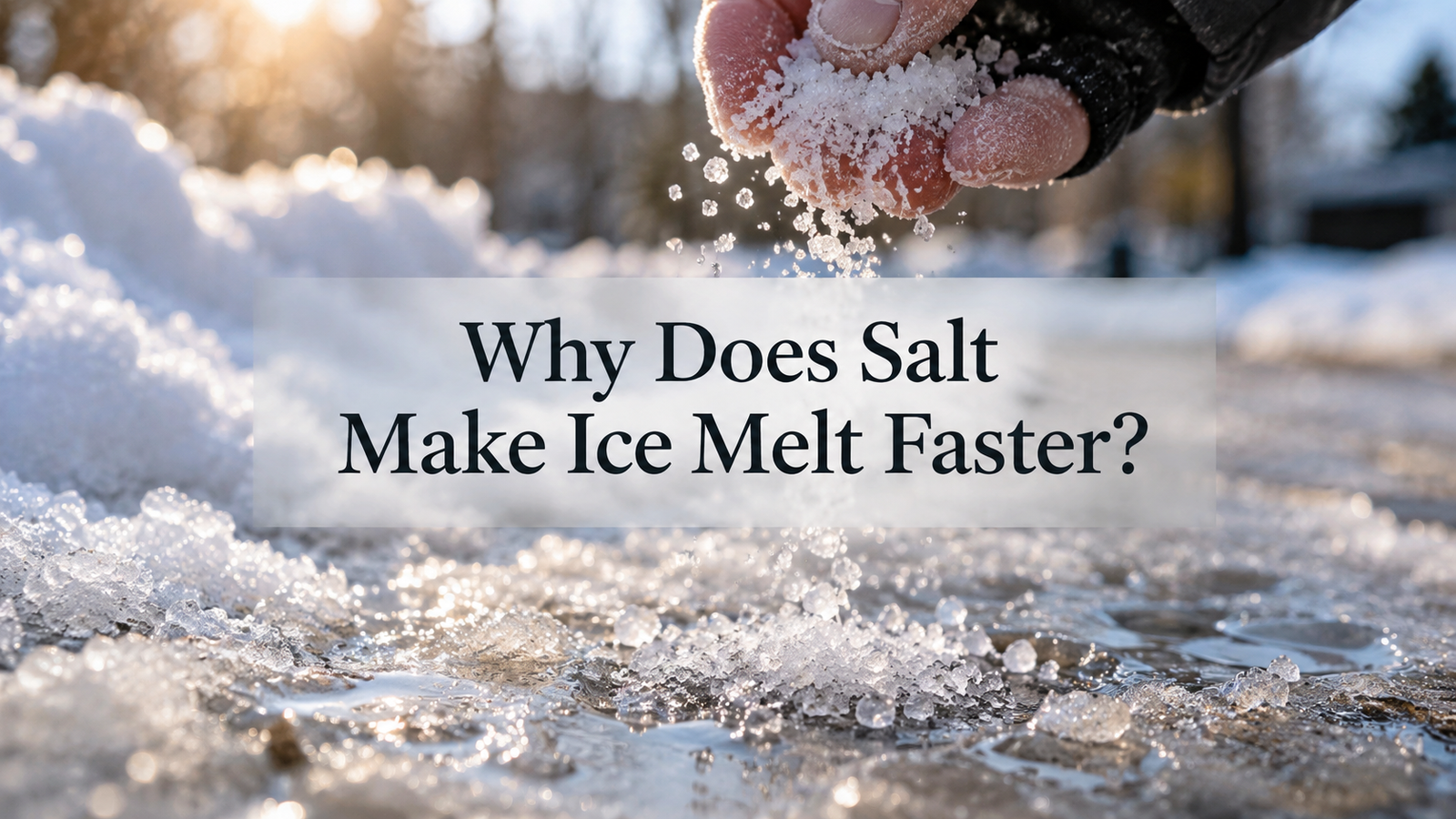
If you have ever seen salt being spread on an icy road or sidewalk, you may have wondered why it works so well. At first glance, it seems strange that a small amount of ordinary salt can help turn solid ice into liquid water. The reason comes down to a simple but fascinating scientific process. Salt lowers the freezing point of water, which makes it harder for water to remain frozen at temperatures where pure water would normally turn into ice.
Understanding why salt makes ice melt faster is a useful way to learn about freezing points, water molecules, temperature, and how different substances interact. It is also a good example of how basic science is used in everyday life, especially during cold weather.
What Happens When Water Freezes?
To understand why salt melts ice, it helps to first understand how water freezes.
Water is made of tiny molecules that are always moving. When water is warm, these molecules move relatively freely. As the temperature drops, their movement slows down.
At around 0 degrees Celsius, pure water can begin changing from liquid water into solid ice. During this process, the water molecules arrange themselves into an organized structure. This structure forms the solid material that we call ice.
However, freezing and melting can happen at the same time. Even when a piece of ice looks completely solid, some molecules at its surface are constantly moving between the solid and liquid states.
If the temperature is low enough, freezing becomes more dominant. If conditions change and melting becomes more favorable, more ice turns into water.
Salt changes this balance.
How Does Salt Make Ice Melt Faster?
Salt makes ice melt faster mainly because it lowers the freezing point of water.
When salt is placed on ice, some of the ice surface begins to melt naturally. This creates a very thin layer of liquid water. The salt dissolves in this water and forms a salty solution known as brine.
This salt water does not freeze as easily as pure water.
Pure water normally freezes at about 0 degrees Celsius. Salt water, however, can remain liquid at temperatures below 0 degrees Celsius. Because the freezing point has been lowered, some of the ice must melt in order for the water and salt mixture to reach a new balance.
This is why ice begins melting when salt is added.
The scientific term for this process is freezing point depression.
What Is Freezing Point Depression?
Freezing point depression means that adding certain substances to water lowers the temperature at which the water freezes.
Salt is one of the most common examples.
When salt dissolves in water, it separates into electrically charged particles called ions. Ordinary table salt is mainly sodium chloride. When sodium chloride dissolves, it separates into sodium ions and chloride ions.
These particles spread throughout the water and interfere with the ability of water molecules to arrange themselves into the organized structure needed to form ice.
As a result, the water must become colder before it can freeze.
This is the basic reason salt makes ice melt faster.
Why Does Ice Start Melting Even When the Air Is Cold?
Many people assume that ice can only melt when the surrounding temperature rises above 0 degrees Celsius. However, salt makes it possible for ice to melt even when the air temperature is below freezing.
Imagine that the temperature outside is minus 3 degrees Celsius.
Pure water would normally freeze at this temperature. But if enough salt is mixed with the water, the freezing point may drop below minus 3 degrees Celsius.
Now the temperature is no longer cold enough for the salty water to remain completely frozen. Some of the ice melts and produces more liquid water.
This is why road salt can work during winter even when outdoor temperatures are below the normal freezing point of water.
Why Does Salt Need Some Liquid Water?
Salt cannot work effectively without at least a small amount of liquid water.
Fortunately, the surface of ice usually contains a microscopic layer of water. This happens because molecules at the surface of ice are less tightly held than molecules deeper inside the solid.
When salt touches this thin layer of water, it begins dissolving.
Once the salt dissolves, it creates brine. The brine has a lower freezing point than pure water, so more ice melts. This produces even more liquid water, allowing more salt to dissolve.
The process continues as long as the temperature and salt concentration allow it.
Does Salt Actually Heat the Ice?
Salt does not melt ice by directly heating it.
This is an important point because it is easy to imagine that the salt somehow produces heat. Instead, salt changes the physical conditions under which water freezes.
The salt interferes with the freezing process and lowers the freezing temperature of the water.
In fact, when ice melts, it absorbs heat from its surroundings. This means that a mixture of ice and salt can sometimes become colder than the original ice.
This effect is useful in certain scientific experiments and traditional methods of making ice cream.
Why Is Salt Used on Icy Roads?
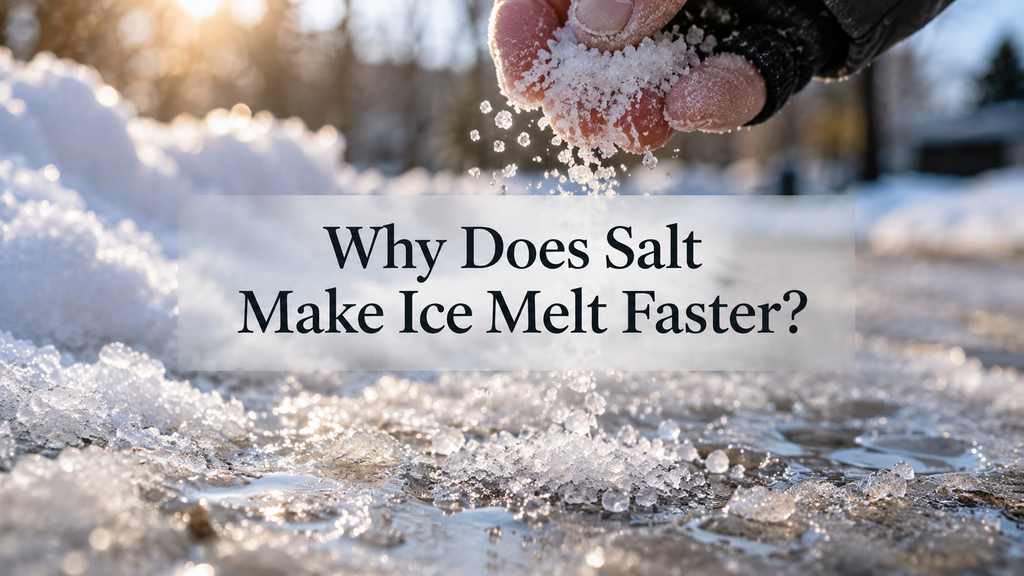
One of the most familiar uses of salt is removing ice from roads, sidewalks, driveways, and parking areas.
During cold weather, water on a road may freeze and create a slippery surface. Vehicles can lose traction, while pedestrians may have difficulty walking safely.
Spreading salt helps create a salty water solution on the surface.
Because this solution freezes at a lower temperature than ordinary water, existing ice may begin to melt. Salt can also make it more difficult for additional water to freeze under suitable temperature conditions.
This can improve road conditions and make travel safer.
However, salt is not equally effective at every temperature.
Does Salt Work in Extremely Cold Weather?
Salt becomes less effective as temperatures fall.
Ordinary sodium chloride works best when temperatures are only moderately below freezing. At very low temperatures, it becomes much more difficult for enough liquid water to exist for the salt to dissolve and form brine.
When conditions become extremely cold, road maintenance teams may use other materials such as calcium chloride or magnesium chloride.
These substances can lower the freezing point of water more effectively under colder conditions.
The basic scientific idea is still the same. Dissolved particles make it harder for water to freeze.
Why Does Crushed Ice Melt Faster With Salt?
If salt is added to crushed ice, melting can happen quickly because crushed ice has a larger surface area.
A large solid block of ice exposes only its outer surface to the salt. Crushed ice consists of many smaller pieces, creating much more surface area.
This gives the salt more opportunities to come into contact with thin layers of liquid water on the ice.
As more salt dissolves, more brine forms, which encourages additional melting.
This is one reason salt and crushed ice are often used together in science demonstrations.
Why Does Salt Make an Ice Mixture Colder?
One of the most interesting effects of adding salt to ice is that the mixture may become colder even though the ice is melting.
Melting requires energy.
When solid ice changes into liquid water, it absorbs heat from its surroundings. If salt causes additional ice to melt, more heat is absorbed.
As a result, the temperature of the mixture may fall.
This principle was traditionally used when making homemade ice cream. Ice and salt were placed around a container holding the ice cream mixture. The salty ice mixture became cold enough to freeze the ingredients inside the container.
So even though salt causes ice to melt, the melting process can produce a very cold environment.
Does Sugar Melt Ice Too?
Salt is not the only substance that can lower the freezing point of water.
Sugar can also lower the freezing point when it dissolves in water. However, salt is generally more effective because of the way it separates into multiple particles when dissolved.
When sodium chloride dissolves, it forms sodium ions and chloride ions. This produces more dissolved particles than the same number of sugar molecules.
The number of dissolved particles plays an important role in determining how much the freezing point changes.
This is why salt is commonly used for melting ice rather than sugar.
What Type of Salt Works Best?
Different salts can have different effects on ice.
Sodium chloride is the most common because it is widely available and relatively inexpensive. This is the same basic chemical found in ordinary table salt, although road salt usually has a much less refined form.
Calcium chloride is another common option. It can work at lower temperatures and is often more effective in very cold weather.
Magnesium chloride is also used for ice control.
Each material has advantages and disadvantages depending on temperature, cost, environmental impact, and the surface where it is being used.
Can Too Much Salt Be Harmful?
Although salt is useful for controlling ice, using large amounts can create environmental problems.
Salt can wash away from roads when snow and ice melt. The salty water may enter soil, streams, lakes, and groundwater.
High salt levels can affect plants and freshwater organisms.
Road salt can also contribute to corrosion. It may damage metal parts on vehicles, bridges, and other structures over time.
For this reason, many communities try to use salt carefully and combine it with other winter road management methods.
Sand, for example, does not melt ice in the same way, but it can improve traction on slippery surfaces.
A Simple Experiment You Can Try
The effect of salt on ice can easily be observed at home.
Place two similar ice cubes on separate plates. Leave one ice cube alone and sprinkle some salt on the other.
Watch both ice cubes for several minutes.
You will usually notice that the salted ice cube begins developing small channels, holes, or pools of water more quickly.
The salt dissolves in the thin layer of water around the ice. This creates salt water with a lower freezing point. As a result, more of the ice melts.
The experiment provides a simple visual example of freezing point depression.
Why Is This Scientific Principle Important?
The science behind salt and ice may seem simple, but it connects to several important ideas in chemistry and physics.
It demonstrates how dissolved substances can change the physical properties of liquids.
It also shows that freezing is not controlled by temperature alone. The chemical composition of the water also matters.
This same general principle appears in many areas of daily life and science, including food preparation, transportation, laboratory experiments, and environmental studies.
Learning why salt makes ice melt faster gives us a better understanding of how small changes at the molecular level can produce effects that are easy to see in the real world.
Final Thoughts
So, why does salt make ice melt faster?
The main reason is that salt lowers the freezing point of water. When salt dissolves in the thin layer of water on the surface of ice, it forms a salty solution. This solution must reach a lower temperature than pure water before it can freeze.
Because the surrounding temperature may now be too warm for the salty water to stay frozen, some of the ice melts.
Salt does not simply warm the ice. Instead, it changes the conditions required for freezing. This process is known as freezing point depression.
It is a simple scientific idea with very practical uses. Every time salt is spread on an icy sidewalk or winter road, chemistry is working at the molecular level.
What looks like ordinary salt melting a piece of ice is actually a clear example of how temperature, water molecules, and dissolved particles interact. It is one of those everyday scientific processes that becomes much more interesting once we understand what is happening beneath the surface.