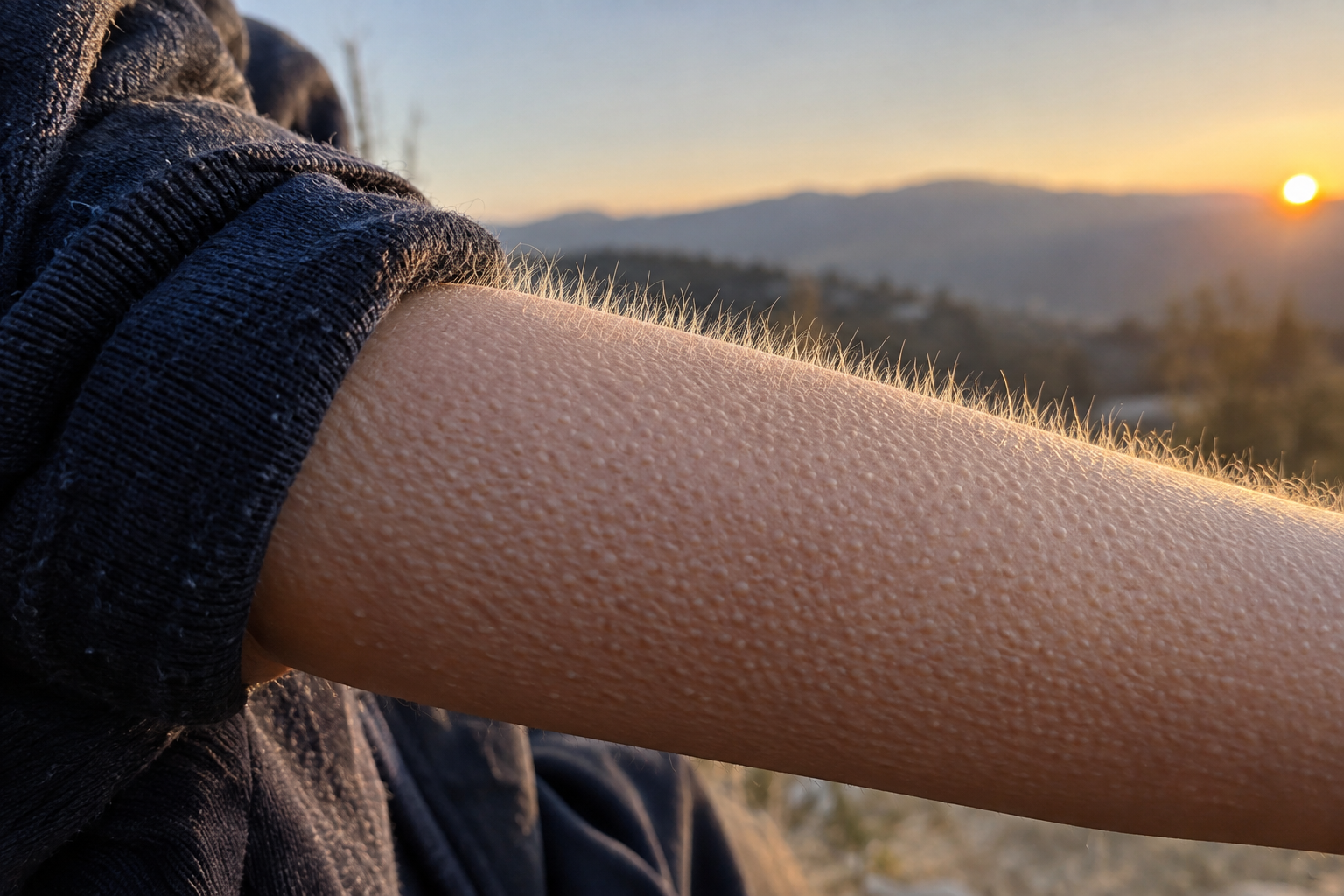
Have you ever stepped outside on a cold morning and suddenly noticed tiny bumps appearing all over your arms? Or perhaps you were listening to a powerful song, watching an emotional movie, or hearing a frightening sound when your skin suddenly changed. Those little bumps are called goosebumps.
Goosebumps are one of the most familiar reactions of the human body, yet many people never stop to think about why they happen. They seem simple, but behind them is an interesting combination of nerves, muscles, hormones, emotions, and human evolution.
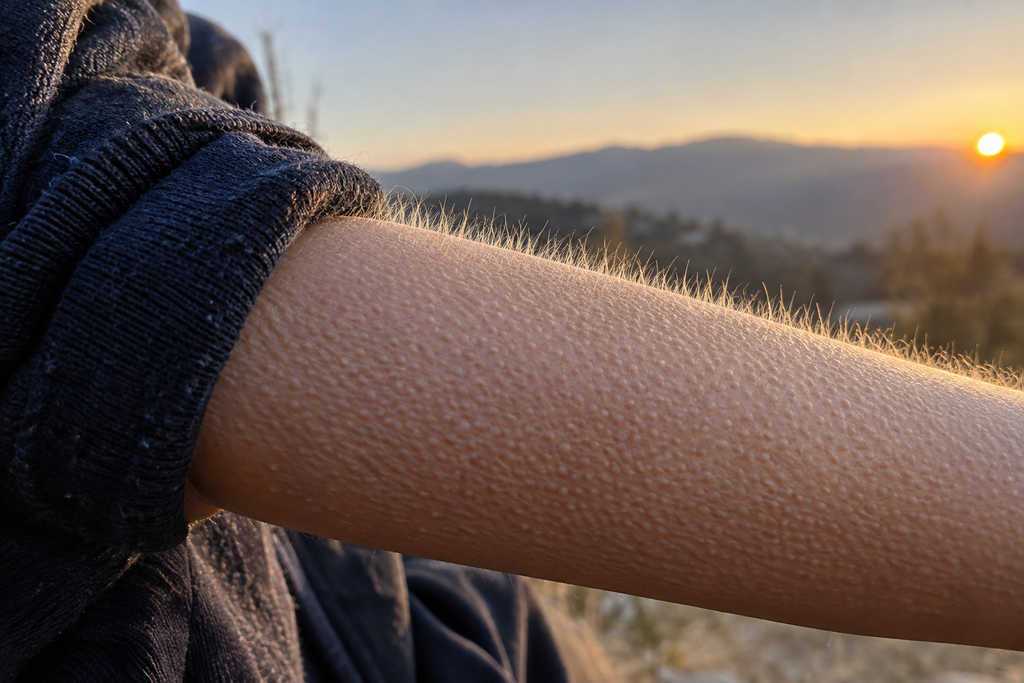
The scientific name for goosebumps is piloerection. They appear when very small muscles connected to our hair follicles contract. This causes the hairs on the skin to stand upright and produces the tiny raised bumps that we can easily see and feel.
Although goosebumps are common, their original purpose goes back millions of years. Our distant ancestors had much more body hair than modern humans. For them, this reaction was far more useful than it is for us today.
Understanding why we get goosebumps gives us a fascinating look at how the human nervous system works and how some ancient survival mechanisms are still present inside our bodies.
What Are Goosebumps?
Goosebumps are small raised areas that appear on the surface of the skin when tiny muscles at the base of hair follicles tighten.
Every hair on the body grows from a small structure called a hair follicle. Attached to many of these follicles is a tiny muscle known as the arrector pili muscle.
When this muscle contracts, it pulls the hair upward. At the same time, the surrounding skin becomes slightly raised. This creates the bumpy appearance that we commonly call goosebumps.
The name comes from the appearance of the skin after the reaction occurs. It looks similar to the skin of a plucked goose or chicken.
Goosebumps can appear on many parts of the body, but they are often easiest to notice on the arms, legs, neck, and back.
The reaction usually lasts for only a short time. Once the trigger disappears, the muscles relax and the skin returns to normal.
Why Does Cold Weather Cause Goosebumps?
Cold temperature is probably the most common cause of goosebumps.
When your body senses that the environment is cold, your nervous system automatically begins trying to conserve heat.
One of the reactions is the tightening of the small muscles connected to your hair follicles.
In animals with thick fur, this reaction is very useful. When their hairs stand upright, more air becomes trapped between the hairs. This layer of trapped air acts like insulation and helps keep the body warm.
Humans have much less body hair, so the warming effect is very small. Even so, the same biological reaction still exists.
This is why your arms may suddenly become covered with goosebumps when you walk into a cold room or feel a cold breeze.
Your body is using an ancient response that once helped our ancestors stay warmer.
The Role of the Nervous System
Goosebumps are controlled by the autonomic nervous system.
This part of the nervous system manages many body functions without requiring conscious thought.
For example, it helps control heart rate, breathing, digestion, sweating, and changes in blood vessels.
The autonomic nervous system has different branches. One important part is the sympathetic nervous system.
The sympathetic nervous system becomes active during stressful, exciting, frightening, or physically demanding situations.
When this system is activated, nerves send signals to the small muscles connected to hair follicles. These muscles contract and goosebumps appear.
You do not have to think about producing goosebumps. The reaction happens automatically.
This is why you cannot normally make goosebumps appear simply by deciding that you want them.
Why Does Fear Cause Goosebumps?
Cold is not the only reason goosebumps appear. Strong fear can also trigger them.
Imagine walking alone at night and suddenly hearing a strange sound behind you.
Your brain immediately begins checking whether the sound could represent danger.
If the brain believes that there may be a threat, the sympathetic nervous system becomes active.
This is part of the body’s famous fight or flight response.
During this reaction, your heart may beat faster, your breathing may increase, your muscles may become tense, and hormones such as adrenaline may be released.
Goosebumps can appear at the same time.
For our distant ancestors, standing hair may have helped them look larger when facing danger.
We can still see this reaction clearly in animals today.
A frightened cat may raise the hair along its back and tail. This makes the animal appear bigger and possibly more threatening to an attacker.
Humans no longer have thick fur, but the same ancient response can still appear when we feel fear.
Why Does Music Give Us Goosebumps?
One of the most interesting causes of goosebumps is music.
Many people have experienced a moment when a song becomes so powerful or emotional that chills move through the body and goosebumps appear.
Researchers often describe this feeling using the word frisson.
Frisson refers to a sudden strong emotional sensation that may include chills, tingling, or goosebumps.
Music can create this response when it produces intense emotion.
For example, a sudden change in melody, an unexpected harmony, a powerful voice, or a dramatic increase in volume can affect the brain strongly.
Certain parts of the brain involved in pleasure and reward may become active.
At the same time, the autonomic nervous system can respond, causing physical effects such as faster heartbeat, chills, and goosebumps.
This shows how closely emotions and physical reactions are connected.
A sound entering your ears can create changes in your brain that eventually become visible on your skin.
Emotional Goosebumps
Music is only one example of an emotional trigger.
Goosebumps can appear during many powerful emotional experiences.
A person may get goosebumps while listening to an inspiring speech, seeing someone achieve an important goal, watching a dramatic movie, remembering an emotional event, or witnessing something beautiful.
People sometimes describe these experiences as moving, touching, or overwhelming.
The exact brain processes are complex, but strong emotional stimulation can activate parts of the nervous system that also control goosebumps.
This is another example of how emotions can produce real physical changes in the body.
The Evolutionary Purpose of Goosebumps
To understand goosebumps fully, we need to think about human evolution.
Modern humans have relatively little body hair compared with many other mammals.
Our distant ancestors, however, had much more hair covering their bodies.
When their arrector pili muscles contracted, the hair stood upright.
This may have provided two important advantages.
The first advantage was warmth.
Raised hair could trap air close to the skin and create a layer of insulation.
The second advantage was protection.
Standing hair could make an individual appear larger during a dangerous situation.
Both effects would have been useful for survival.
As humans evolved and lost much of their body hair, goosebumps became less useful.
However, the nerves and muscles responsible for the reaction remained.
This is why humans still experience goosebumps even though they provide little practical benefit today.
Why Did Humans Lose Most of Their Body Hair?
This raises another interesting question. If body hair was useful, why did humans lose so much of it?
Scientists have proposed several explanations.
One important idea is related to temperature control.
Early humans often traveled long distances and lived in warm environments. Having less body hair may have allowed sweat to evaporate more efficiently.
Sweating is an extremely effective way to cool the human body.
If thick hair covered the skin, sweat would not evaporate as easily.
Over many generations, reduced body hair may have improved the ability of humans to stay cool during physical activity.
Humans still kept hair in certain areas, including the scalp, eyebrows, eyelashes, and parts of the body where hair may provide protection or other advantages.
The goosebump response survived even after most thick body hair disappeared.
What Happens Inside the Skin?
The physical process behind goosebumps happens very quickly.
First, the brain detects a trigger.
The trigger may be cold temperature, fear, excitement, music, or another strong emotional experience.
Next, the sympathetic nervous system sends signals through nerves in the skin.
These signals reach the arrector pili muscles attached to hair follicles.
The muscles contract.
As they tighten, the hair follicles are pulled slightly upward.
The hairs rise and the nearby skin forms small bumps.
All of this can happen within seconds.
Once the nervous signal decreases, the muscles relax and the skin becomes smooth again.
Are Goosebumps Different From Chills?
People sometimes use the words goosebumps and chills as if they mean exactly the same thing, but they are slightly different.
Goosebumps refer specifically to the raised bumps created when the small muscles around hair follicles contract.
Chills are a broader sensation.
A person may feel cold, shiver, or experience a wave moving through the body.
Chills can occur with goosebumps, but they do not always have to occur together.
For example, emotional music may cause goosebumps without making you feel physically cold.
Similarly, someone with a fever may experience strong chills and shivering.
Why Do We Shiver When We Are Cold?
Shivering is another body response designed to generate heat.
When muscles rapidly contract and relax, they produce heat.
This helps raise body temperature.
Goosebumps and shivering can therefore happen at the same time when a person becomes cold.
However, they work in different ways.
Goosebumps originally helped raise body hair and trap warm air.
Shivering produces heat through repeated muscle activity.
Together, these reactions are part of the body’s temperature control system.
Can Everyone Get Goosebumps?
Most people can experience goosebumps.
However, the strength of the reaction may vary from person to person.
Some people easily get goosebumps from music, films, memories, or emotional situations.
Others rarely notice this reaction.
Differences in nervous system sensitivity, emotions, personality, environment, and genetics may influence how strongly people respond.
Goosebumps may also be easier to see on some types of skin depending on hair thickness and other physical differences.
Can You Control Goosebumps?
For most people, goosebumps are automatic.
Because they are controlled by the autonomic nervous system, we do not normally control them directly.
However, some people claim they can voluntarily create goosebumps.
Researchers have studied a small number of individuals who appear able to trigger the reaction intentionally.
This ability seems to be unusual.
Most people experience goosebumps only when the nervous system responds to a trigger.
Why Are Goosebumps Called Goosebumps?
The name is surprisingly simple.
When the feathers are removed from a goose, the skin contains many small raised bumps where the feathers once grew.
Human skin with goosebumps looks similar.
Different languages have their own terms for this reaction, and many of them compare the appearance to the skin of birds.
The medical term, however, is piloerection.
“Pilo” refers to hair, while “erection” refers to the hair becoming upright.
Can Goosebumps Be a Sign of Illness?
In normal situations, goosebumps are completely harmless.
They usually occur because of cold temperatures or strong emotions.
However, chills and goosebumps can sometimes appear when someone is sick, especially during fever.
When the body is fighting an infection, the brain may temporarily adjust the body’s temperature target.
This can make a person feel unusually cold even if their actual body temperature is rising.
As a result, shivering and goosebumps may occur.
Occasional goosebumps by themselves are normally nothing to worry about.
If they appear along with serious symptoms such as high fever, severe weakness, breathing difficulty, confusion, or persistent illness, medical advice may be needed.
Why Do Goosebumps Sometimes Appear Without Cold or Fear?
Sometimes people notice goosebumps even when the temperature seems comfortable and nothing frightening is happening.
This may be caused by subtle emotional or sensory triggers.
A memory, a sound, a thought, a smell, or even the anticipation of something exciting can activate the nervous system.
Sometimes the trigger happens so quickly that we do not consciously recognize it.
The body can react before we fully understand why.
This shows how sensitive the nervous system can be.
Goosebumps and Human Emotions
Goosebumps provide an interesting connection between the mind and the body.
We often think of emotions as something that happens only inside the brain.
In reality, emotions can affect almost every part of the body.
Fear can increase heart rate.
Embarrassment can make the face turn red.
Stress can cause sweating.
Sadness can bring tears.
Excitement can create butterflies in the stomach.
And powerful emotions can cause goosebumps.
These reactions remind us that the brain and body are constantly communicating with each other.
Why Goosebumps Are Still Interesting to Scientists
Even though goosebumps seem simple, researchers continue to study them.
They can provide information about how the nervous system reacts to emotions, temperature, and stimulation.
Scientists are also interested in the connection between hair follicles, nerves, and the muscles surrounding them.
Research into these systems may help scientists better understand skin biology and the way the nervous system interacts with different tissues.
Goosebumps are therefore more than just a strange skin reaction.
They are a visible sign of complicated processes happening inside the body.
Common Questions About Goosebumps
Why do we get goosebumps when we are cold?
Cold temperatures activate the sympathetic nervous system. Tiny muscles connected to hair follicles contract, making the hairs stand upright and creating goosebumps.
Why do we get goosebumps when listening to music?
Strong emotional responses to music can activate the brain’s reward system and the autonomic nervous system. This can produce chills and goosebumps.
Are goosebumps useful for humans?
They are much less useful today because humans have relatively little body hair. In our ancestors, raised hair probably helped trap warm air and made the body appear larger during danger.
What is the scientific name for goosebumps?
The scientific term is piloerection.
Are goosebumps harmful?
Normal goosebumps caused by cold or emotion are harmless.
Why do animals get goosebumps too?
Many mammals have the same basic response. Their hair or fur stands upright, helping conserve heat or making the animal appear larger.
Interesting Facts About Goosebumps
One interesting fact is that goosebumps are controlled by muscles that are among the smallest muscles in the human body.
Another fascinating fact is that the same general reaction can be seen across many different mammals.
Cats, dogs, rodents, and other animals can raise their fur when cold or threatened.
Humans retained the same system even though most of our thick body hair disappeared during evolution.
Goosebumps also show how quickly the brain can affect the skin.
A single sound, memory, or emotional moment can produce a visible physical reaction within seconds.
Final Thoughts
So, why do we get goosebumps?
The answer involves both biology and evolution.
Goosebumps appear when tiny muscles attached to our hair follicles contract. These muscles are controlled by the sympathetic nervous system and can react to cold temperatures, fear, excitement, music, memories, and other strong emotions.
For our distant ancestors, this reaction probably had important survival benefits. Raised body hair could help trap warm air and make the body appear larger when facing danger.
Modern humans no longer have enough body hair for goosebumps to provide much warmth or protection, but the ancient biological system is still part of us.
That is what makes goosebumps so fascinating.
Something as simple as tiny bumps appearing on your skin can tell a much bigger story about the human nervous system, our emotional lives, and our evolutionary past.
The next time you feel goosebumps spreading across your arms while standing in the cold or listening to a powerful song, remember that your body is performing a reaction that has existed for millions of years.