A small cut may look like a very simple injury, but inside the body, an impressive healing process begins almost immediately. The moment the skin is damaged, the body starts working to stop bleeding, protect the area from infection, rebuild damaged tissue, and finally strengthen the new skin.
Most of us have experienced a small cut from a kitchen knife, a piece of paper, a sharp edge, or a minor accident. We usually clean it, cover it if necessary, and wait for it to disappear. What we do not normally see is the complex biological process happening underneath the surface.
The human body has its own natural repair system. Different cells, proteins, blood vessels, and chemical signals work together in a carefully organized sequence. This process is known as wound healing.
Understanding how the human body heals a small cut can help us appreciate how advanced our natural healing system really is. It can also help us understand why proper wound care is important.
What Happens When the Skin Is Cut?
The skin is the largest organ of the human body. It acts as a protective barrier between the internal body and the outside environment.
Healthy skin helps prevent bacteria, viruses, dirt, chemicals, and other harmful substances from entering the body. It also helps control body temperature and prevents excessive water loss.
When a small cut occurs, this protective barrier is broken.
Tiny blood vessels beneath the skin may also become damaged. As a result, blood begins to flow from the injured area.
The body immediately recognizes this damage and starts the healing process.
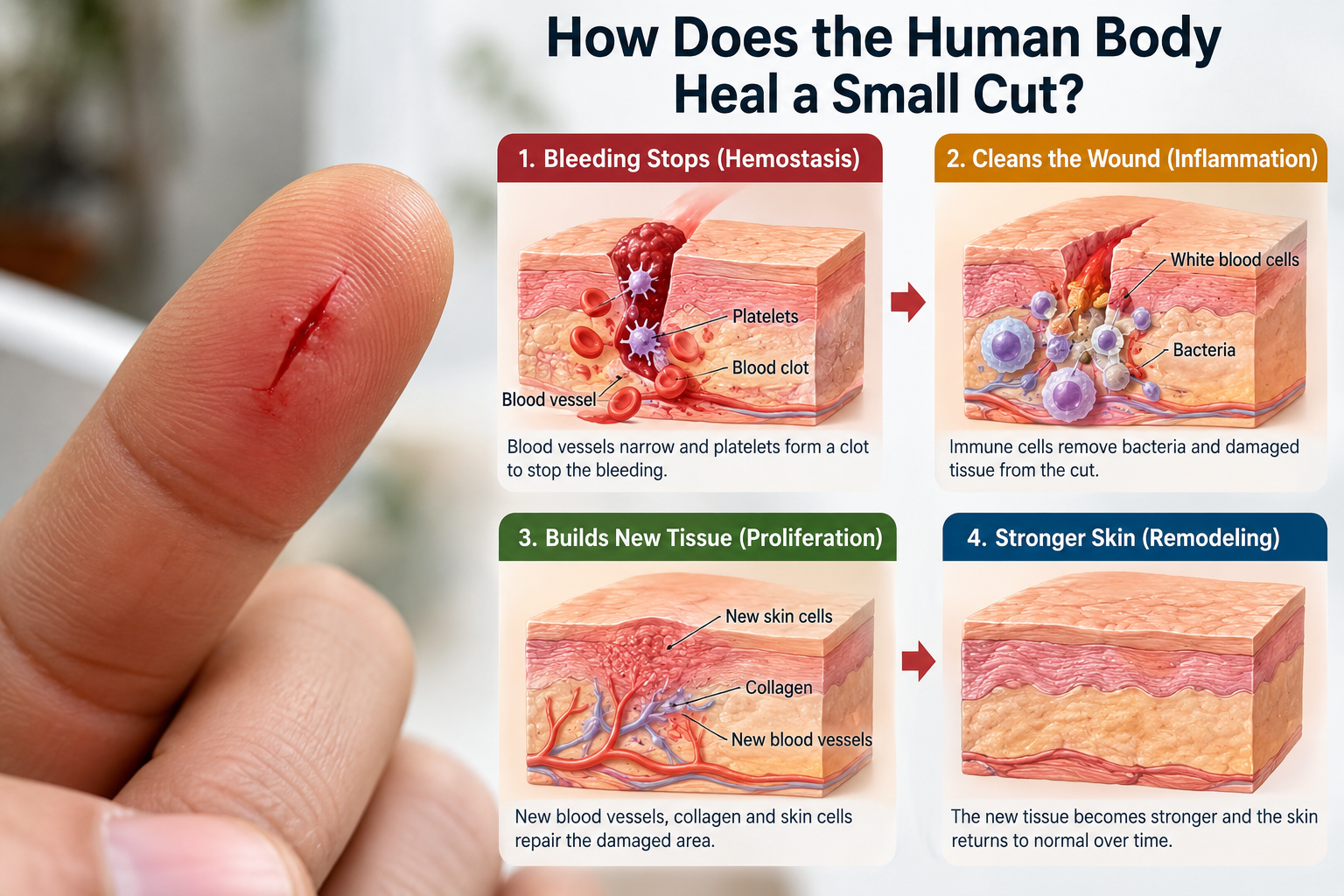
Wound healing generally happens in four main stages.
These stages are:
- Hemostasis
- Inflammation
- Proliferation
- Remodeling
Each stage has a specific purpose, but they often overlap with one another.
Stage One: The Body Stops the Bleeding
The first priority of the body is to stop blood loss.
This stage is known as hemostasis.
Hemostasis begins within seconds after a cut occurs.
When blood vessels are damaged, they temporarily become narrower. This process is called vasoconstriction.
The narrowing of the blood vessels helps reduce the amount of blood reaching the injured area.
At the same time, special blood cells called platelets move toward the damaged blood vessel.
Platelets normally circulate freely in the bloodstream. When they detect an injury, they become activated.
They begin sticking to the damaged area and to each other.
This creates a temporary platelet plug.
The body also activates a process known as the blood clotting cascade.
During this process, different proteins in the blood work together to produce fibrin.
Fibrin forms thin, strong strands that create a kind of biological net around the wound.
Red blood cells and platelets become trapped inside this fibrin network.
Together, they form a blood clot.
The clot helps stop bleeding and protects the damaged tissue underneath.
In a small cut, bleeding may stop within a few minutes if the body’s clotting system is functioning normally.
Why Does a Scab Form?
After the blood clot forms, the surface of the clot may begin to dry.
This dried blood, fibrin, platelets, and other material can form a scab.
A scab acts like a temporary protective cover.
It helps prevent dirt and microorganisms from easily entering the damaged skin.
However, modern wound care does not always depend on forming a thick dry scab.
In many situations, keeping a small wound slightly moist with appropriate wound care can support faster skin repair than allowing it to become extremely dry.
The important thing is to keep the area clean and protected.
Stage Two: The Immune System Cleans the Wound
Once bleeding is controlled, the body begins cleaning the injured area.
This is the inflammatory stage.
Inflammation sometimes sounds harmful, but normal inflammation is actually an important part of healing.
The body sends immune cells toward the cut.
One of the first types of immune cells to arrive is called neutrophils.
Neutrophils help destroy bacteria and remove damaged tissue.
Later, another type of immune cell called macrophages becomes active in the wound.
Macrophages are extremely important during wound healing.
They remove dead cells, bacteria, and damaged material from the injured area.
They also release chemical signals that tell other cells to begin rebuilding the tissue.
This stage explains why a fresh cut may become slightly red, warm, swollen, or tender.
These symptoms can be part of the body’s normal healing response.
The blood vessels around the wound become more open, allowing additional blood, oxygen, nutrients, and immune cells to reach the damaged tissue.
This increased blood flow can cause redness and warmth.
A small amount of swelling can also occur because fluid moves into the tissues around the injury.
Why Does a Healing Cut Sometimes Hurt?
Pain is common after a cut.
When the skin is damaged, nerve endings may also be injured or irritated.
The body releases several chemical substances during inflammation. Some of these substances can make nearby nerves more sensitive.
This increased sensitivity creates pain or tenderness.
Pain serves an important purpose.
It encourages us to protect the injured area and avoid movements that could damage the wound again.
As healing progresses, discomfort usually becomes less intense.
Stage Three: The Body Starts Building New Tissue
After the wound has been cleaned, the body begins rebuilding what was damaged.
This stage is called proliferation.
Several important processes take place during this stage.
New blood vessels develop.
New connective tissue is produced.
Skin cells move across the wound.
The wound gradually becomes smaller.
One of the most important cells during this phase is the fibroblast.
Fibroblasts produce collagen.
Collagen is a strong structural protein found throughout the body.
It provides support and strength to skin, tendons, ligaments, bones, and many other tissues.
Inside a healing cut, collagen acts like a framework for new tissue.
The body begins filling the wound with fresh tissue known as granulation tissue.
Healthy granulation tissue often appears pink or reddish because it contains many newly formed blood vessels.
How New Blood Vessels Help the Cut Heal
Healing tissue needs oxygen and nutrients.
However, when a cut damages the skin, some of the nearby blood vessels may also be damaged.
The body solves this problem by creating new blood vessels.
This process is known as angiogenesis.
Small new blood vessels begin growing into the injured area.
They bring oxygen and nutrients needed by the healing cells.
Without a good blood supply, wounds heal more slowly.
This is one reason why conditions that reduce blood circulation can interfere with wound healing.
How New Skin Forms Over the Cut
Another important process is called epithelialization.
Skin cells called keratinocytes begin moving from the edges of the wound toward the center.
These cells gradually cover the damaged area.
If the cut is very small, the skin cells may close the wound relatively quickly.
Deeper wounds usually require more time because the body must rebuild more tissue.
As the skin cells continue multiplying and moving across the wound, a new protective surface begins to form.
Eventually, the wound becomes completely covered with new skin.
Why Does a Cut Feel Itchy While Healing?
Many people notice that a healing cut becomes itchy.
This is usually a normal part of the healing process.
There are several possible reasons.
New skin cells are forming.
Nerves around the wound are recovering.
Inflammatory chemicals may affect nearby nerve endings.
The skin may also become dry or tight as the wound closes.
Together, these changes can create an itchy feeling.
Although scratching may feel tempting, it is better to avoid scratching a healing wound.
Scratching can reopen the skin and introduce bacteria.
Stage Four: The New Skin Becomes Stronger
Closing the wound is not the final step.
After the skin surface has healed, the body continues improving the repaired tissue.
This phase is known as remodeling or maturation.
During this stage, collagen fibers are reorganized.
Some unnecessary blood vessels disappear.
The repaired tissue becomes stronger and more flexible.
The remodeling stage can continue for weeks or even months.
A small superficial cut may eventually become almost impossible to notice.
A deeper cut may leave a scar.
Why Do Some Cuts Leave Scars?
Scarring depends mainly on how deeply the skin is injured.
The skin contains several layers.
The outer layer is called the epidermis.
Below it is the dermis.
Very shallow injuries that affect mainly the epidermis may heal without leaving a visible scar.
Deeper cuts that reach the dermis are more likely to produce scar tissue.
When deeper skin structures are damaged, the body focuses on repairing the area quickly and restoring strength.
The new collagen fibers may not be arranged exactly the same way as the original skin.
This difference creates a scar.
At first, scars may appear red, pink, raised, or darker than the surrounding skin.
Over time, many scars gradually become flatter and lighter.
How Long Does a Small Cut Take to Heal?
The healing time depends on several factors.
A very small superficial cut may begin closing within a day or two and may look significantly better within several days.
Some minor cuts heal within approximately one week.
Deeper cuts can take longer.
The exact healing time depends on the size and depth of the wound, its location, blood circulation, nutrition, age, general health, and whether infection develops.
Cuts on areas that constantly move may also take longer to heal.
For example, a cut near a finger joint may repeatedly stretch when the finger bends.
This can slow healing.
What Does the Body Need for Wound Healing?
Healing requires energy and nutrients.
The body needs protein to build new tissue.
Protein provides amino acids that are used to produce collagen and other important structures.
Vitamin C also plays an important role in collagen production.
Zinc is involved in cell division and tissue repair.
Other vitamins and minerals also support normal immune function and recovery.
A balanced diet containing vegetables, fruits, protein sources, whole grains, and sufficient fluids helps provide the nutrients the body needs.
Severe nutritional deficiencies can slow wound healing.
Why Is Oxygen Important?
Oxygen is essential for wound healing.
Healing cells use oxygen while producing energy and rebuilding damaged tissue.
Immune cells also use oxygen when fighting microorganisms.
Good blood circulation helps deliver oxygen to the wound.
This is why reduced circulation can make wounds slower to heal.
Smoking can also interfere with wound healing because substances in tobacco smoke can reduce oxygen delivery and affect blood vessels.
How Does the Body Protect a Cut From Infection?
Whenever the skin barrier is broken, bacteria may enter the wound.
The immune system responds quickly.
Neutrophils, macrophages, and other immune cells recognize and destroy many harmful microorganisms.
Blood flow also increases around the injured area, allowing more immune cells to arrive.
The clot and developing skin barrier provide additional protection.
However, the body’s defenses are not always enough.
A wound can still become infected, especially if it is contaminated with dirt or bacteria.
Proper cleaning therefore remains important.
How Should a Small Cut Be Cared For?
Most minor cuts can be managed with basic first aid.
Wash your hands before touching the wound.
Gently rinse the cut with clean running water.
Remove visible dirt carefully if possible.
If bleeding continues, apply gentle pressure with clean gauze or cloth.
Once the bleeding stops, protect the area with a clean dressing if necessary.
Change the dressing if it becomes dirty or wet.
Avoid repeatedly touching the wound with unwashed hands.
It is usually unnecessary to use very harsh chemicals inside a minor wound because they may irritate healthy tissue.
Simple cleaning and protection are often enough for small uncomplicated cuts.
Signs That a Cut May Be Infected
Normal healing can cause mild redness and tenderness.
However, certain symptoms may suggest infection.
These include increasing redness, increasing swelling, worsening pain, pus, unpleasant odor, fever, or red streaks spreading away from the wound.
A wound that becomes worse instead of gradually improving should be evaluated by a healthcare professional.
People with diabetes, circulation problems, weakened immune systems, or other health conditions may need medical advice sooner because wounds can become more complicated.
When Should a Cut Receive Medical Attention?
Not every cut can be safely treated at home.
Medical care may be needed if the wound is deep, large, heavily contaminated, or caused by an animal or human bite.
A wound may also require professional care if bleeding does not stop after continuous pressure.
Cuts with widely separated edges may sometimes need stitches or another method of closure.
Medical attention is also important if there is numbness, loss of movement, severe pain, or concern about damage to nerves, tendons, or blood vessels.
Tetanus vaccination status may also need to be checked, especially after certain dirty or contaminated wounds.
Why Do Children Often Seem to Heal Quickly?
Age can influence wound healing.
Children and younger adults generally have strong cell regeneration and good circulation.
Their skin cells often divide and repair tissue efficiently.
As people become older, several parts of the healing process may become slower.
Skin becomes thinner, blood circulation may decrease, and cell activity may change.
This does not mean that older adults cannot heal properly, but recovery may take more time.
Can Stress Affect Wound Healing?
The condition of the whole body can influence how quickly a wound heals.
Long term psychological stress may affect hormones and immune function.
Poor sleep may also interfere with recovery.
During sleep, the body performs many repair and maintenance functions.
Good nutrition, adequate rest, hydration, and proper wound care create better conditions for normal healing.
Why Is the Human Healing Process So Impressive?
A small cut shows how highly coordinated the human body is.
Within seconds, blood vessels change their behavior.
Platelets form a plug.
Proteins create a clot.
Immune cells arrive to remove bacteria and damaged material.
Fibroblasts produce collagen.
New blood vessels grow.
Skin cells move across the wound.
Finally, the repaired tissue becomes stronger through months of remodeling.
All of this happens automatically.
Most of the time, we are not even aware of it.
The body does not simply cover the damaged area. It follows an organized sequence designed to restore protection and function.
Final Thoughts
So, how does the human body heal a small cut?
The answer involves several carefully coordinated biological stages.
First, the body stops the bleeding through blood vessel narrowing, platelets, and clot formation.
Next, the immune system cleans the wound and protects it against harmful microorganisms.
After that, fibroblasts, collagen, new blood vessels, and skin cells begin rebuilding the damaged area.
Finally, the new tissue is reorganized and strengthened.
What appears to be a simple cut on the surface is actually the beginning of a highly organized repair process inside the body.
Understanding this process also explains why basic wound care matters. Keeping a cut clean, protected, and free from unnecessary irritation gives the body’s natural healing system the best opportunity to work properly.
In most healthy people, small cuts heal without serious problems. However, wounds that are deep, infected, heavily contaminated, or slow to improve should receive appropriate medical attention.
The next time a small cut slowly disappears from your skin, remember that thousands of cells and biological signals have been working together behind the scenes to repair it.