

Yawning is one of the most common things people do every day. We may yawn when we feel sleepy, when we wake up, while sitting quietly, or even when we see another person yawn. It is such a normal part of life that most people rarely stop to ask why it happens.
But yawning is more interesting than it first appears. It involves several muscles in the face, mouth, chest, and breathing system. Researchers have studied yawning for many years, and although several explanations have been suggested, scientists do not believe that there is only one simple reason behind every yawn.
So, why do we yawn? What causes yawning? Is yawning always a sign of tiredness? Why does seeing someone yawn sometimes make us yawn too?
In this article, we will look at the science behind yawning in simple language and understand why this natural behavior happens.
What Is Yawning?
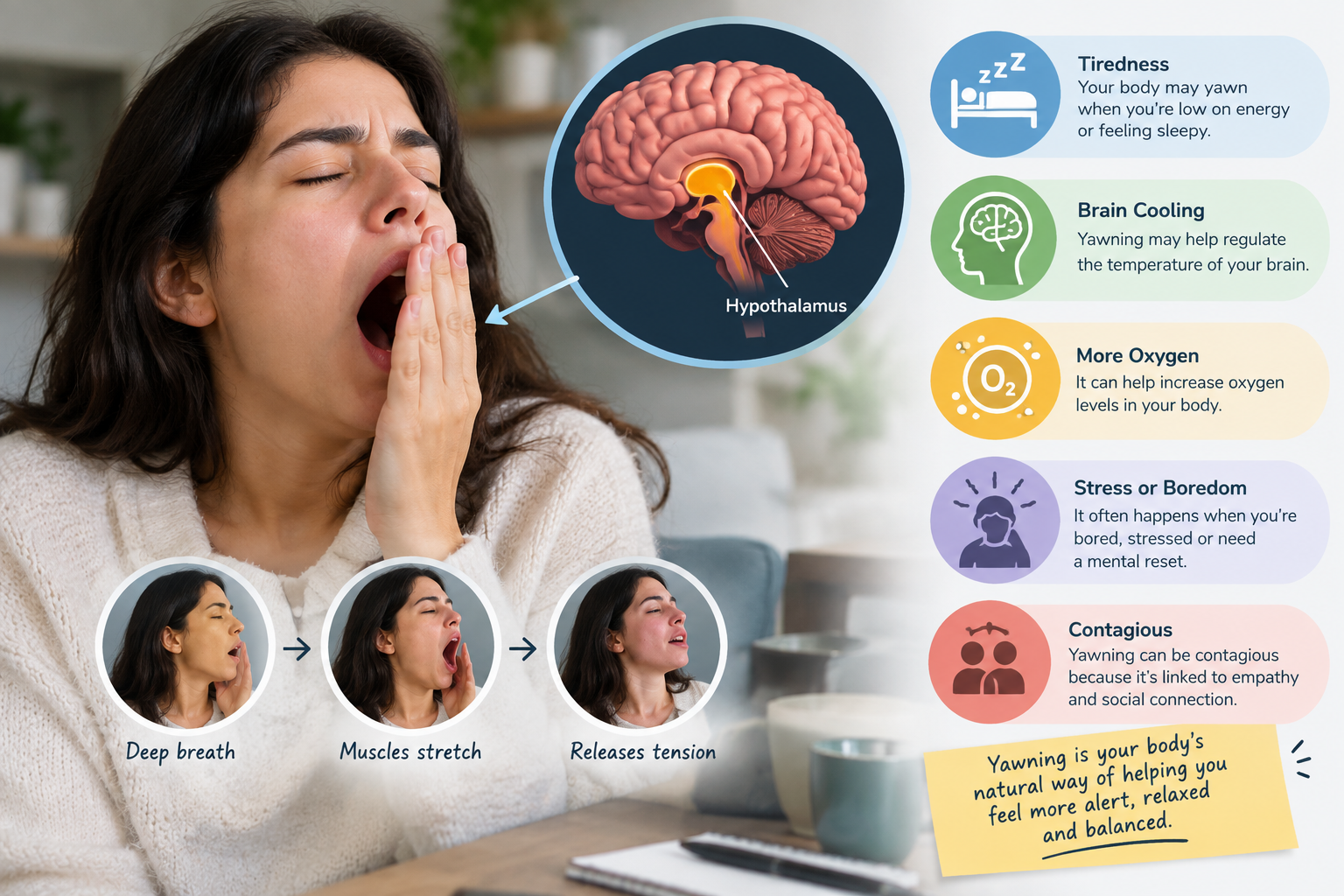
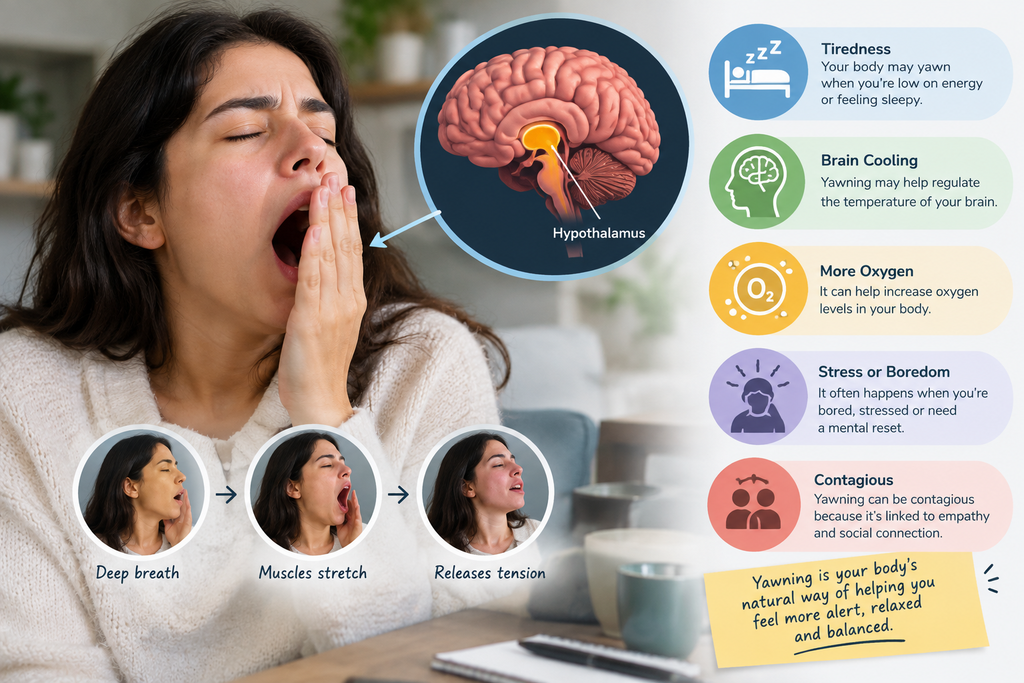
Yawning is a natural reflex that usually involves opening the mouth widely, taking a slow and deep breath, and then breathing out. During a typical yawn, the jaw opens, the facial muscles move, and the chest and breathing muscles become involved.
Yawning can happen when a person is awake, tired, relaxed, or changing from one state of alertness to another. For example, many people yawn after waking up in the morning. Others notice yawning before going to bed.
A yawn usually lasts only a few seconds, but the exact pattern can vary from person to person.
Yawning is not limited to humans. Many animals also yawn, including dogs, cats, horses, birds, and some other mammals. This suggests that yawning is an old biological behavior that may have developed for useful reasons.
Why Do We Yawn?
The simple answer is that scientists are still studying the exact purpose of yawning.
For a long time, people believed that yawning happened mainly because the body needed more oxygen. The idea was that taking a large breath during a yawn would increase oxygen in the blood and remove carbon dioxide.
However, research has shown that this explanation does not fully explain yawning. Changes in oxygen and carbon dioxide levels do not consistently cause people to yawn.
Today, researchers consider yawning to be a behavior connected with brain activity, alertness, body temperature, tiredness, and changes between different states of activity.
This does not mean that every yawn has exactly the same cause. A person may yawn because they are sleepy, because they are relaxed, because they are changing their level of alertness, or because another person has yawned.
Yawning and Sleepiness
One of the most common causes of yawning is sleepiness.
When we become tired, our level of alertness changes. The brain does not remain equally active throughout the day. As the body prepares for sleep, yawning may become more frequent.
This is why you may notice several yawns in the evening when you are sitting quietly. You may also yawn when you wake up because your brain is moving from a sleeping state to an awake state.
Yawning can therefore appear during both sides of the sleep transition.
You might yawn:
- Before going to sleep
- Immediately after waking up
- When you have not slept enough
- During periods of low activity
- When you are resting after a busy day
Yawning is therefore often associated with changes in alertness rather than tiredness alone.
Does Lack of Sleep Cause More Yawning?
Yes, insufficient sleep can make yawning more noticeable.
When a person does not get enough sleep, the brain has to maintain alertness while dealing with fatigue. This can lead to increased sleepiness during the day, and yawning may become more common.
For example, someone who stays awake late at night may find themselves yawning repeatedly the next morning.
However, yawning alone cannot tell us exactly how much sleep a person needs. Sleep requirements vary between individuals and also change with age, daily activity, and other factors.
If you regularly feel extremely sleepy despite getting enough sleep, it may be useful to pay attention to your overall sleep habits and discuss persistent concerns with a healthcare professional.
Yawning May Be Related to Brain Temperature
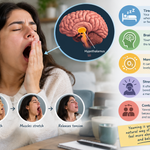
One interesting scientific idea is that yawning may help regulate brain temperature.
The brain works best within a suitable temperature range. Researchers have proposed that yawning may contribute to temperature regulation through several physical processes.
When you yawn, you open your mouth widely and move your jaw. You also take a relatively deep breath. These actions may affect blood flow around the head and movement of air through the mouth and nasal passages.
Some research has found relationships between environmental temperature and yawning behavior. However, the exact role of yawning in regulating brain temperature is still being investigated.
It is important not to think of yawning as a simple cooling system. Scientists do not consider this explanation proven as the single purpose of yawning. Instead, temperature regulation is one possible part of a larger biological process.
Why Do We Yawn When We Are Bored?
Many people notice yawning during boring activities.
You might yawn while reading something uninteresting, sitting through a long meeting, watching a slow presentation, or waiting somewhere quietly.
Boredom itself may not directly cause yawning. Instead, boredom often reduces mental stimulation. When the brain is not receiving much interesting information, alertness can decrease.
As attention falls, a person may become more relaxed or sleepy. Yawning can then appear as part of this change in alertness.
This explains why you may rarely yawn while playing an exciting game but start yawning while sitting quietly for a long period.
Why Do We Yawn When We Are Relaxed?
Yawning can also happen when the body is relaxed.
For example, someone may yawn after sitting down following a busy day. They may not feel extremely sleepy, but their body is moving from an active state into a calmer state.
The change in activity level may affect alertness and lead to yawning.
This is one reason yawning should not always be interpreted as a sign that someone is ready to fall asleep.
A relaxed person can yawn while still feeling awake.
Why Is Yawning Contagious?
One of the most interesting facts about yawning is that it can be contagious.
When you see someone yawn, hear someone yawn, or sometimes even think about yawning, you may suddenly feel the need to yawn yourself.
This is called contagious yawning.
It is not completely understood why this happens. Researchers have studied possible connections between contagious yawning, social behavior, attention, empathy, and brain processes.
The response appears to be influenced by the brain’s ability to notice and respond to the behavior of others.
Contagious yawning is not simply a conscious decision. You may see someone yawn and suddenly find yourself doing the same thing without planning to.
This makes yawning an interesting example of how human behavior can be influenced by what we observe around us.
Why Do We Yawn When Someone Else Yawns?
The brain is constantly observing other people’s actions. When you see a familiar behavior, your brain processes that information and may produce a related response.
Yawning appears to be one behavior that can spread between people.
However, contagious yawning is not equally strong in every person or situation. Some people are highly likely to yawn after seeing another person yawn, while others may not respond at all.
Factors such as attention, tiredness, social relationships, and individual differences may influence the response.
So if you yawn after seeing a friend yawn, there is nothing unusual about it. It is a common human behavior.
Does Yawning Give the Body More Oxygen?
This is one of the most common questions about yawning.
People often assume that a yawn happens because the body needs extra oxygen. The large breath taken during a yawn certainly feels different from normal breathing.
However, studies have not supported the idea that yawning is simply the body’s response to low oxygen.
Normal breathing already provides the body with oxygen and removes carbon dioxide. Yawning does not appear to be necessary simply because the blood needs more oxygen.
This does not mean that the deep breath during yawning has no physical effect. It means that oxygen shortage is not considered a complete explanation for why people yawn.
What Happens Inside the Body During a Yawn?
A yawn involves more than opening the mouth.
First, the mouth begins to open widely. The jaw moves downward while several facial and jaw muscles become active.
The lungs then take in a deeper breath than usual. The chest and diaphragm are involved in this movement.
During the yawn, blood flow and muscle activity around the head and neck may also change.
After the deep breath, the person normally exhales and closes the mouth.
Although the action looks simple, several parts of the body work together to produce a yawn.
Why Do We Yawn After Waking Up?
Morning yawning is extremely common.
When we wake up, the brain is moving from a sleeping state into a state of greater alertness. Yawning may be part of this transition.
You may yawn once or several times while getting out of bed, stretching, washing your face, or preparing for the day.
Yawning and stretching often occur together in the morning. Both behaviors involve physical movement after a long period of inactivity.
The exact relationship between these behaviors is still being studied, but the combination is clearly common in humans and many animals.
Why Do We Yawn Before Sleeping?
Yawning before bedtime makes sense because the body is becoming less alert.
As the evening progresses, many people naturally become quieter and less active. The brain begins preparing for sleep, and yawning may become more frequent.
A yawn can therefore be one of the signs that your body is moving toward a lower level of alertness.
Still, yawning does not guarantee that you will fall asleep immediately. You can yawn and remain awake for quite some time.
Can Stress Cause Yawning?
Stress and emotional changes may sometimes be associated with yawning.
People can yawn during situations that involve nervousness, concentration, anticipation, or changes in emotional state.
The reason is not fully understood. Yawning may be connected to changes in alertness that occur when the body responds to a challenging or unusual situation.
For example, a person might yawn before giving a speech or before an important event. This does not necessarily mean they are bored or sleepy.
The human body has many automatic responses to changes in emotional and physical conditions, and yawning may sometimes be part of that response.
Why Do We Yawn During Exercise?
Yawning during exercise may seem strange because exercise normally increases alertness and breathing.
However, some people notice yawning before, during, or after physical activity.
This may be related to changes in body temperature, alertness, breathing, or the transition between different levels of activity.
Yawning before exercise could occur while the body is preparing to become active. Yawning after exercise may happen when the body begins moving back toward a calmer state.
Occasional yawning during physical activity is not necessarily a problem.
However, if unusual yawning occurs together with symptoms such as chest pain, severe shortness of breath, fainting, or dizziness, medical attention is appropriate.
Is Yawning Good for the Body?
Yawning is a normal biological behavior, and there is no reason for most healthy people to try to stop ordinary yawning.
Scientists continue to investigate its exact functions. Possible roles include helping with changes in alertness, brain temperature regulation, physical movement, and social communication.
Because yawning is found across many animal species, it likely has biological importance.
At the same time, researchers have not established one single function that explains every yawn.
The most reasonable understanding is that yawning is a complex behavior with several possible roles.
Why Do Babies Yawn?
Babies also yawn.
Yawning can be observed during different stages of development and is not limited to adults.
Babies spend a large amount of time sleeping, so changes between sleep and wakefulness are an important part of their daily lives.
Like adults, babies can yawn naturally without it meaning that something is wrong.
Parents should look at the baby’s overall behavior rather than treating one yawn as a warning sign.
If a baby appears unusually difficult to wake, has trouble breathing, feeds poorly, or shows other concerning symptoms, medical advice should be sought.
Why Do Animals Yawn?
Yawning is found in many animals.
Dogs may yawn when tired, relaxed, excited, or responding to another situation. Cats can yawn after resting. Horses and other mammals also show yawning behavior.
The meaning of yawning may not be exactly the same in every species.
Scientists have studied animal yawning because it can provide clues about the evolution and biological function of the behavior.
The fact that yawning occurs in many different animals suggests that it has been preserved over a long period of evolution.
Can You Stop Yourself From Yawning?
Sometimes you can temporarily suppress a yawn, but it can be difficult when the reflex is strong.
People may try to close their mouths, take normal breaths, or change their attention when they feel a yawn coming.
However, there is usually no reason to prevent normal yawning.
If you are in a situation where opening your mouth widely would be inappropriate, such as during a conversation or formal meeting, you may naturally try to control it.
When Should Frequent Yawning Be Checked?
Yawning several times during the day is usually normal.
The number of yawns can vary significantly between people. Sleep habits, daily activities, tiredness, boredom, and environmental conditions can all influence how often someone yawns.
However, very frequent or unusual yawning that appears together with other symptoms deserves attention.
For example, if excessive yawning is accompanied by unexplained severe daytime sleepiness, fainting, chest discomfort, difficulty breathing, weakness, confusion, or other sudden symptoms, it is important to seek medical advice.
Yawning by itself is rarely enough to identify a health problem. The surrounding symptoms and the person’s overall condition are much more important.
Common Myths About Yawning
There are several common ideas about yawning that are not fully supported by science.
Myth 1: Yawning Always Means You Are Sleepy
Sleepiness is an important reason for yawning, but it is not the only one.
People can yawn while relaxed, bored, waking up, or observing another person yawning.
Myth 2: Yawning Means You Need More Oxygen
The oxygen shortage explanation is too simple. Research has not shown that ordinary yawning happens mainly because the body needs more oxygen.
Myth 3: Every Yawn Has the Same Purpose
Yawning can occur in different situations. Scientists continue to investigate its various possible functions.
Myth 4: Frequent Yawning Always Means Something Is Wrong
Not necessarily. Some people naturally yawn more than others, and tiredness or a change in daily routine can increase yawning.
Interesting Facts About Yawning
Yawning has several fascinating features.
Humans are not the only animals that yawn. Many animals show similar behavior.
Yawning often happens around changes in sleep and wakefulness.
Seeing another person yawn can trigger contagious yawning.
Yawning involves coordinated movement of the jaw, face, breathing muscles, and chest.
People can yawn when they are tired, relaxed, bored, nervous, or changing between different activity levels.
Scientists continue to study yawning because its exact biological purpose is still not completely understood.
Final Thoughts
So, why do we yawn?
The answer is more complicated than simply saying that we are tired or need more oxygen. Yawning is a natural reflex connected with changes in alertness and may also be related to brain temperature, physical activity, relaxation, and social behavior.
Yawning commonly appears before sleep and after waking. It can also happen during boring activities or periods of relaxation. Sometimes one person’s yawn can trigger another person’s yawn, creating the familiar experience of contagious yawning.
Although researchers have learned a great deal about yawning, its complete purpose has not been established. It appears to be a complex behavior rather than a simple response to one condition.
The next time you yawn, remember that your body is performing a surprisingly coordinated action. A simple opening of the mouth involves the brain, muscles, breathing system, and changes in your level of alertness.
That ordinary yawn is a small example of how many different systems in the human body work together without us having to think about them.