Our eyes perform many complicated jobs every second without us even noticing. One of the most impressive abilities of the human eye is adjusting to different amounts of light.
Think about what happens when you walk out of a dark room into bright sunlight. For a few moments, the light may feel uncomfortable or even painful. Then your eyes quickly adapt and everything becomes easier to see.
The opposite happens when you enter a dark room after spending time outdoors in bright sunlight. At first, the room may appear almost completely black. After a few minutes, objects slowly begin to appear.
This happens because the human visual system is constantly adjusting to changes in brightness.
The process involves the pupil, iris, retina, photoreceptor cells, nervous system, and brain. These structures work together so that we can see in environments ranging from bright daylight to very dim rooms.
Understanding how our eyes adjust to different amounts of light helps us appreciate how advanced human vision really is.
Why Do Our Eyes Need to Adjust to Light?
The amount of light around us can change dramatically throughout the day.
On a sunny afternoon, the environment may contain thousands of times more light than a dimly lit room at night.
If our eyes reacted to every level of brightness in exactly the same way, vision would be extremely difficult.
Too much light could overwhelm the sensitive cells inside the eye. Too little light would make it difficult for these cells to detect objects.
The eye therefore uses several methods to control how much light enters and how sensitive the retina becomes.
This process is usually called light adaptation and dark adaptation.
Light adaptation happens when we move from a darker environment into a brighter one.
Dark adaptation happens when we move from a bright environment into a darker one.
Both processes help maintain useful vision under changing conditions.
The Pupil Controls How Much Light Enters the Eye
One of the first things that happens when lighting changes is a change in pupil size.
The pupil is the dark circular opening in the center of the eye.
It may look like a black dot, but it is actually an opening that allows light to enter the eye.
Around the pupil is the colored part of the eye known as the iris.
The iris contains muscles that control the size of the pupil.
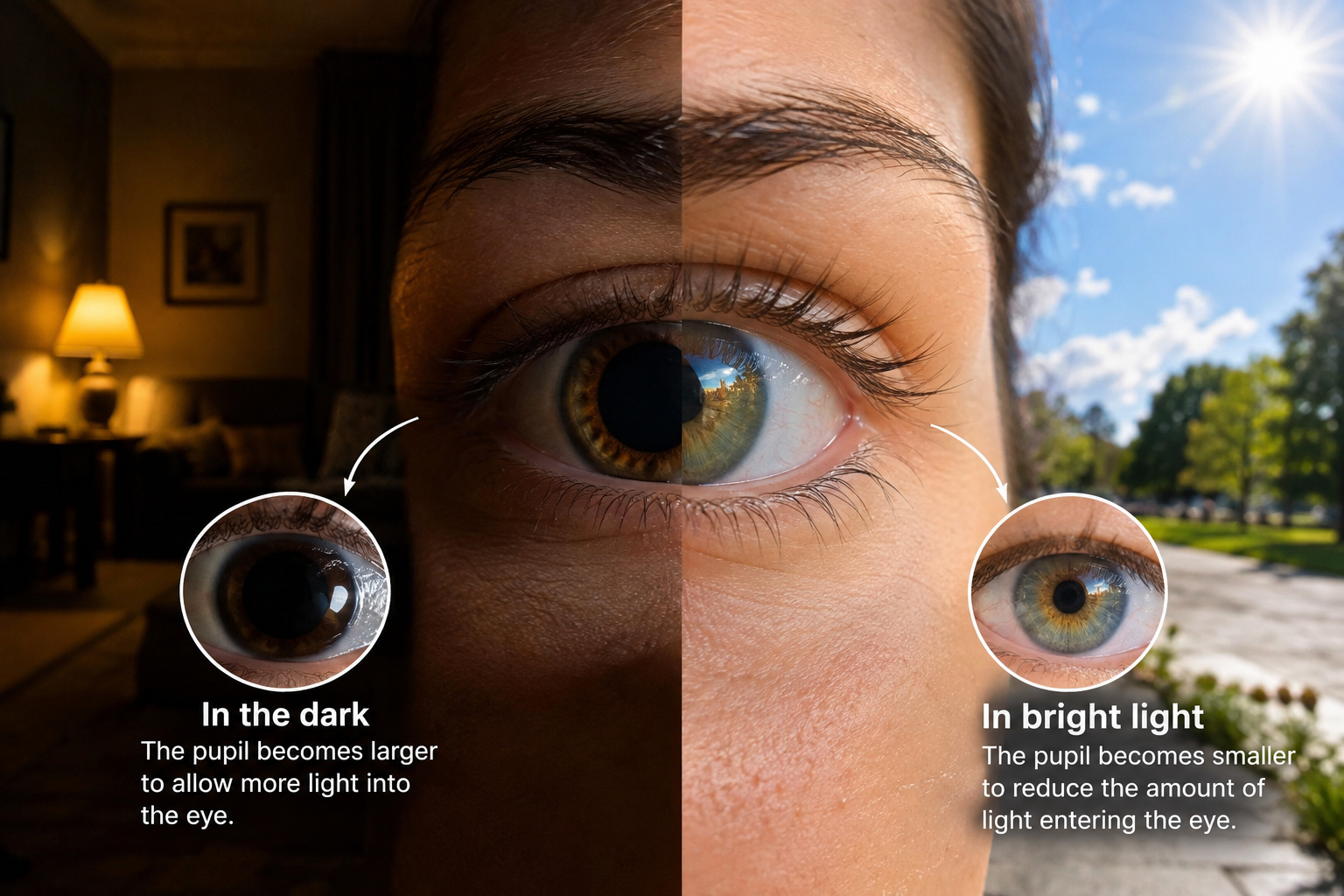
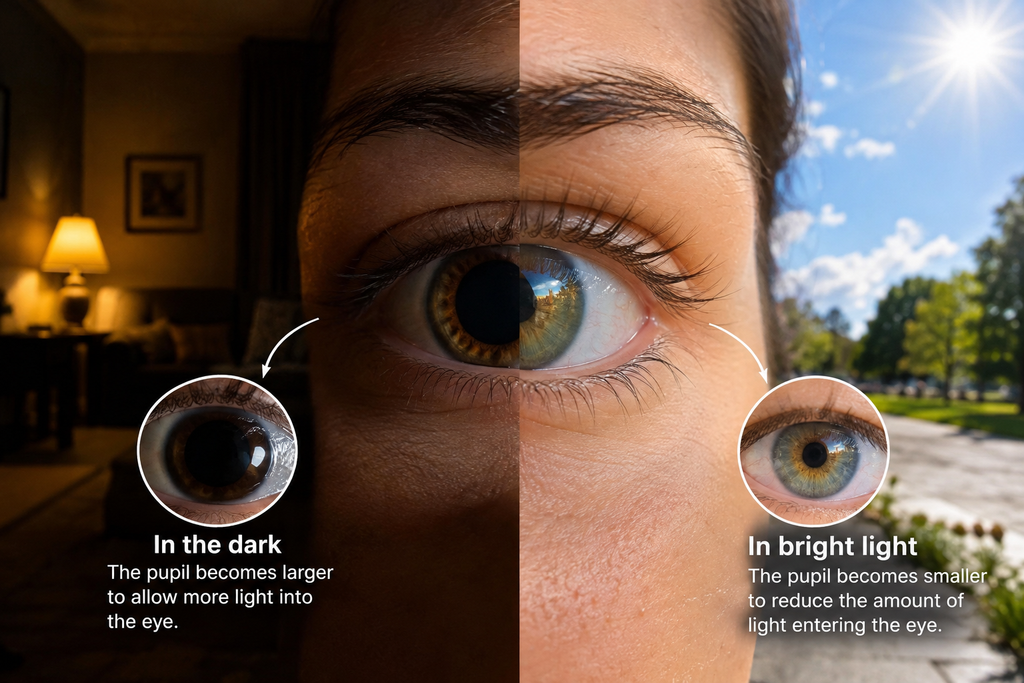
When the environment becomes bright, the pupil gets smaller.
When the environment becomes dark, the pupil becomes larger.
This automatic response helps regulate the amount of light entering the eye.
What Happens to the Pupil in Bright Light?
Imagine walking outside on a bright sunny day.
A large amount of light suddenly reaches your eyes.
The nervous system detects this increase in brightness and sends signals to muscles in the iris.
These muscles cause the pupil to become smaller.
A smaller pupil allows less light to enter the eye.
This protects the sensitive retina from excessive brightness and helps create a clearer image.
The pupil can change size very quickly, often within seconds.
This is one of the fastest ways the eye responds to changes in light.
What Happens to the Pupil in Darkness?
Now imagine entering a dark room.
The amount of light reaching the eye suddenly decreases.
The iris responds by making the pupil larger.
A larger pupil allows more light to enter the eye.
This improves the chance that the retina will detect the limited light available in the environment.
However, pupil size alone cannot explain our ability to see in darkness.
The pupil can increase the amount of incoming light, but the retina also has to become more sensitive.
This is where special cells called photoreceptors become important.
The Retina Detects Light
The retina is a thin layer of light sensitive tissue at the back of the eye.
It acts somewhat like the image sensor inside a digital camera.
Light entering the eye passes through the cornea and lens before reaching the retina.
The retina contains millions of specialized cells that detect light.
The two main types are rods and cones.
These cells have different jobs.
Cones are mainly responsible for vision in bright conditions and for detecting color.
Rods are much more sensitive to low levels of light and are especially important for night vision.
The balance between rod and cone activity helps the eyes function under many different lighting conditions.
How Cone Cells Help Us See in Bright Light
Cone cells work best when plenty of light is available.
They allow us to see fine details and recognize colors.
There are different types of cone cells that respond mainly to different ranges of visible light.
The brain combines signals from these cones to create our perception of color.
During the daytime, cones play a major role in vision.
They help us read small letters, recognize faces, notice colors, and see sharp details.
This is why objects often appear clearer and more colorful during the day than they do at night.
When bright light enters the eye, cone cells can respond efficiently without becoming overwhelmed.
How Rod Cells Help Us See in Darkness
Rod cells are different from cones.
They are extremely sensitive to small amounts of light.
This makes them useful in dark environments.
However, rods do not provide detailed color vision.
This explains why colors seem weaker or disappear almost completely when lighting becomes very dim.
At night, the world often appears mostly gray or colorless because rod cells are doing much of the work.
There are many more rod cells than cone cells in the human retina.
Most rods are located away from the central part of the retina.
This is one reason why you may sometimes notice a faint object more easily when you look slightly beside it instead of directly at it.
What Is Light Adaptation?
Light adaptation occurs when the eyes move from a darker environment into brighter surroundings.
Suppose you are sitting inside a dark cinema and then walk outside into daylight.
For a moment, everything may appear extremely bright.
Your eyes then begin to adjust.
The pupils become smaller, reducing the amount of light entering the eyes.
At the same time, the light sensitive chemicals inside retinal cells change.
The sensitivity of the retina decreases so that it can handle the brighter environment.
Cone cells become especially important.
Light adaptation usually happens relatively quickly.
Within a short time, the bright environment begins to look normal.
What Is Dark Adaptation?
Dark adaptation is usually slower.
Imagine spending several minutes outdoors during the day and then entering a dark room.
At first, you may barely see anything.
Gradually, your vision improves.
Your pupils enlarge and allow more light to enter.
Meanwhile, the retina becomes increasingly sensitive to small amounts of light.
Rod cells become especially active during this process.
After several minutes, objects that were previously invisible may become noticeable.
Full dark adaptation can take much longer than the initial pupil response.
This is because chemical changes inside the photoreceptor cells require time.
The Role of Rhodopsin in Night Vision
One important substance involved in dark vision is rhodopsin.
Rhodopsin is a light sensitive pigment found inside rod cells.
When light strikes rhodopsin, it undergoes a chemical change.
This begins a chain of events that produces an electrical signal.
The signal eventually travels through the optic nerve toward the brain.
In bright conditions, much of the rhodopsin becomes temporarily altered by light.
When a person enters darkness, the eye needs time to rebuild the active form of rhodopsin.
As more rhodopsin becomes available, rod cells become more sensitive.
This is one major reason dark adaptation takes time.
Why Does Darkness Become Easier to See After Several Minutes?
When you first enter a dark area, your visual system is still adjusted to the brighter environment you just left.
The rods are not yet working at their maximum sensitivity.
During the next several minutes, the eye goes through several changes.
The pupil becomes larger.
The sensitivity of the retina increases.
Rhodopsin becomes available again in rod cells.
The brain also becomes better able to interpret weak visual signals.
Together, these changes improve your ability to see.
After enough time, very small amounts of light may be enough to detect objects and movement.
Why Can Bright Light Ruin Night Vision?
You may have noticed that looking at a bright light at night can make the surroundings suddenly appear darker.
For example, imagine sitting outside at night after your eyes have adjusted to darkness.
If someone shines a bright flashlight into your eyes, your night vision may temporarily become worse.
Bright light reduces the sensitivity of the rod system.
The pupils also become smaller.
After the bright light disappears, the eyes need time to adapt to darkness again.
This is why astronomers and people working at night sometimes use dim red lights.
Rod cells are less sensitive to certain longer wavelengths of red light compared with other visible wavelengths.
Using a dim red light can help people see nearby objects while reducing the disturbance to dark adapted vision.
How the Brain Helps With Light Adjustment
The eyes collect visual information, but vision is not produced by the eyes alone.
The brain plays an essential role.
Electrical signals from the retina travel through the optic nerve to areas of the brain responsible for processing visual information.
The brain compares brightness, contrast, color, shape, and movement.
It continuously adjusts how visual information is interpreted.
This means that our perception of brightness depends partly on surrounding conditions.
An object may look bright in a dark room but relatively dim in direct sunlight.
The object itself may not have changed.
Instead, the visual system interprets brightness in relation to the environment.
Why Do Our Eyes Water in Bright Sunlight?
Very bright light can sometimes cause the eyes to water.
This may happen because intense light causes discomfort and triggers protective reflexes.
Squinting often occurs at the same time.
When we squint, the eyelids partially reduce the amount of light entering the eye.
Tears may also help protect and lubricate the surface of the eye.
Sunglasses can reduce discomfort by limiting excessive visible light.
Good quality sunglasses may also protect the eyes from ultraviolet radiation.
Why Does It Hurt to Look at Very Bright Light?
The human eye is designed to work across a wide range of lighting conditions, but there are limits.
Extremely bright light can overload the visual system and may damage sensitive tissues.
The Sun is an important example.
Looking directly at the Sun can expose the retina to intense radiation.
This can cause retinal injury, sometimes without immediate pain because the retina does not contain pain receptors in the same way as the surface of the eye.
For this reason, people should never look directly at the Sun, especially through binoculars, telescopes, or other optical devices without proper solar filters.
Why Do Older People Sometimes Need More Light?
Vision changes naturally with age.
The pupil may not become as large as it did earlier in life.
The lens of the eye may also become less transparent.
As a result, less light may reach the retina.
This is one reason older adults often prefer stronger lighting while reading or doing detailed work.
Dark adaptation may also become slower with age.
A person may therefore need more time to adjust after entering a dark room.
These changes vary from person to person.
Why Is Driving at Night More Difficult?
Night driving is more challenging because the visual system receives less light.
Rod cells become more important, but rods are not as good as cones at detecting fine details and color.
Headlights from approaching vehicles can also interfere with dark adaptation.
A bright headlight may temporarily reduce the eye’s sensitivity to darkness.
After the vehicle passes, the driver may need a short period to regain better night vision.
This is why clean windshields, proper headlights, and careful driving are especially important at night.
Why Do We See Better in the Center During the Day?
The central region of the retina contains an area called the fovea.
The fovea contains a very high concentration of cone cells.
It gives us extremely detailed central vision.
When reading, looking at someone’s face, or examining a small object, the image is usually focused on the fovea.
This works especially well in bright conditions because cone cells need a reasonable amount of light.
In darkness, rod cells become more important.
Since rods are more common outside the fovea, very faint objects may sometimes be easier to notice with slightly off center vision.
Does Eye Color Affect Light Sensitivity?
The iris contains pigments that determine eye color.
Darker eyes generally contain more pigment than lighter eyes.
This pigment helps absorb some scattered light inside the eye.
People with lighter colored eyes may sometimes report greater sensitivity to bright light.
However, many other factors influence light sensitivity, including pupil size, age, medications, eye health, and individual differences.
Eye color alone does not determine how well someone can see in bright or dark conditions.
Why Do Cameras Use Similar Ideas?
The human eye is often compared with a camera because both systems control light.
A camera has an aperture that changes size to control how much light reaches the sensor.
The pupil performs a somewhat similar role in the eye.
A camera can also change the sensitivity of its sensor.
The retina performs a more complex biological form of sensitivity adjustment.
However, the human visual system goes beyond a simple camera.
The eye and brain constantly process and interpret information.
This allows us to recognize objects across changing lighting conditions without consciously adjusting anything.
Everyday Examples of Light Adaptation
We experience light adaptation many times without realizing it.
Walking out of a dark bedroom in the morning is one example.
Entering a cinema after standing outside is another.
Driving through a tunnel also requires rapid adjustment.
At the entrance of the tunnel, the environment suddenly becomes darker.
The pupils enlarge and retinal sensitivity begins increasing.
When the car leaves the tunnel, the eyes suddenly receive much more light.
The pupils then become smaller and the visual system quickly adjusts again.
Our eyes repeat these processes countless times during normal life.
Can Screens Affect Light Adjustment?
Bright screens can influence how our eyes feel in dark surroundings.
If you look at a bright phone screen in a dark room, your eyes partially adjust to the brightness of the screen.
When you look away, the room may temporarily seem even darker.
Lowering screen brightness at night can reduce this strong contrast.
Many devices also include night modes that reduce screen brightness and change the color balance.
However, the most important factor for immediate visual comfort is often the difference between screen brightness and surrounding light.
Why Is Human Vision So Flexible?
Human eyes cannot see in total darkness because vision requires at least some light.
However, the visual system works across an enormous range of brightness.
Several mechanisms make this possible.
The pupil changes size.
Cone and rod cells respond differently to light.
Photoreceptor sensitivity changes.
Visual pigments undergo chemical changes.
The nervous system adjusts signals.
The brain interprets brightness based on the surrounding environment.
Instead of relying on one single mechanism, the body uses many systems at the same time.
This combination gives human vision remarkable flexibility.
Final Thoughts
Our eyes adjust to different amounts of light through a carefully coordinated process involving the pupil, iris, retina, rods, cones, visual pigments, nervous system, and brain.
In bright conditions, the pupil becomes smaller and cone cells handle much of the visual work.
In darkness, the pupil becomes larger and highly sensitive rod cells become increasingly important.
Dark adaptation takes time because the retina must restore its sensitivity, including the activity of important visual pigments such as rhodopsin.
The brain then interprets the signals arriving from the eyes and helps create a stable visual experience.
The next time you walk from bright sunlight into a dark room, notice how your vision slowly improves.
Nothing in the room has changed.
Instead, your eyes and brain have changed the way they respond to the available light.
It is one of the many quiet biological processes happening every moment that allow us to experience the world clearly.