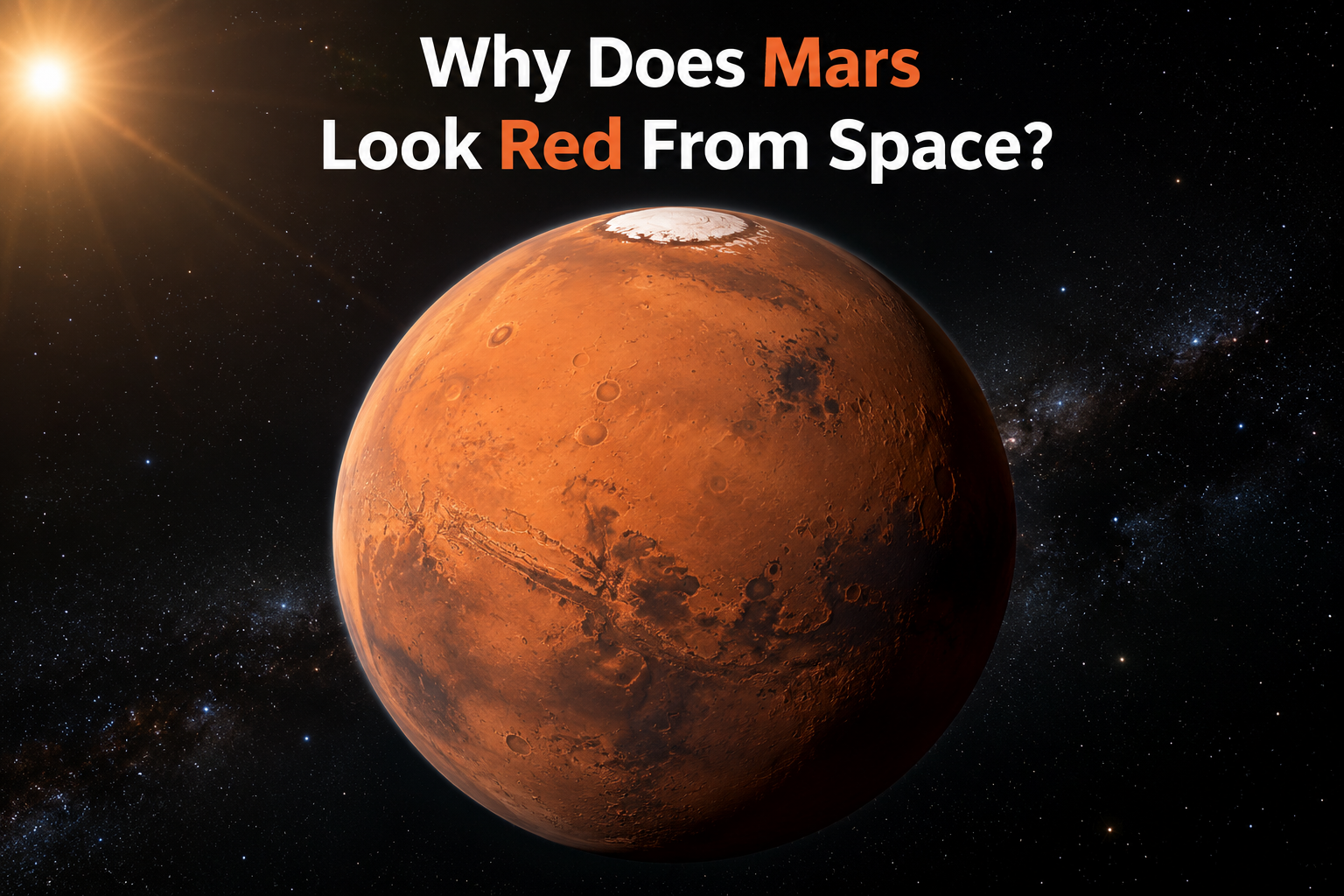
Mars is one of the easiest planets to recognize in the night sky because of its unusual reddish color. For thousands of years, people have looked at Mars and noticed that it appears different from most other bright objects in the sky. This distinctive appearance is the reason Mars is often called the Red Planet. But why does Mars look red from space? The answer is connected to the minerals in its soil, the presence of iron, the planet’s thin atmosphere, and the way sunlight interacts with dust across the Martian surface.
The red color of Mars is not caused by fire, heat, or glowing rocks. Mars is actually a cold and dusty world. Its reddish appearance mainly comes from iron minerals that have reacted with oxygen over a very long period of time. This process created iron oxides, which are similar to the rust that forms on iron objects on Earth.
Understanding why Mars looks red from space helps us learn more about the planet’s history, surface, atmosphere, and geological development.
The Main Reason Mars Looks Red
The main reason Mars looks red is the large amount of iron oxide found in its rocks, soil, and dust.
Iron is a common element in many planets and rocky bodies. On Mars, iron is present in minerals throughout the surface. Over time, some of this iron reacted with oxygen and formed iron oxide.
Iron oxide often has a reddish or orange color. On Earth, we commonly call this material rust.
The surface of Mars contains huge amounts of fine dust filled with these iron oxide particles. Because the dust covers large areas of the planet, Mars appears reddish when viewed from Earth or from spacecraft in space.
This means the red color is mainly a surface effect caused by the chemical composition of Martian dust and rock.
What Is Iron Oxide?
Iron oxide is a chemical compound made from iron and oxygen.
There are several types of iron oxide, and many of them have red, orange, or brown colors. These materials can be found naturally in rocks and soil on Earth as well.
If you have ever seen reddish soil, rusty metal, or red colored desert rocks, you have probably seen materials containing iron oxide.
On Mars, iron oxide is spread across much of the planet’s surface.
Scientists believe iron rich minerals were present in Martian rocks from very early in the planet’s history. These minerals gradually changed through chemical reactions.
The result was the reddish dust that now gives Mars its famous color.
Is Mars Actually Covered in Rust?
In a simple way, yes.
However, describing Mars as rusty does not mean that the entire planet is covered with the same type of rust that forms on a metal gate or car.
The process is more complicated.
Martian rocks contain iron bearing minerals. When these minerals reacted with oxygen and possibly water in the past, iron oxides formed.
These iron oxide minerals became part of the soil and dust.
Because the dust is extremely fine, winds can carry it across enormous distances. This allows reddish material to spread over mountains, plains, valleys, and impact craters.
As a result, even regions made from darker rock can become coated with red dust.
Where Did the Iron on Mars Come From?
Mars formed about 4.5 billion years ago from material that surrounded the young Sun.
This material contained many elements, including iron.
As Mars developed, iron became part of its interior, crust, rocks, and minerals.
Mars therefore did not suddenly gain iron later in its history. Iron has been part of the planet since its formation.
Volcanic activity may also have brought iron rich materials from inside Mars toward the surface.
Mars has enormous ancient volcanoes, including Olympus Mons, which is the largest known volcano in the solar system.
Volcanic rocks commonly contain iron bearing minerals. As these rocks broke apart and weathered, iron became available for chemical reactions that helped create the reddish surface material.
How Did the Iron Become Oxidized?
This question is especially interesting because modern Mars has a very thin atmosphere and very little liquid water on its surface.
Scientists believe several processes may have contributed to the oxidation of Martian iron.
One possibility is that Mars once had much more water than it does today.
Evidence from spacecraft shows ancient river valleys, lake beds, minerals formed in water, and other signs that liquid water existed on Mars in the distant past.
Water may have helped iron react with oxygen bearing compounds.
Another possibility involves reactions between minerals and small amounts of water in the atmosphere or underground.
Researchers have also suggested that chemical reactions caused by sunlight, ice, dust, and atmospheric gases may have produced iron oxides even without large amounts of liquid water.
The exact history is still being studied.
What scientists do know is that iron oxide became widespread enough to color much of the Martian surface.
Martian Dust Makes the Red Color Stronger
Dust is extremely important when explaining why Mars looks red from space.
Mars is a dry planet with large amounts of loose surface material.
Its atmosphere is thin, but winds can still move very small dust particles.
These particles can remain suspended in the atmosphere and travel across the planet.
Some Martian dust particles are incredibly small. Their tiny size allows them to stay airborne for long periods.
Because this dust contains iron oxide, it gives both the surface and lower atmosphere a reddish appearance.
This is why Mars can look red even when viewed from very far away.
The effect becomes especially noticeable during large dust storms.
Mars Has Enormous Dust Storms
Mars experiences some of the largest dust storms in the solar system.
Some Martian dust storms remain local, while others grow until they cover huge areas.
Occasionally, dust storms can spread across almost the entire planet.
During these events, enormous amounts of red and orange dust enter the atmosphere.
The suspended particles change how sunlight moves through the Martian atmosphere.
From space, the planet can appear even more dusty and reddish during major storms.
Spacecraft orbiting Mars have photographed these dramatic changes many times.
Is the Whole Surface of Mars Red?
No. Mars is not completely red.
The planet contains many different colors and surface materials.
Some regions are dark brown, black, gray, tan, orange, or even slightly golden.
Dark areas may contain volcanic rocks such as basalt.
Other regions contain light colored minerals, ice, sand, or dust.
Mars also has bright polar regions containing frozen carbon dioxide and water ice.
However, because reddish dust covers so much of the planet, red and orange tones dominate its overall appearance.
This is especially true when Mars is viewed from a great distance.
Why Does Mars Look Different in Spacecraft Photos?
People sometimes notice that photographs of Mars do not always show exactly the same shade of red.
Some images show Mars as orange. Others make the surface appear brown, golden, pale red, or even slightly gray.
There are several reasons for these differences.
Lighting conditions change depending on the time of day, atmospheric dust, and the angle of the Sun.
Different cameras also record color differently.
Scientists may process images to make certain geological features easier to study.
Some spacecraft images are designed to show colors similar to what human eyes might see. Other images use special filters that reveal minerals or surface details that humans cannot normally see.
Therefore, photographs of Mars may look slightly different even though they show the same planet.
What Color Would Mars Look Like to a Human Standing There?
A human standing on Mars would probably see a landscape dominated by reddish brown, orange, and tan colors.
The soil would often look dusty.
Rocks could appear darker where dust has been removed.
The sky would also look unusual.
On Earth, our atmosphere scatters sunlight in a way that makes the daytime sky appear blue.
Mars has a much thinner atmosphere filled with fine dust particles.
Because of the way Martian dust scatters light, the daytime sky can look yellowish, orange, or reddish.
Interestingly, sunsets on Mars can sometimes appear bluish near the Sun.
This is almost the opposite of what we normally see on Earth.
Why Does Mars Look Red From Earth?
Mars looks reddish from Earth for the same basic reason it looks red from space.
Sunlight reaches Mars and reflects from its surface.
A large amount of this reflected light comes from reddish iron oxide rich dust.
The reflected light travels through space and reaches our eyes or telescopes.
Even though Mars is millions of kilometers away, its reddish color can still be visible.
The exact brightness of Mars changes depending on its distance from Earth and its position in its orbit.
When Mars comes relatively close to Earth, its red or orange appearance can become particularly noticeable.
Why Is Mars Called the Red Planet?
The nickname Red Planet comes directly from the planet’s appearance.
Ancient civilizations noticed the reddish object moving across the sky long before modern astronomy existed.
Different cultures connected Mars with ideas such as fire, conflict, strength, or war because of its color.
The Romans named the planet after Mars, their god of war.
Today, we understand that the planet’s color has a chemical explanation rather than a mythological one.
Still, the name Red Planet remains one of the most famous nicknames in astronomy.
Does the Red Color Tell Us Anything About Mars’ History?
Yes. The reddish surface provides useful clues about the history of Mars.
Iron oxide indicates that chemical reactions involving iron and oxygen took place.
These reactions may have involved water.
Because scientists have found strong evidence that Mars once had rivers, lakes, and possibly a much thicker atmosphere, the oxidation of iron may be connected to ancient environmental conditions.
Studying iron minerals can therefore help scientists understand what Mars was like billions of years ago.
This is important because ancient Mars may have been warmer and wetter than the cold planet we see today.
Was Ancient Mars Always Red?
Scientists do not know exactly what ancient Mars looked like.
It may not always have appeared as red as it does now.
If Mars once had more surface water and less widespread dust, parts of the planet may have looked very different.
Volcanic landscapes could have appeared dark.
Lakes may have reflected the sky.
Rivers may have flowed across valleys.
As Mars lost much of its atmosphere and surface water, its environment became colder and drier.
Rocks gradually broke down into smaller particles.
Iron rich dust spread across the surface.
Over enormous periods of time, the planet developed the dusty reddish appearance we recognize today.
How Do Scientists Study the Color of Mars?
Scientists use telescopes, satellites, landers, and robotic rovers to study Mars.
Orbiting spacecraft photograph the surface from above and measure the minerals found in different regions.
Landers study soil directly.
Rovers can examine individual rocks and collect detailed chemical information.
NASA’s Curiosity and Perseverance rovers have studied Martian rocks, soil, and dust in great detail.
Instruments on these missions can identify minerals and chemical elements.
By studying iron compounds, scientists can learn how different Martian environments formed.
These observations help researchers build a clearer picture of Mars’ geological and environmental history.
Could Mars Become Less Red?
The red appearance of Mars is unlikely to disappear anytime soon.
Iron oxide is already widespread across the surface.
Weathering, wind, and dust storms continually move this material around.
However, local regions can change appearance.
Strong winds can remove dust from rocks, revealing darker surfaces underneath.
New dust can later cover those rocks again.
Seasonal changes can also affect how certain areas look.
The polar ice caps expand and shrink during the Martian seasons.
Dust storms can temporarily change the brightness and color of large regions.
So Mars can change visually, but its overall reddish character remains.
Why Understanding Mars’ Color Matters
At first, asking why Mars looks red may seem like a simple question about color.
In reality, the answer connects several areas of science.
It involves chemistry because iron reacts to form iron oxides.
It involves geology because rocks and minerals shape the surface.
It involves atmospheric science because dust is transported through the Martian atmosphere.
It also involves planetary history because oxidation may reveal clues about ancient water and environmental conditions.
The red color is therefore more than a visual feature.
It is part of the scientific story of Mars.
Final Thoughts
Mars looks red from space mainly because its surface contains large amounts of iron oxide rich dust. Iron in Martian rocks reacted with oxygen and possibly water or other chemical compounds over billions of years. This produced reddish minerals similar to rust.
Fine dust containing these minerals spread across the planet through powerful winds and dust storms. Because so much of the surface is covered with this material, Mars reflects reddish and orange light into space.
However, Mars is not completely red. It contains dark volcanic rocks, lighter soils, icy polar regions, and many different mineral colors. The famous red appearance simply dominates when the planet is viewed from a distance.
The color of Mars also provides valuable clues about its past. It suggests that the planet experienced important chemical and environmental changes during its long history. By studying Martian rocks, dust, and iron minerals, scientists continue to learn more about ancient water, planetary weathering, and the evolution of the Red Planet.
So when we look at Mars and see its familiar reddish glow, we are actually seeing evidence of billions of years of geological and chemical change written across the surface of another world.