The universe is filled with stars, planets, galaxies, clouds of gas, black holes, and many other objects that are extremely far from Earth. For centuries, people studied the night sky with their eyes and later with telescopes placed on the ground. Ground telescopes have helped scientists make many important discoveries, but they also have certain limitations. The atmosphere around Earth can block, absorb, or disturb some of the light coming from space. This is one of the main reasons scientists developed space telescopes.
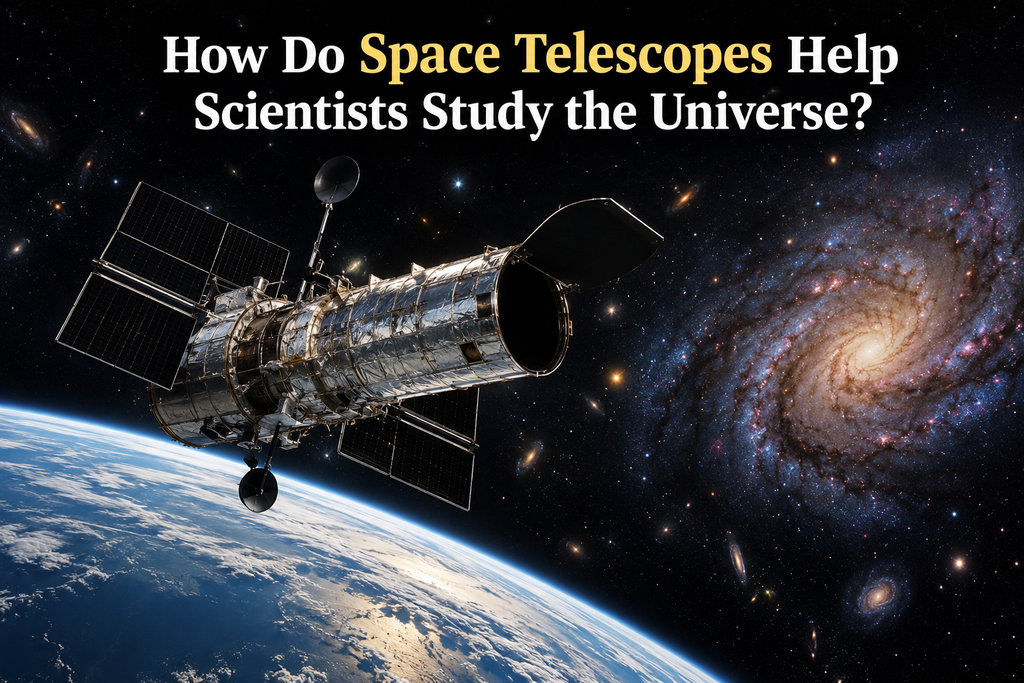
Space telescopes help scientists study the universe by observing space from above Earth’s atmosphere. From this position, they can collect clearer images and detect forms of light that may never reach the ground. They allow researchers to study distant galaxies, discover planets around other stars, observe the birth and death of stars, investigate black holes, and learn more about the history of the universe.
Understanding how space telescopes work shows why they have become such powerful tools in modern astronomy.
What Is a Space Telescope?
A space telescope is an observatory that operates beyond most or all of Earth’s atmosphere. It contains instruments designed to collect light and other types of electromagnetic radiation coming from objects in space.
Some space telescopes orbit Earth, while others operate much farther away. Their location depends on their scientific purpose.
A telescope does not simply make distant objects look larger. Its most important job is collecting light. The more light a telescope gathers, the more information scientists can obtain about an object.
Space telescopes use mirrors, cameras, sensors, and scientific instruments to capture information. This information is then transmitted back to Earth, where researchers process and study it.
Why Put Telescopes in Space?
Earth’s atmosphere protects life from harmful radiation and helps create the conditions necessary for living organisms. However, the atmosphere can make astronomical observations more difficult.
When light from stars travels through the atmosphere, moving air can slightly change the path of the light. This makes stars appear to twinkle. While twinkling stars may look beautiful, the same effect can make astronomical images less clear.
Clouds, moisture, pollution, and artificial light can also interfere with observations.
Another important limitation is that Earth’s atmosphere blocks many forms of electromagnetic radiation. Some ultraviolet radiation, X rays, gamma rays, and infrared radiation cannot easily reach ground based observatories.
A space telescope avoids many of these problems because it operates above the atmosphere. Scientists can therefore observe the universe with greater clarity and across a much wider range of wavelengths.
Space Telescopes Produce Clearer Images
One of the most important benefits of space telescopes is image quality.
When scientists observe a distant galaxy from Earth’s surface, the light from that galaxy must travel through the atmosphere before reaching the telescope. Atmospheric movement can blur the image.
A telescope operating in space receives the light before it passes through this moving layer of air.
This allows space observatories to capture extremely detailed images of stars, galaxies, planets, nebulae, and other objects.
Clear images are important because many astronomical objects are incredibly distant. Even small improvements in image quality can help scientists identify structures that would otherwise be difficult to see.
For example, scientists can examine the shapes of distant galaxies, study clouds around young stars, and observe regions where new stars are forming.
Space Telescopes Can Detect Different Types of Light
Human eyes can only see visible light, but visible light represents just a small part of the electromagnetic spectrum.
Objects in the universe produce many different types of radiation. These include radio waves, microwaves, infrared radiation, visible light, ultraviolet radiation, X rays, and gamma rays.
Each type of radiation can reveal different information.
Infrared observations can help scientists see through clouds of dust that may hide young stars. Ultraviolet observations can reveal extremely hot stars. X ray telescopes can study energetic objects such as black holes and exploding stars.
Because Earth’s atmosphere blocks many of these wavelengths, scientists often place specialized telescopes in space.
By combining observations from different wavelengths, astronomers can create a more complete picture of what is happening in the universe.
Studying Distant Galaxies
Space telescopes allow scientists to observe galaxies that are billions of light years away.
Because light takes time to travel, looking at distant objects also means looking into the past.
If scientists observe a galaxy located one billion light years away, the light reaching the telescope began its journey about one billion years ago. The telescope is therefore showing the galaxy as it appeared in the distant past.
Some space telescopes can detect galaxies so far away that scientists are seeing them as they existed relatively early in the history of the universe.
These observations help researchers understand how galaxies formed and changed over time.
Scientists can compare younger galaxies with galaxies that exist closer to us today. This helps them study how galaxies grow, merge, and develop different shapes.
Learning How Stars Are Born
Stars are often born inside enormous clouds of gas and dust known as nebulae.
These regions can be difficult to observe in visible light because thick dust may block our view.
Infrared space telescopes can detect radiation that passes through much of this dust. This allows scientists to see deeper into stellar nurseries.
Researchers can observe clouds collapsing under gravity and forming young stars. They can also study disks of gas and dust surrounding these stars.
These disks are especially interesting because planets may eventually form from the material inside them.
By studying young stars, scientists can better understand how our own Sun and solar system may have developed billions of years ago.
Watching Stars Reach the End of Their Lives
Space telescopes also help scientists study what happens when stars grow old.
Stars do not live forever. Their final stages depend largely on their mass.
Some stars slowly expand and release their outer layers. Other massive stars may explode in powerful events known as supernovae.
Space telescopes can study the light produced during these events.
Different instruments can examine the visible light, infrared radiation, ultraviolet radiation, X rays, or gamma rays produced by dying stars.
These observations help scientists understand how stars create and spread chemical elements.
Many of the elements found on Earth were produced inside earlier generations of stars. When those stars died, they released material into space. That material later became part of new stars, planets, and eventually living organisms.
Studying Black Holes
Black holes are among the most fascinating objects in astronomy.
A black hole has gravity so strong that light cannot escape once it passes a certain boundary. Because black holes do not produce visible light in the usual way, scientists often study the material around them.
Gas and dust falling toward a black hole can become extremely hot. This material may produce powerful X rays and other forms of radiation.
Space telescopes designed to observe X rays can detect this energy.
Scientists can then study how matter behaves near a black hole and estimate important properties such as the black hole’s mass.
Observations of galaxies have also shown that very massive black holes exist near the centers of many galaxies.
Studying these objects may help researchers understand how black holes and galaxies influence each other’s development.
Discovering Planets Outside Our Solar System
One of the most exciting areas of modern astronomy is the search for planets around other stars.
These planets are known as exoplanets.
Space telescopes have helped scientists discover thousands of possible and confirmed planets beyond our solar system.
One common method is called the transit method.
When a planet passes in front of its star from our point of view, it blocks a very small amount of the star’s light. Sensitive space telescopes can measure this tiny decrease in brightness.
If the same pattern happens regularly, scientists may conclude that a planet is orbiting the star.
Researchers can use these measurements to estimate the planet’s size and orbital period.
In some cases, telescopes can also study light passing through a planet’s atmosphere. This may reveal information about gases in the atmosphere.
The study of exoplanets is helping scientists understand whether solar systems like ours are common or unusual.
Looking Back Into the Early Universe
One of the greatest advantages of powerful space telescopes is their ability to study extremely distant objects.
Light travels at a finite speed. This means that the farther away an object is, the older the light we receive from it.
When astronomers observe a very distant galaxy, they may be seeing light that has traveled through space for billions of years.
In this sense, space telescopes act like time machines.
They cannot physically travel into the past, but they allow scientists to observe ancient light.
By examining this light, researchers can study what the universe looked like when it was much younger.
Scientists hope these observations will help answer major questions about how the first stars and galaxies formed.
Measuring the Expansion of the Universe
Space telescopes have also helped astronomers study the expansion of the universe.
Scientists know that many distant galaxies are moving away from us. The farther away a galaxy is, the faster it generally appears to be moving away.
Astronomers use several methods to measure cosmic distances.
Certain types of stars and exploding stars can serve as useful distance indicators because scientists understand their brightness.
Space telescopes can observe these objects with high accuracy.
Measurements from space have helped researchers estimate the rate at which the universe is expanding.
These studies are important for understanding the age, history, and future of the universe.
Studying Dark Matter and Dark Energy
Much of the universe cannot be directly seen.
Scientists believe that a large amount of matter exists in an invisible form known as dark matter. Dark matter does not shine like stars, but its gravity affects galaxies and other objects.
Space telescopes can study the shapes and movements of galaxies to look for evidence of dark matter.
Scientists can also observe gravitational lensing. This happens when gravity from a massive object bends light traveling from something behind it.
The amount of bending can help scientists estimate how much mass is present.
Space observations also contribute to research on dark energy, which is the name given to the unknown cause associated with the accelerating expansion of the universe.
Dark matter and dark energy remain major mysteries, and space telescopes provide some of the most important observations used to study them.
Famous Space Telescopes and Their Contributions
Different space telescopes are designed for different scientific goals.
The Hubble Space Telescope is one of the best known examples. It has provided detailed observations of planets, stars, nebulae, and galaxies.
The James Webb Space Telescope mainly observes infrared light. Its powerful instruments allow scientists to study very distant galaxies, star forming regions, and planetary atmospheres.
Other space missions have focused on X rays, gamma rays, planet searches, or measurements of the cosmic background.
Each telescope adds another piece to our understanding of the universe.
Astronomers often combine information from several observatories because one object can look very different at different wavelengths.
Space Telescopes Help Test Scientific Ideas
Astronomy is not only about taking beautiful pictures.
Scientists use space telescopes to test theories about how the universe works.
A scientific model may predict how a star should evolve, how galaxies should form, or how matter should behave near a black hole.
Astronomers compare these predictions with real observations.
If the observations match the predictions, the theory gains support. If they do not match, scientists may need to improve or replace the explanation.
In this way, space telescopes provide evidence that helps science move forward.
How Space Telescope Data Reaches Earth
Space telescopes collect enormous amounts of scientific data.
The information is usually converted into digital signals and sent to Earth using radio communication.
Ground stations receive these signals and forward the data to scientific centers.
Researchers then process the information using computers.
Many telescope images are created from several separate observations. Scientists may combine data from different filters or wavelengths to reveal details that cannot easily be seen in a single image.
The final images may look spectacular, but the real scientific value lies in the measurements contained within the data.
Scientists can measure temperature, brightness, chemical composition, distance, motion, and many other properties.
Why Space Telescopes Matter for Future Astronomy
Space telescopes have changed the way humans understand the universe.
Future observatories are expected to study planets, stars, galaxies, and cosmic structures in even greater detail.
Some missions may search for smaller planets around nearby stars. Others may investigate the earliest stages of galaxy formation.
Researchers are also developing instruments capable of studying planetary atmospheres with increasing accuracy.
Every improvement in telescope technology allows scientists to ask new questions.
The universe is incredibly large, and much of it remains unexplored.
Space telescopes give humanity a way to study places that spacecraft may not physically reach for thousands or millions of years.
Conclusion
Space telescopes help scientists study the universe by observing cosmic objects from above Earth’s atmosphere. They provide clearer images, detect wavelengths that may be blocked before reaching the ground, and allow astronomers to investigate stars, galaxies, black holes, planets, and the early universe.
They have helped scientists discover planets around distant stars, observe how stars are born and die, investigate the expansion of the universe, and search for clues about dark matter and dark energy.
Perhaps the most remarkable thing about space telescopes is their ability to turn light into knowledge. A small amount of light arriving from an object billions of light years away can reveal information about its temperature, movement, composition, age, and history.
As telescope technology continues to improve, scientists will be able to see deeper into space and further into the past. Each new observation can answer old questions while creating entirely new ones.
Space telescopes therefore do much more than show us beautiful images of the universe. They are scientific tools that help humanity understand where stars and planets come from, how galaxies change, and how the universe itself has developed across billions of years.