When we think about rocks, we usually imagine something heavy, solid, and dense. If we throw an ordinary stone into a pond, river, or bucket of water, it quickly sinks to the bottom. Because of this common experience, it may sound strange to hear that some rocks can actually float on water.
But it is true.
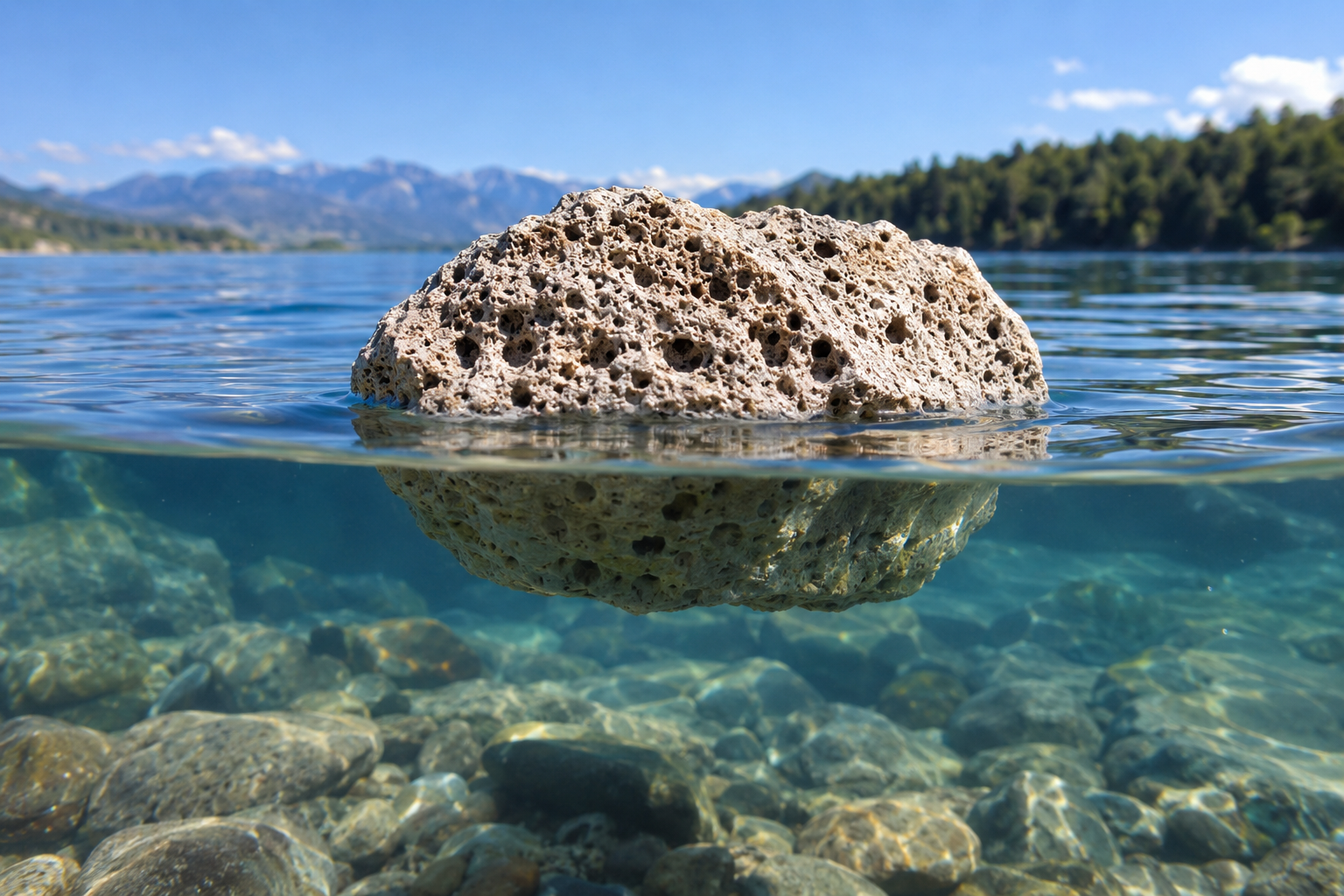
Certain types of rocks can remain on the surface of water for hours, days, months, or even longer. The most famous example is pumice, a light volcanic rock that contains thousands of tiny holes filled with air.
The reason some rocks float on water becomes easy to understand when we look at density, air spaces, volcanic activity, and the way different rocks are formed.
In this article, I will explain why some rocks float on water, how pumice forms, why ordinary rocks sink, and what scientists have learned from floating rocks found in oceans around the world.
The Simple Reason Some Rocks Float
The main reason some rocks float is density.
Density tells us how much matter is packed into a certain amount of space. A material with high density contains a lot of matter in a small volume. A material with low density contains less matter in the same amount of space.
Water has a certain density. If an object is denser than water, it usually sinks. If it is less dense than water, it can float.
Most rocks are denser than water. This is why stones such as granite, basalt, marble, and limestone usually sink.
However, some rocks contain so many air filled spaces that their overall density becomes lower than the density of water.
Pumice is the best known example.
Although the material making up pumice is actually rock, the large number of tiny holes inside it makes the entire rock surprisingly light.
You can think of pumice almost like a rocky sponge.
What Is Pumice?
Pumice is a volcanic rock.
It forms during explosive volcanic eruptions when gas rich magma reaches the surface very quickly.
Deep underground, magma contains dissolved gases. These gases remain trapped because of the great pressure below the Earth’s surface.
When magma suddenly rises during a volcanic eruption, the pressure drops.
The trapped gases rapidly expand and form bubbles.
At the same time, the hot molten rock cools very quickly.
Because the cooling happens so fast, many gas bubbles become trapped inside the solidifying rock.
The result is pumice.
A piece of pumice may contain thousands or even millions of tiny cavities. These cavities are known as vesicles.
The large number of vesicles gives pumice its light, porous structure.
Why Pumice Can Float on Water
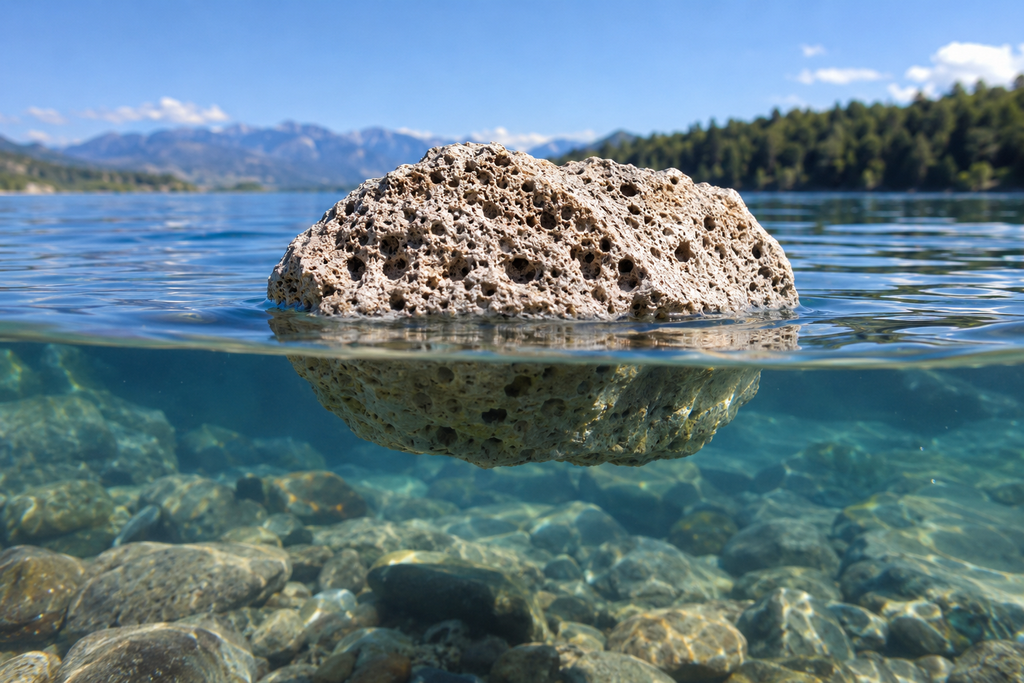
Pumice floats because the average density of the entire rock can be lower than the density of water.
The solid volcanic material itself is usually denser than water. However, the large amount of air trapped inside the rock reduces its overall density.
Imagine two containers of the same size.
One container is filled completely with solid material.
The second container contains the same material but also has many empty air spaces.
The second container will usually weigh less because some of its volume is occupied by air instead of solid material.
Pumice works in a similar way.
Its internal structure is full of tiny air pockets.
These air pockets help reduce the average density of the rock enough for it to remain on the water’s surface.
The Role of Buoyancy
Floating is also connected with a force called buoyancy.
When an object is placed in water, the water pushes upward against it.
This upward force is called the buoyant force.
The idea was famously explained by the ancient Greek scientist Archimedes.
An object in water experiences an upward force equal to the weight of the water that the object displaces.
If the buoyant force is strong enough to support the object’s weight, the object floats.
If the object’s weight is greater than the upward buoyant force, it sinks.
For pumice, the combination of low average density and trapped air allows the buoyant force to support the rock.
That is why pumice can remain on the surface.
Why Most Rocks Sink
Most rocks do not contain enough trapped air to reduce their density.
Granite, for example, is made mainly of minerals such as quartz, feldspar, and mica.
These minerals are packed closely together.
There may be tiny cracks and spaces inside granite, but they are usually not large enough or numerous enough to make the rock less dense than water.
Basalt also usually sinks.
This may seem interesting because both basalt and pumice can come from volcanic material.
The difference lies in their structure.
Basalt is generally dense and compact.
Pumice is highly porous and full of gas bubbles.
So even rocks that come from similar volcanic processes can behave very differently in water.
How Gas Creates Floating Rock
Gas is extremely important in the formation of pumice.
Volcanic magma can contain gases such as water vapor, carbon dioxide, and sulfur containing gases.
While magma remains deep underground, the enormous pressure keeps much of this gas dissolved in the molten rock.
As magma rises toward the surface, pressure decreases.
The gases begin to escape from the magma and form bubbles.
This process is similar to opening a bottle of carbonated drink.
Inside the sealed bottle, gas is dissolved under pressure.
When the bottle is opened, the pressure falls and bubbles begin to form.
Something similar happens inside rising magma, although volcanic processes are much more powerful.
If the magma cools while the gas bubbles are still present, those bubbles can become frozen into the rock.
This creates the porous structure of pumice.
What Do the Holes in Pumice Look Like?
The holes in pumice can vary in size.
Some are extremely small and can only be clearly seen under magnification.
Others are large enough to be easily visible.
The holes are often connected through narrow channels.
This creates a complex network inside the rock.
When pumice first enters the water, many of these spaces contain air.
The trapped air contributes to the rock’s ability to float.
Over time, however, water may slowly enter some of these spaces.
This can eventually make the rock heavier.
Can Pumice Sink Eventually?
Yes, some pumice can eventually sink.
A newly formed piece of pumice may float because its internal spaces are filled with air.
As time passes, water can enter the pores.
The process does not always happen quickly.
Some pores may remain filled with air for a long time because of their shape and small size.
Surface tension can also help prevent water from immediately entering certain tiny spaces.
Eventually, if enough water fills the pores, the average density of the pumice may increase.
At that point, the rock may sink.
Different pieces of pumice can behave differently.
Some may sink quickly, while others may remain afloat for months or even years.
Can Large Pieces of Pumice Float?
Yes.
Even large pieces of pumice can float if they contain enough air filled spaces.
Floating does not depend only on size.
It mainly depends on average density.
A large object can float if its average density is lower than that of water.
Ships are a good example.
Ships are made from materials such as steel, which is much denser than water.
However, ships contain large spaces filled with air.
This makes the average density of the entire ship low enough for it to float.
Pumice follows the same basic physical principle.
What Are Pumice Rafts?
One of the most fascinating results of volcanic eruptions is the formation of pumice rafts.
Sometimes underwater or island volcanoes erupt and release enormous amounts of pumice into the ocean.
Because the pumice floats, thousands or millions of pieces can collect together on the sea surface.
This creates what scientists call a pumice raft.
Some pumice rafts can cover very large areas of ocean.
From above, they may look like strange floating fields or islands.
Ocean currents and winds can move these floating rocks across great distances.
Pumice Can Travel Across Oceans
Floating pumice can travel surprisingly far.
Ocean currents can carry pumice for hundreds or even thousands of kilometers.
During this journey, the floating rocks may become small moving habitats.
Marine organisms can attach themselves to the pumice.
These organisms may include algae, barnacles, small shellfish, corals, and other sea life.
As the pumice travels, these organisms can also be transported to new locations.
Because of this, scientists study pumice rafts to better understand how marine species can move naturally across oceans.
Floating Rocks and Marine Life
Pumice has an unusual role in ocean ecosystems.
Its rough surface provides many places for small organisms to attach.
A single piece of pumice may carry several different types of marine life.
Large pumice rafts may transport entire communities.
Scientists are interested in whether floating pumice can help marine organisms reach distant islands or coral reef systems.
In some situations, pumice may act like a natural raft for life.
This shows how a volcanic event can influence both geology and biology.
Are All Light Rocks Able to Float?
No.
A rock can feel light in your hand and still sink.
The important factor is not simply how heavy the rock feels.
What matters is its density compared with water.
For example, a small piece of dense rock may feel light because it is small.
However, it can still sink because its material is denser than water.
A larger piece of pumice may feel heavier overall, but it can float because its average density is lower.
This difference between weight and density is important.
Weight and Density Are Not the Same
Weight tells us how strongly gravity pulls on an object.
Density tells us how much mass is packed into a certain volume.
A large object can weigh more than a small object and still have a lower density.
For example, a large beach ball can weigh more than a tiny metal screw.
But the beach ball floats while the screw sinks.
The ball contains a large amount of air, giving it a low average density.
Pumice works in a similar way.
Its air filled structure changes the average density of the entire rock.
Are There Other Rocks That Can Float?
Pumice is the most famous floating rock, but other highly porous volcanic materials may also float under certain conditions.
Some volcanic scoria can be very light and full of holes.
However, scoria usually has thicker walls and is generally denser than pumice.
For that reason, most scoria sinks in water.
Certain very porous materials may float temporarily if enough air remains trapped inside them.
However, true long lasting floating behavior is most strongly associated with pumice.
What Is the Difference Between Pumice and Scoria?
Pumice and scoria are both volcanic rocks containing gas bubbles.
But they are usually easy to tell apart.
Pumice is often light in color, although it can also appear gray or darker.
It has very thin walls around its many tiny bubbles.
This gives it a very low density.
Scoria is usually darker, often black, brown, or reddish.
Its holes may be larger, but the solid rock between those holes is usually thicker and denser.
This is why pumice commonly floats while scoria generally sinks.
Where Is Pumice Found?
Pumice is mainly found in regions with volcanic activity.
It can form around explosive volcanoes on land or beneath the ocean.
Large deposits may appear after powerful eruptions.
Pumice can also wash onto beaches after traveling through the sea.
In some coastal areas, people may find light colored, rough stones that feel unusually light.
A simple water test may show whether the stone is pumice.
If it floats, that is a strong clue, although identification should also consider the rock’s texture and appearance.
Why Is Pumice Useful to People?
Pumice has many practical uses because it is light, rough, and porous.
It is commonly used as an abrasive material.
Pumice stones are often used to remove hard or dead skin.
Finely crushed pumice may also be used in polishing products.
In construction, pumice can be mixed into lightweight concrete.
Its low density helps reduce the weight of building materials.
Pumice is also used in gardening.
Its porous structure can improve soil drainage and allow more air to reach plant roots.
This is especially useful for plants that do not like waterlogged soil.
Does Pumice Absorb Water Like a Sponge?
Pumice can absorb some water, but it does not behave exactly like an ordinary household sponge.
Its pores are made of rigid rock.
Some pores are connected, while others may be partly sealed.
Water can slowly enter many of these spaces.
However, trapped air and surface tension can slow the process.
This is one reason pumice may continue floating even after being in water for a long period.
Scientists have studied this process because it helps explain why pumice rafts can survive long ocean journeys.
A Simple Experiment You Can Try
If you have a piece of pumice, you can perform a simple experiment.
Fill a container with water.
Place the pumice gently on the surface.
It should float if it contains enough trapped air.
Now compare it with an ordinary stone of similar size.
The normal stone will probably sink immediately.
You can leave the pumice in water and observe it over time.
You may notice that it becomes wetter and slightly heavier.
Depending on the structure of the rock, it may eventually sink.
This simple experiment clearly demonstrates how density affects floating.
Why Floating Rocks Are Interesting to Scientists
Floating rocks may seem like a small curiosity, but they can teach scientists many things.
They reveal information about volcanic eruptions, magma chemistry, gas content, and cooling conditions.
Pumice rafts can also show how ocean currents move.
By tracking where pumice travels after an eruption, researchers can learn more about surface circulation in the sea.
The organisms living on floating pumice may also provide clues about marine migration and ecological connections.
So a floating rock can become useful evidence for geology, ocean science, and biology.
How Volcanic Eruptions Create Different Rocks
Volcanoes do not produce only one type of rock.
The final rock depends on several factors.
These include the chemical composition of the magma, the amount of gas present, the speed of cooling, and the style of the eruption.
Slow cooling can produce larger mineral crystals.
Fast cooling often produces very small crystals or even volcanic glass.
Gas rich explosive eruptions can create highly porous rocks such as pumice.
This is a good example of how the same basic material can develop very different properties depending on how it forms.
Why Does Pumice Feel So Light?
When you hold pumice, it may feel surprisingly light compared with ordinary stone.
This is because a significant part of its volume is empty space.
Instead of being completely filled with solid mineral material, the rock contains countless air pockets.
These spaces reduce its mass without greatly reducing its physical size.
As a result, pumice may appear large while weighing relatively little.
Its rough, bubbly texture is a visible clue to its volcanic history.
Can Floating Rocks Be Dangerous?
Pumice itself is generally not dangerous to touch.
However, very large pumice rafts can create problems for boats.
A dense field of floating pumice may clog water intake systems or damage some types of marine equipment.
Small boats may also have difficulty moving through thick accumulations.
At the same time, pumice rafts are scientifically valuable because they provide evidence of underwater volcanic eruptions that may have occurred far from land.
Common Misunderstandings About Floating Rocks
One common misunderstanding is that a floating rock must be hollow inside.
Pumice does not usually contain one large empty chamber.
Instead, it contains a huge number of tiny gas filled spaces.
Another misunderstanding is that floating rocks are made from a completely different substance from normal rocks.
Pumice is still genuine rock.
Its unusual behavior comes from its structure rather than from some special floating material.
People also sometimes think a floating rock must be extremely small.
In reality, both small and large pieces of pumice can float.
Again, density matters more than size.
What Floating Rocks Teach Us About Science
The question of why some rocks float on water is a good reminder that appearances can be misleading.
We normally associate rocks with heaviness.
But science shows that the internal structure of a material can completely change how it behaves.
Pumice is solid enough to be called rock, yet porous enough to float.
The explanation combines geology and physics.
Volcanic gases create the holes.
Rapid cooling traps the bubbles.
The resulting low density allows buoyancy to support the rock on water.
Several different scientific ideas come together to explain something that at first seems impossible.
Final Thoughts
Some rocks float on water mainly because they contain a large number of air filled spaces that reduce their average density.
Pumice is the best example.
It forms during explosive volcanic eruptions when gas rich magma rises rapidly and cools before its bubbles can escape.
The trapped gas creates thousands of tiny holes inside the rock.
These holes make pumice light enough for the upward buoyant force of water to support it.
Most ordinary rocks sink because their minerals are packed more tightly together and their density is greater than that of water.
Pumice is different because a large part of its volume is occupied by air.
Over time, water can slowly enter its pores, and some pieces eventually sink.
Others can remain afloat for long periods and may travel enormous distances across oceans.
Floating pumice can even carry marine organisms from one region to another.
What looks like a simple floating stone therefore tells a much larger story.
It tells us about volcanic eruptions deep inside the Earth, the physics of density and buoyancy, the movement of ocean currents, and even the transportation of marine life.
That is what makes floating rocks such an interesting example of how geology works in the real world.
Frequently Asked Questions
Why do some rocks float on water?
Some rocks float because they contain many air filled pores that lower their overall density below the density of water. Pumice is the most common example.
What kind of rock can float on water?
Pumice is the best known rock that can float on water.
Why does pumice float?
Pumice floats because thousands of tiny gas bubbles become trapped inside it during volcanic formation, making the rock very porous and lightweight.
Do all volcanic rocks float?
No. Many volcanic rocks, including most basalt and scoria, are denser than water and sink.
Can pumice eventually sink?
Yes. If enough water enters the pores and replaces trapped air, the rock can become dense enough to sink.
How is pumice formed?
Pumice forms when gas rich magma erupts explosively and cools rapidly. Gas bubbles become trapped inside the solidifying volcanic rock.
Can pumice travel across the ocean?
Yes. Floating pumice can be carried for hundreds or even thousands of kilometers by ocean currents.
Is pumice a real rock?
Yes. Pumice is a natural volcanic rock formed from rapidly cooled magma.
Is pumice useful?
Yes. Pumice is used in skin care, polishing, lightweight construction materials, gardening, and many industrial applications.
What scientific principle explains floating rocks?
The main principles are density and buoyancy. If a rock’s average density is lower than water, the buoyant force can keep it floating.