


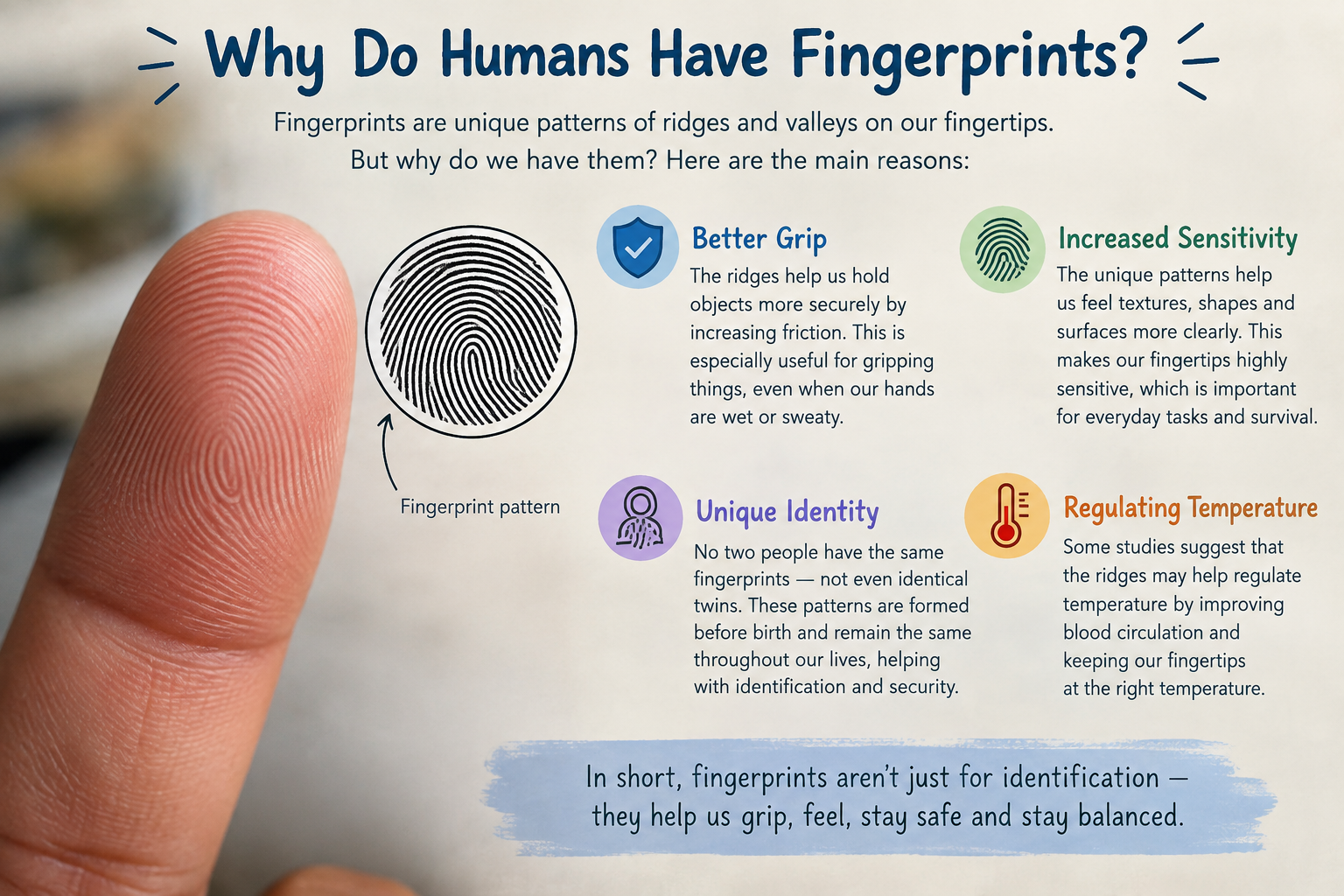
Fingerprints are one of the most interesting features of the human body. Every person has them, and even identical twins have different fingerprint patterns. We often use fingerprints to unlock phones, identify people, or investigate crimes, but fingerprints have a much deeper biological purpose.
The tiny lines and patterns on our fingertips begin developing before birth. They are shaped by a combination of genetics and conditions inside the womb. Once fingerprints are fully formed, their basic pattern remains remarkably stable throughout a person’s life.
But why do humans have fingerprints in the first place? Do they help us hold objects? Do they improve our sense of touch? Or are they simply a natural feature with no important purpose?
Scientists have studied fingerprints for many years, and research suggests that fingerprints may provide several useful advantages. They can influence how our fingers interact with surfaces, support our sense of touch, and help us handle objects. At the same time, some older explanations about fingerprints have been questioned by modern research.
In this article, we will explore the science behind fingerprints, how they develop, why they are unique, and what role they may play in everyday human life.
What Are Fingerprints?
Fingerprints are patterns of raised ridges and small grooves found on the skin of our fingertips. These ridges create the familiar patterns that we can see when looking closely at our fingers.
The raised areas are called friction ridges. Between them are small grooves. When the fingertips touch a surface, these ridges can leave behind a pattern made from sweat and natural oils from the skin.
Fingerprints are not limited to the fingertips. Similar friction ridge patterns can also be found on the palms of the hands and the soles of the feet.
The patterns on our fingers generally fall into three major groups. These are loops, whorls, and arches.
Loops
Loops are among the most common fingerprint patterns. The ridges enter from one side, curve around, and leave from approximately the same side.
There are different types of loops, including ulnar loops and radial loops. The name depends on the direction in which the pattern opens.
Whorls
Whorls have circular or spiral like patterns. They often look similar to a small target or swirl.
Whorl patterns can contain several circular ridge formations and are commonly used in fingerprint classification.
Arches
Arches are less common than loops and whorls. In an arch pattern, the ridges usually enter from one side and rise toward the center before moving toward the other side.
Some arches are simple, while others have a sharper central rise.
These patterns make fingerprints visually different from one person to another.
Why Are Fingerprints Unique?
One of the most remarkable facts about fingerprints is that no two people are known to have exactly the same fingerprint patterns.
Even identical twins, who share almost all of their genetic information, have different fingerprints.
This happens because fingerprint development is influenced by more than genes alone. The developing fingers experience small differences in conditions inside the womb. These differences can affect how the friction ridges form.
Factors such as the position of the fetus, movement, growth of the fingers, and conditions surrounding the developing skin may contribute to the final fingerprint pattern.
This means that genetics provide part of the basic instructions, while the physical environment during development also plays a role.
The result is a fingerprint pattern that is highly individual.
When Do Fingerprints Develop?
Fingerprints develop before a baby is born.
During early development, the skin on the fingers begins to change as the fetus grows. Specialized layers of skin develop, and friction ridges gradually form.
This process takes place during a period when the hands and fingers are growing rapidly.
The exact details of fingerprint development are complex. The ridges form through interactions between different layers of developing skin. Small differences in growth and pressure can influence the final arrangement.
By the time a baby is born, the basic fingerprint patterns are already established.
After birth, the fingerprints grow as the person grows, but the overall arrangement of the ridges remains largely the same.
Do Fingerprints Change as We Grow?
Fingerprints do not normally change their basic pattern as we grow older.
However, the size of the fingerprint increases as the fingers become larger.
Think about a child and an adult. Their fingerprints are not the same size, but the basic ridge arrangement remains consistent.
The skin can also become rougher, drier, or thinner with age. Cuts, burns, scars, and certain skin conditions can temporarily or permanently affect parts of a fingerprint.
The deeper structures that create the friction ridges, however, are usually stable.
This stability is one reason fingerprints can be useful for identification.
Do Fingerprints Help Us Grip Objects?
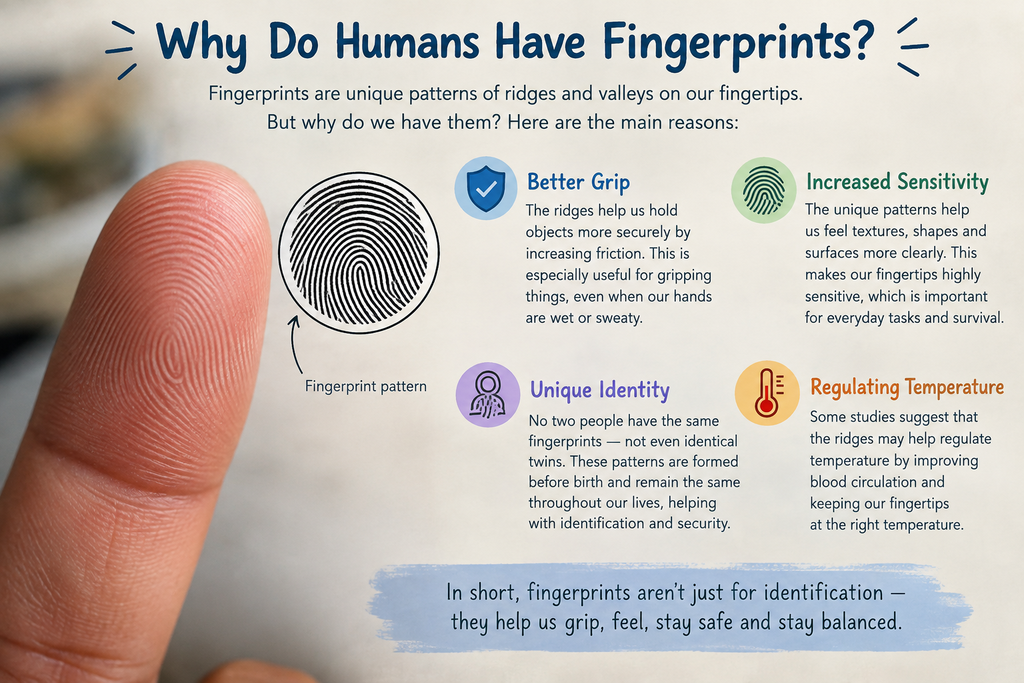
One of the most common explanations for fingerprints is that they help humans grip objects.
There is scientific evidence that friction ridges influence the way our fingers interact with surfaces. The ridges create areas of contact between the fingertip and an object.
However, the relationship between fingerprints and grip is more complicated than simply saying that fingerprints make everything easier to hold.
The friction between skin and an object depends on many factors. These include moisture, pressure, surface texture, material, and temperature.
Fingerprints may help the fingertip interact effectively with different surfaces, particularly during precise handling.
For example, when you pick up a small object, your fingertips need to control pressure carefully. The detailed surface structure of the skin may contribute to this process.
Fingerprints and the Sense of Touch
Fingerprints may also have an important relationship with our sense of touch.
Human fingertips contain many sensory receptors. These receptors allow us to detect pressure, vibration, texture, movement, and other physical changes.
The raised ridges on our fingertips can interact with surfaces while we touch them.
When the finger moves across a surface, the interaction between the ridges and the surface can create tiny patterns of vibration. Sensory receptors in the skin can detect these changes.
This may help the nervous system gather information about texture.
For example, you can close your eyes and rub your finger over a rough piece of fabric. Your brain can often recognize that the surface is rough without seeing it.
The fingertips are highly sensitive because humans depend heavily on touch for exploring and manipulating objects.
Why Are Fingerprints Called Friction Ridges?
The term friction ridge describes the raised patterns on the skin.
These ridges are found on areas of the body that frequently interact with surfaces, especially the fingers, palms, and soles of the feet.
The word friction refers to the resistance that occurs when two surfaces move against each other.
Because our fingertips have friction ridges, their surface is not completely smooth.
This specialized skin structure may provide useful control when humans handle objects.
It is important to remember that fingerprints are not simply tiny gripping tools. Their biological function likely involves several aspects of touch and interaction with the environment.
Could Fingerprints Help Prevent Slipping?
Fingerprints may contribute to grip, but scientists have debated exactly how much they improve it.
A common idea is that the ridges increase friction by creating more contact with an object. However, research has shown that the effect is not always straightforward.
The ridges can actually reduce the total area of direct contact compared with a completely flat surface.
Instead, their arrangement may help regulate contact and provide useful mechanical and sensory information.
The fingertips also contain sweat glands. Small amounts of moisture can influence friction between the skin and an object.
Too much moisture, however, can sometimes make surfaces more difficult to handle.
This is why fingerprints should not be thought of as a simple system designed only to prevent slipping.
Why Do We Have Fingerprints on Our Toes and Feet?
Friction ridges are not limited to the fingers.
They are also present on the palms and soles of the feet.
The soles of the feet experience pressure and contact whenever we stand or walk. Their specialized skin helps the feet interact with different surfaces.
The palms also frequently touch and manipulate objects.
This distribution suggests that friction ridge skin is associated with areas where humans need detailed contact with surfaces.
Fingerprints are simply the most familiar example of this specialized skin pattern.
Why Do Identical Twins Have Different Fingerprints?
Identical twins develop from the same fertilized egg and share extremely similar genetic information.
Yet their fingerprints are different.
This is an excellent example of how biological development involves both genetics and environmental conditions.
Genes influence the overall development of the body, but many small events occur during fetal development. The exact position of the hands, patterns of growth, pressure, and movement can differ.
These small differences can influence the final fingerprint arrangement.
As a result, even identical twins do not develop identical fingerprints.
Their fingerprints can be similar in general pattern, but the detailed ridge characteristics are different.
Can Fingerprints Tell Us Anything About a Person?
Fingerprints can tell us that a particular friction ridge pattern is associated with a particular individual.
They can also provide information useful for identification when a clear print is available.
However, fingerprints generally do not reveal personal characteristics such as personality, intelligence, or behavior.
Some claims have been made over the years suggesting that fingerprint patterns can reveal personality traits or predict a person’s future. These claims should not be confused with established fingerprint science.
The strongest scientific use of fingerprints is their role as a physical identification feature.
How Are Fingerprints Used Today?
Fingerprints have many practical applications in modern life.
One of the most familiar uses is digital security.
Many smartphones and other electronic devices use fingerprint sensors to recognize an authorized user.
Fingerprint identification is also used in certain workplaces, government systems, law enforcement databases, and border control systems.
In forensic science, investigators may compare fingerprints found at a scene with known fingerprint records.
The reliability of an identification depends on the quality of the print, the quality of the comparison, and the methods used by trained professionals.
A partial or unclear fingerprint may not provide enough information for a confident identification.
Why Do Fingerprints Leave Marks?
Fingerprints can leave marks because the skin contains sweat glands.
Sweat reaches the surface through small openings. When the fingertip touches another surface, moisture and natural substances from the skin can be transferred.
The resulting pattern can resemble the ridge structure of the finger.
This is why fingerprints may become visible on smooth surfaces such as glass, polished metal, or some plastic materials.
A fingerprint left on a surface is often called a latent fingerprint when it is not immediately visible.
Special methods can sometimes make these prints easier to see.
Do Fingerprints Have Any Connection With Sweat?
Yes, fingerprints and sweat are closely connected in everyday interactions with surfaces.
The ridges themselves are made from specialized skin tissue, while sweat glands release moisture through pores located within the friction ridge skin.
When we touch something, the moisture can transfer onto the surface.
This helps explain why fingerprints can sometimes be detected even when we do not intentionally leave them.
Our hands naturally produce small amounts of sweat throughout the day. The amount can change depending on temperature, activity, emotions, and other conditions.
Why Do Some People Have More Noticeable Fingerprints?
Fingerprints can look different depending on the condition of the skin.
Dry skin may make the ridges appear less noticeable. Moist skin may leave clearer marks on certain surfaces.
Age can also affect the appearance of the skin. Frequent exposure to water, chemicals, physical work, or friction can temporarily affect the outer layer of the skin.
Small injuries may change individual parts of a fingerprint.
A deep scar can permanently alter the ridge pattern in that particular area.
However, ordinary changes in the surface skin do not normally erase the underlying fingerprint pattern.
Can Fingerprints Disappear?
In most people, fingerprints remain throughout life.
The outer layer of skin is constantly replaced, but the structures responsible for the friction ridges remain stable.
A superficial cut may disappear as the skin heals, and the fingerprint pattern can return.
A deeper injury that damages the structures beneath the surface may leave a scar and permanently change a small part of the fingerprint.
Certain medical conditions and long term exposure to harsh substances can also affect the appearance of fingerprints.
Complete loss of fingerprints is unusual.
Are Fingerprints Only Useful for Humans?
Friction ridge patterns are not unique to humans.
Some other primates have specialized skin patterns on their hands and feet.
Certain animals also have textured skin surfaces that help them interact with their environments.
However, human fingerprints are particularly useful for identification because their detailed patterns are highly variable between individuals and remain relatively stable throughout life.
This combination of uniqueness and stability makes fingerprints especially valuable in human identification.
The Evolutionary Question
Scientists continue to study why friction ridges evolved.
It is tempting to say that fingerprints exist only to improve grip, but the full explanation may be more complicated.
Friction ridge skin probably provides a combination of mechanical and sensory benefits.
Humans have highly developed hands that allow us to perform precise tasks. We can write, sew, use tools, open containers, manipulate small objects, and perform countless other activities.
Our fingertips are central to these abilities.
The specialized skin on the fingertips is therefore likely connected to the broader biological need to interact with surfaces and gather detailed information through touch.
Why Fingerprints Matter in Everyday Life
Most people rarely think about their fingerprints during ordinary activities.
Yet our fingertips are constantly working.
When you hold a cup, type on a keyboard, turn a key, open a door, pick up a coin, or touch a phone screen, your fingertips are interacting with surfaces.
The friction ridges are part of the specialized skin that makes these interactions possible.
Fingerprints are therefore not simply patterns that police officers or phone manufacturers use. They are part of normal human anatomy.
Interesting Facts About Fingerprints
There are several fascinating facts about fingerprints.
Every person develops a unique combination of ridge details.
Identical twins have different fingerprints.
Fingerprint patterns develop before birth.
The basic fingerprint pattern usually remains stable throughout life.
Fingerprints are formed by friction ridges rather than simple lines drawn on the surface of the skin.
Fingerprints can leave marks because of sweat and natural substances present on the skin.
The fingertips, palms, and soles all contain friction ridge skin.
Small injuries may heal without changing the underlying pattern, while deeper injuries can create permanent scars.
Fingerprints can be used as one method of biometric identification.
These facts show how a simple looking feature of the human body has a surprisingly complex biological story.
Final Thoughts
So, why do humans have fingerprints?
The exact evolutionary purpose of fingerprints is not explained by one simple answer. Research suggests that friction ridges are involved in the way our fingers interact with surfaces and may also contribute to our ability to detect textures and vibrations through touch.
Fingerprints develop before birth through a complex combination of genetic instructions and conditions during fetal development. This process creates highly individual patterns, even among identical twins.
Their stability throughout life also makes fingerprints useful for identification and modern biometric security.
What looks like a collection of tiny lines on the fingertips is actually part of a specialized system that connects our skin, senses, movement, and interaction with the world.
The next time you look at your fingertips, remember that those small patterns were formed before you were born and have remained with you throughout your life. They are a simple but remarkable example of how detailed and individual the human body can be.