Soap is one of the most common cleaning products we use every day. We wash our hands with it, clean our bodies with it, and use different types of soap to remove dirt from clothes, dishes, and household surfaces. Although using soap seems very simple, the science behind how soap removes dirt and oil is surprisingly interesting.
Water alone can wash away some dust and loose particles, but it does not work very well on oily or greasy substances. This is because water and oil naturally resist mixing with each other. Soap solves this problem by acting as a bridge between water and oil. Its special molecular structure allows it to attach to grease on one side while interacting with water on the other side.
Understanding how soap helps remove dirt and oil gives us a useful look at chemistry in everyday life. It also explains why washing with soap is usually more effective than rinsing with water alone.
What Is Soap Made Of?
Soap is made from molecules that have two very different ends. One end is attracted to water, while the other end is attracted to oils and fats.
The water loving part of a soap molecule is known as the hydrophilic end. The word hydrophilic means that it is attracted to water. The other part is called the hydrophobic end. This part avoids water but is attracted to oil, grease, and other fatty substances.
This unusual structure is the reason soap works so well as a cleaner.
When soap is mixed with water, its molecules begin to organize themselves in ways that help lift oily dirt away from surfaces.
Why Water Alone Cannot Remove Oil Easily
To understand why soap is necessary, it helps to first understand the relationship between water and oil.
Water molecules are strongly attracted to one another. Oil molecules also tend to stay together. Since their chemical properties are different, water and oil do not easily mix.
This is why cooking oil forms droplets or a separate layer when placed in water.
The same thing happens when oily material sticks to the skin, dishes, clothes, or other surfaces. Water may flow over the oil without removing much of it.
If you try to wash a greasy plate with only cold water, much of the grease often remains. Once soap is added, however, the grease can be broken into much smaller droplets and carried away with the water.
How Soap Attaches to Dirt and Oil
When soap is added to water, the hydrophobic ends of its molecules are attracted to oily dirt.
These ends begin to move into the grease or oil. At the same time, the hydrophilic ends remain attracted to the surrounding water.
As more soap molecules gather around a small amount of grease, they form a structure that traps the oil inside.
This structure is called a micelle.
Inside a micelle, the oil loving ends of the soap molecules point inward toward the grease. The water loving ends point outward toward the surrounding water.
In this way, oily dirt that could not normally mix with water becomes surrounded by soap molecules.
Once the dirt is trapped inside these structures, water can carry it away.
What Are Micelles?
Micelles are one of the most important parts of the cleaning process.
A micelle is a tiny group of soap molecules arranged around a particle of oil or grease.
Imagine a small drop of cooking oil covered by hundreds of soap molecules. The oil attracting parts of the soap point toward the center, while the water attracting parts face outward.
The outside of the micelle can interact with water, allowing the oily material inside to remain suspended in the water rather than sticking back onto the surface.
During rinsing, the micelles containing oil and dirt flow away with the water.
This is one of the main reasons soap is able to clean greasy surfaces so effectively.
How Soap Helps Remove Ordinary Dirt
Not all dirt is oily.
Dust, soil, food particles, sweat, dead skin cells, and many other materials can collect on surfaces.
Some loose dirt can be removed by water alone. However, dirt often becomes mixed with natural skin oils, cooking grease, or other oily substances.
Once dirt becomes attached to oil, it can stick much more strongly to a surface.
Soap helps loosen the oily material holding the dirt in place.
As the grease is surrounded by soap molecules and lifted away, many dirt particles are released with it.
This allows rinsing water to carry both the oil and the attached dirt away.

Why Rubbing Makes Soap Work Better
Soap becomes more effective when combined with physical movement.
When we rub our hands together, scrub a plate with a sponge, or move fabric during washing, we create friction.
This movement helps loosen dirt from the surface.
It also helps spread soap molecules over a larger area so they can come into contact with more grease.
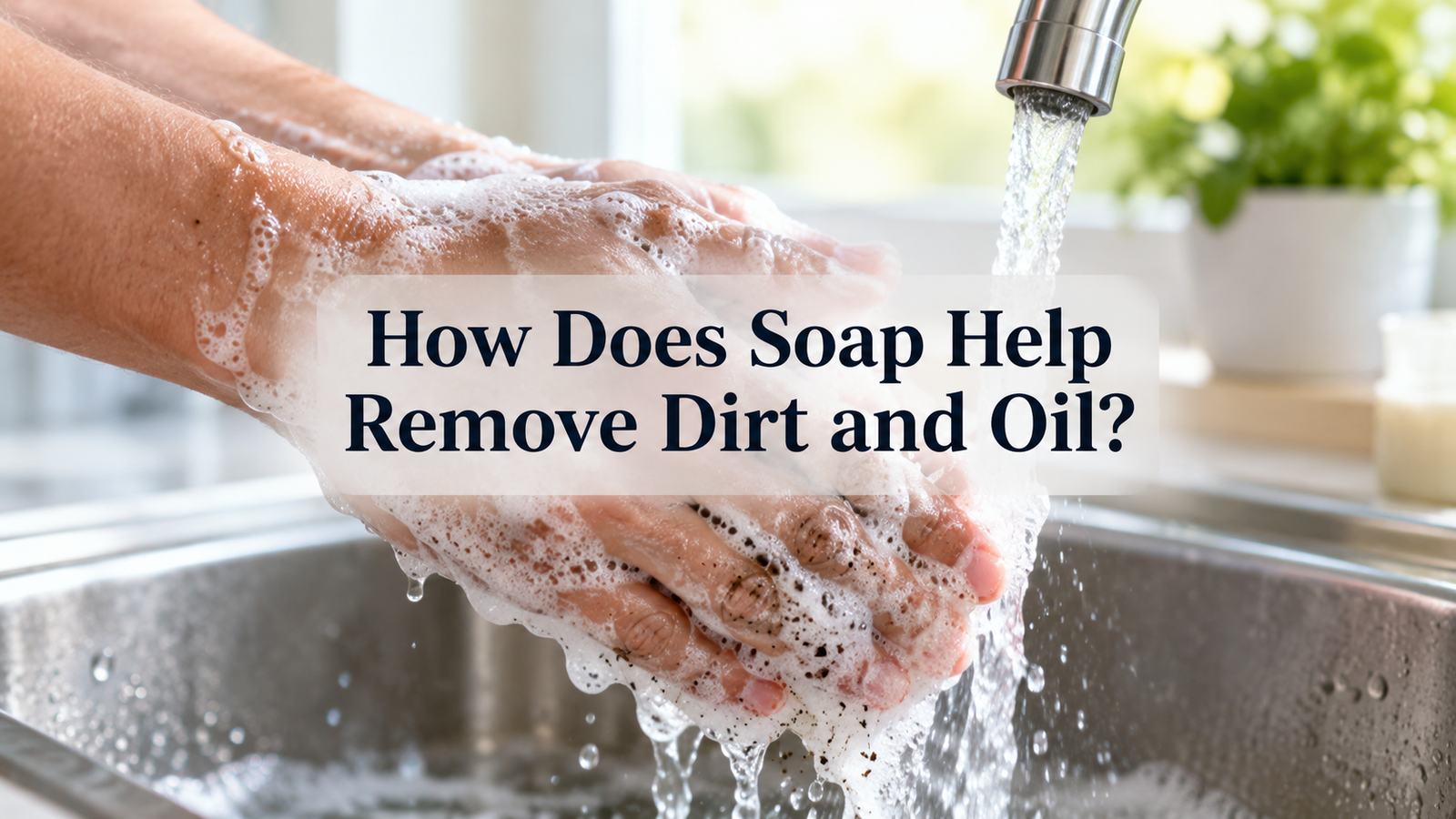
For example, when washing hands, rubbing the palms, fingers, fingertips, thumbs, and areas around the nails helps soap reach places where dirt and oils may collect.
Without rubbing, soap can still work, but its contact with dirt may be less complete.
This is why both soap and mechanical action are important parts of effective cleaning.
Why Warm Water Can Help
Warm water can sometimes make soap more effective, especially when dealing with grease.
Fats and oils often become softer or more fluid when warmed. This can make them easier for soap molecules to surround and remove.
Warm water can also help soap spread more easily across surfaces.
However, very hot water is usually unnecessary for normal cleaning. In many everyday situations, comfortable warm water or even cool water can work well when enough soap and proper rubbing are used.
The cleaning action mainly depends on the soap molecules interacting with dirt and oil.
How Soap Lowers Surface Tension
Soap also affects a property of water known as surface tension.
Water molecules attract each other strongly. This creates a kind of invisible tension at the surface of water.
Because of this surface tension, plain water does not always spread easily across certain materials.
Soap reduces the surface tension of water.
When the surface tension becomes lower, water can spread more easily over skin, fabric, dishes, and other surfaces.
This helps water reach small spaces and makes it easier for soap to come into contact with dirt.
Substances that reduce surface tension and help water interact with oils are often called surfactants.
Soap is a type of surfactant.
What Is a Surfactant?
The word surfactant comes from the idea of a surface active agent.
A surfactant changes the way liquids behave at surfaces.
Soap molecules are surfactants because they help water interact with substances that normally resist mixing with it.
Their hydrophilic and hydrophobic parts allow them to connect water with oily materials.
Many modern cleaning products contain surfactants that work in a similar way.
Dishwashing liquids, shampoos, laundry detergents, and household cleaners often contain surfactant molecules designed to remove different types of dirt.
Soap and Greasy Dishes
A greasy plate is a simple example of how soap works.
After eating oily food, a thin layer of fat may remain on the plate.
If the plate is rinsed with plain water, the water may slide over the grease without removing all of it.
When dish soap is added, the oil attracting parts of the soap molecules attach themselves to the grease.
As the plate is scrubbed, the grease breaks into smaller droplets.
Soap molecules surround these droplets and form micelles.
The water attracting parts of the molecules remain in contact with the water.
When the plate is rinsed, the suspended grease is carried away.
The same basic process happens when soap removes oil from many other surfaces.
How Soap Works on the Skin
Human skin naturally produces oils.
These oils help protect the skin, but they can also collect dust, sweat, and other substances.
When we wash with soap, the oil attracting parts of the soap molecules attach to some of these oily materials.
Rubbing helps loosen them from the skin.
Water then carries the soap, oil, and trapped dirt away.
However, frequent washing with strong soaps may remove too much natural oil from the skin. This can sometimes cause dryness.
For this reason, many hand and body cleansers are designed to clean effectively while being milder on the skin.
Does Soap Kill Germs?
Soap is especially useful because it can help remove many microorganisms from surfaces.
In many cases, ordinary soap does not need to kill every microorganism directly in order to be useful.
The cleaning process helps loosen microbes, oils, dirt, and organic material from the skin.
Rubbing and rinsing then physically remove much of this material.
Some microbes may also have outer structures that can be disrupted by certain soap molecules.
This is one reason regular handwashing with soap is widely used as a basic hygiene practice.
The combination of soap, water, rubbing, and rinsing is what makes handwashing effective.
Soap Compared With Detergent
Soap and detergent both contain molecules that help water mix with oily materials.
Traditional soap is usually made by reacting fats or oils with an alkaline substance.
Detergents are often made from different chemical ingredients, although they work through a similar basic principle.
Both contain molecules with a water attracting region and an oil attracting region.
One difference is that some traditional soaps do not perform as well in hard water.
Hard water contains minerals such as calcium and magnesium.
These minerals can react with soap and form a residue commonly called soap scum.
Many synthetic detergents are designed to work more effectively in hard water.
This is why detergents are commonly used in laundry products, dishwashing liquids, and household cleaners.
Why Soap Produces Foam
Many people associate foam with cleaning power.
When soap is mixed with water and air, bubbles can form. Soap molecules help stabilize the thin layer of water surrounding these air bubbles.
This creates foam.
Foam can help spread the cleaning product and make it easier to see where soap has been applied.
However, a large amount of foam does not always mean that a product is cleaning better.
The most important process happens when soap molecules interact with oil and dirt.
A low foaming cleaner can still be very effective.
Why Soap Needs to Be Rinsed Away
After soap surrounds oil and dirt, rinsing becomes important.
Without rinsing, the loosened material and soap may remain on the surface.
Running water carries away the micelles that contain grease and dirt.
Good rinsing also removes extra soap that may otherwise leave a residue.
This is why an effective cleaning process usually includes applying soap, rubbing or scrubbing, and then rinsing thoroughly.
Each part of the process has a purpose.
Why Soap Works Better With Enough Contact Time
Soap does not always remove stubborn grease instantly.
It needs time to come into contact with the oily material.
When a greasy pan is heavily coated, allowing soapy water to remain on the surface for a short time can help loosen the residue.
This gives soap molecules more opportunity to interact with the grease.
Scrubbing can then break up the softened material, and rinsing removes it.
The same general idea applies to many cleaning tasks.
Enough soap, good surface contact, movement, and rinsing usually provide better results than a very quick wash.
The Chemistry Behind Everyday Cleaning
The science of soap is a good example of chemistry working in ordinary life.
At first, washing something may seem like a purely physical process.
In reality, many tiny molecular interactions are happening.
Soap molecules move through the water, attach themselves to oil, surround grease particles, reduce surface tension, and help keep oily dirt suspended.
All of this happens on a microscopic scale.
We cannot see individual soap molecules or micelles with our eyes, but we can easily see the result when a greasy surface becomes clean.
Why Soap Has Been Used for So Long
People have used forms of soap for thousands of years.
The ingredients and manufacturing methods have changed greatly over time, but the basic purpose has remained the same.
Soap helps people remove substances that water alone cannot easily wash away.
Modern science has allowed manufacturers to create many specialized cleaning products.
Some are designed for sensitive skin. Others are made for fabrics, dishes, floors, or industrial surfaces.
Despite these differences, the basic cleaning principle is similar.
A molecule connects water with oily dirt so that the unwanted material can be lifted and rinsed away.
Using Soap Effectively
Soap works best when it is used correctly.
The surface should first come into contact with water when appropriate. Enough soap should then be applied to cover the area that needs cleaning.
Rubbing or scrubbing helps loosen dirt and increases contact between the soap and oily material.
Finally, clean water should be used to rinse everything away.
Using an excessive amount of soap usually does not provide a major advantage. Too much soap may simply take longer to rinse.
The goal is to use enough product to interact effectively with the dirt and oil.
Why Understanding Soap Is Useful
Learning how soap removes dirt and oil helps explain many common experiences.
It explains why greasy dishes are difficult to clean with water alone.
It explains why soap can remove oily material from the skin.
It also explains why many cleaning products contain surfactants.
Once we understand the structure of a soap molecule, the entire cleaning process becomes easier to understand.
One end of the molecule prefers water.
The other end prefers oil.
By connecting these two different substances, soap allows oily dirt to become suspended in water and washed away.
Conclusion
So, how does soap help remove dirt and oil?
Soap works because each soap molecule has two important parts. One part is attracted to water, while the other is attracted to oils and fats.
The oil attracting part attaches itself to greasy dirt, while the water attracting part remains connected to the surrounding water.
Groups of soap molecules then surround small droplets of oil and form micelles. These micelles keep the oily material suspended in water so it can be carried away during rinsing.
Soap also lowers the surface tension of water, allowing water to spread more easily across surfaces. Rubbing and scrubbing help loosen dirt, while rinsing removes the trapped oil, dirt, and soap.
What looks like a simple washing process is actually a carefully organized chemical interaction happening at the molecular level.
Soap does not simply make water smell pleasant or create bubbles. Its molecular structure allows water to do something it normally struggles to do: remove oily dirt.
That is why soap remains one of the simplest and most useful cleaning tools in everyday life.