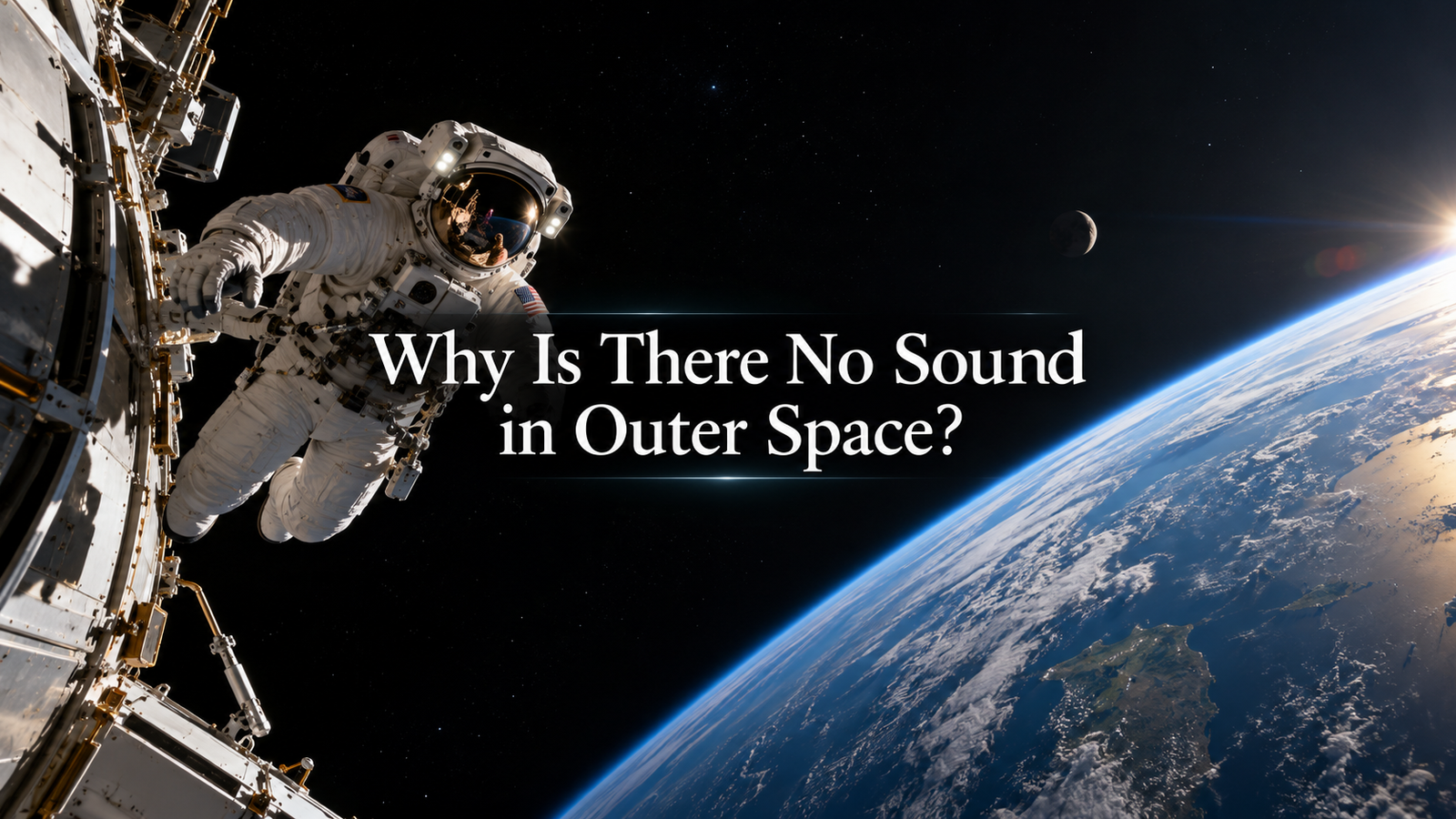
When we watch science fiction movies, space often seems full of noise. Spaceships roar past planets, explosions shake the screen, and powerful engines create dramatic sounds. In reality, outer space is very different. If a large explosion happened near an astronaut in open space, the astronaut would not hear it through the surrounding space. This may seem strange at first, but the reason becomes easy to understand once we learn how sound works.
The simple answer to the question, why is there no sound in outer space, is that sound needs matter to travel through. On Earth, sound usually moves through air. Outer space contains extremely little matter, so there are not enough particles to carry ordinary sound waves from one place to another.
Understanding this idea helps us learn not only about space but also about sound, air, vibrations, planets, stars, and the physical conditions found beyond Earth.
What Is Sound?
Sound begins with vibration.
When an object vibrates, it causes nearby particles to move. These particles then push and pull on other particles around them. In this way, the vibration travels through a material as a sound wave.
For example, when a person speaks, the vocal cords in the throat vibrate. These vibrations disturb the air nearby. Air molecules move back and forth and pass the vibration through the air until it reaches another person’s ears.
The ears detect these vibrations, and the brain interprets them as sound.
The important point is that sound does not simply travel by itself. It needs particles that can transfer vibration.
These particles can belong to gases, liquids, or solids.
That is why we can hear sound through air, underwater, and even through solid materials.
Why Sound Needs a Medium
Scientists use the word medium to describe the material through which a wave travels.
Air can act as a medium for sound. Water can also act as a medium. Metals, wood, glass, and many other solid materials can carry sound as well.
Imagine a long row of people standing close together. If the first person gently pushes the second person, the movement can travel down the line as each person pushes the next one.
Sound behaves in a somewhat similar way.
Instead of people passing movement from one person to another, particles pass vibration from one particle to another.
If the people were spread extremely far apart, the push would no longer move easily through the group.
This gives us a useful way to understand why there is no sound in outer space. The particles in space are simply too widely separated for ordinary sound waves to travel in the way they do through Earth’s atmosphere.
Is Outer Space Completely Empty?
People often describe outer space as empty, but this is not completely accurate.
Space contains particles, gases, dust, radiation, stars, planets, asteroids, comets, and many other forms of matter and energy.
However, the amount of matter in most regions of space is incredibly small compared with the amount of matter in Earth’s atmosphere.
At sea level on Earth, the air contains a huge number of molecules packed into a relatively small volume.
In space, particles may be separated by large distances.
Because there are so few particles, they cannot efficiently transfer ordinary sound vibrations over long distances.
For this reason, scientists often describe space as a near vacuum.
A vacuum is a region containing very little matter.
Since sound requires matter, a vacuum is not suitable for ordinary sound waves.
Why Can We Hear Sound on Earth?
Earth is surrounded by an atmosphere made mainly of nitrogen and oxygen, along with smaller amounts of other gases.
The molecules in this atmosphere are close enough together to transfer vibrations.
Suppose someone claps their hands.
The movement of the hands pushes nearby air molecules. Those molecules push others, creating changes in air pressure. The pressure changes move outward from the source as sound waves.
When the waves reach your ears, they cause parts of the ear to vibrate. Your nervous system then sends information to your brain, which recognizes the sound of the clap.
Without air or another material between the source and your ears, the sound cannot travel in the normal way.
This is why the presence of Earth’s atmosphere is so important for hearing.
What Would Happen If You Shouted in Space?
Imagine that two astronauts are floating outside a spacecraft.
If one astronaut tried to shout at the other without using communication equipment, the second astronaut would not hear the shout through outer space.
The first astronaut’s vocal cords could still vibrate inside the spacesuit. However, those vibrations would not travel through the vacuum between the astronauts.
Fortunately, astronauts do not depend on ordinary sound traveling through space.
They use radio communication.
A microphone inside the helmet changes the astronaut’s voice into electrical signals. These signals are then transmitted using radio waves. A receiver in another astronaut’s equipment receives the signal and changes it back into sound.
This allows astronauts to talk even though sound itself cannot travel through the empty space between them.
Why Radio Waves Can Travel Through Space
Sound waves and radio waves are very different.
Sound is a mechanical wave. It depends on particles moving and transferring vibration.
Radio waves are part of the electromagnetic spectrum. Like visible light, they can travel through a vacuum.
They do not need air, water, or another physical material to move from one place to another.
This is why radio communication is so important in space exploration.
Spacecraft can send information across millions or even billions of kilometers using radio signals.
Scientists on Earth can receive information from probes exploring distant parts of the solar system even though no ordinary sound can travel between the spacecraft and Earth.
Can Sound Travel Inside a Spacecraft?
Yes.
A spacecraft contains air inside its pressurized living areas.
Because air is present, sound can travel normally inside the spacecraft.
Astronauts can hear each other speaking. They can hear fans, equipment, alarms, computers, pumps, and other machines.
In fact, spacecraft can sometimes be quite noisy inside because many systems must operate continuously.
Sound can also travel through the solid structure of a spacecraft.
Vibrations from engines, machines, and equipment may pass through metal surfaces and other materials.
So saying that there is no sound in space does not mean that astronauts experience complete silence everywhere.
It means ordinary sound cannot move through the vacuum of open space.
Can Sound Travel on Other Planets?
Whether sound can travel on another planet depends mainly on whether the planet has an atmosphere.
Mars, for example, has an atmosphere, although it is much thinner than Earth’s atmosphere.
Sound can travel through the Martian atmosphere, but it behaves differently because the air pressure and gas composition are different.
Venus has a very thick atmosphere, so sound could also travel there.
On worlds with little or no atmosphere, sound would have much greater difficulty traveling through the open environment.
This shows that sound is closely connected to the physical properties of a planet’s atmosphere.
What About the Moon?
The Moon has almost no atmosphere.
Its surface is surrounded by an extremely thin collection of particles rather than the thick atmosphere found on Earth.
Because there is no significant air around the Moon, ordinary sound cannot travel freely across its surface.
If two astronauts were standing on the Moon and one struck a tool against a rock, the other astronaut would not hear the sound through the surrounding space.
However, vibrations might travel through solid objects if the astronauts were physically connected to them.
For example, vibrations could move through the ground, a spacecraft structure, or equipment.
Again, this demonstrates that sound needs some kind of material.
Why Do Movies Put Sound in Space?
Films often include sound during space scenes because complete silence can feel less exciting to audiences.
A silent spacecraft battle might be scientifically realistic, but dramatic sound effects make the scene more emotional and entertaining.
Explosions, engine sounds, alarms, and impacts help viewers understand what is happening.
Filmmakers are usually trying to create an enjoyable experience rather than a perfect scientific simulation.
Some movies and documentaries do use silence to show how space actually behaves. These moments can be surprisingly powerful because they remind us how different outer space is from Earth.
Do Stars Make Sound?
Stars contain huge amounts of hot gas and plasma.
Inside a star, matter is present, so pressure waves and vibrations can move through the material.
Scientists can study these vibrations to understand what is happening inside stars.
However, the sound cannot simply travel across the vacuum of space until it reaches Earth.
There is not enough matter between the stars and our planet to carry ordinary sound waves.
Scientists may sometimes convert scientific data from stars into sounds that humans can hear.
This process is useful for research and education, but it does not mean that the original sound traveled naturally through empty space to our ears.
Can Space Have Vibrations?
Yes.
The universe contains many types of waves and vibrations.
Electromagnetic waves move through space constantly. These include visible light, radio waves, microwaves, infrared radiation, ultraviolet radiation, X rays, and gamma rays.
Gravitational waves can also move through the universe.
These waves are very different from ordinary sound waves.
Scientific instruments can detect some types of signals from space and convert the data into audio.
When we hear these recordings, we are often hearing a representation of scientific information rather than normal sound traveling through a vacuum.
This distinction is important when learning about space science.
Why Explosions in Space Would Be Silent
Suppose an object exploded in open space.
The explosion could release light, heat, radiation, gas, and fast moving debris.
A nearby observer might see a bright flash.
However, without enough matter between the explosion and the observer, the pressure waves associated with sound would not travel normally across the vacuum.
The explosion itself would still involve tremendous amounts of energy.
The lack of sound does not mean nothing is happening.
It simply means there is no suitable medium carrying the vibration to the observer’s ears.
This is one of the clearest examples of why outer space has no sound.
Why Space Is Often Described as Silent
From a human perspective, outer space is silent because our ears depend on pressure changes moving through matter.
Our hearing system developed in Earth’s atmosphere.
We are naturally designed to detect vibrations in air.
Space is an environment very different from the one our bodies evolved to live in.
There is almost no air, the pressure is extremely low, temperatures can vary greatly, and radiation levels can be dangerous.
Without protective equipment, humans cannot survive in open space.
The absence of sound is just one of many differences between Earth and the space environment.
A Simple Experiment That Explains Sound in Space
Scientists can demonstrate the relationship between sound and air using a vacuum chamber.
Imagine placing a ringing alarm inside a sealed container.
At first, when air is present, the ringing can be heard clearly.
As air is gradually removed from the container, the sound becomes weaker.
Eventually, when very little air remains, the alarm may still be vibrating, but the sound outside becomes extremely difficult to hear.
The alarm has not stopped working.
There are simply fewer air molecules available to carry the vibrations.
This experiment provides a simple model for understanding what happens in outer space.
Why Understanding Space Sound Matters
Learning why sound cannot travel through outer space teaches us several important ideas about physics.
It shows that waves do not all behave in the same way.
Some waves require matter. Others do not.
Sound needs a physical medium, while electromagnetic waves such as light and radio waves can travel through a vacuum.
This difference makes modern space exploration possible.
If radio waves needed air, communicating with spacecraft would be extremely difficult.
Instead, radio signals can cross enormous distances through space and bring information back to Earth.
Final Thoughts
So, why is there no sound in outer space?
The answer comes down to one basic scientific principle. Sound requires matter to carry vibrations.
On Earth, air molecules transfer sound from one location to another. In water, liquid particles perform the same job. In solids, tightly connected particles can carry vibrations very effectively.
Outer space is mostly a vacuum. The particles that exist there are generally too far apart to carry ordinary sound waves in the way Earth’s atmosphere does.
That is why an astronaut cannot hear another astronaut shouting through open space and why a distant explosion would not produce a booming sound reaching human ears through the vacuum.
Space may appear full of activity, light, radiation, moving planets, exploding stars, and powerful cosmic events, but to human ears, open space remains almost completely silent.
This silence is not because the universe is inactive. It exists because sound needs something to travel through, and in the vast emptiness between planets and stars, there is simply not enough matter to carry it.