Rain is one of the most familiar parts of weather. We see dark clouds gather in the sky, feel the air become cooler, and then watch drops of water begin to fall. It may look simple from the ground, but the process happening inside a cloud is surprisingly interesting.
So, how does rain form inside clouds?
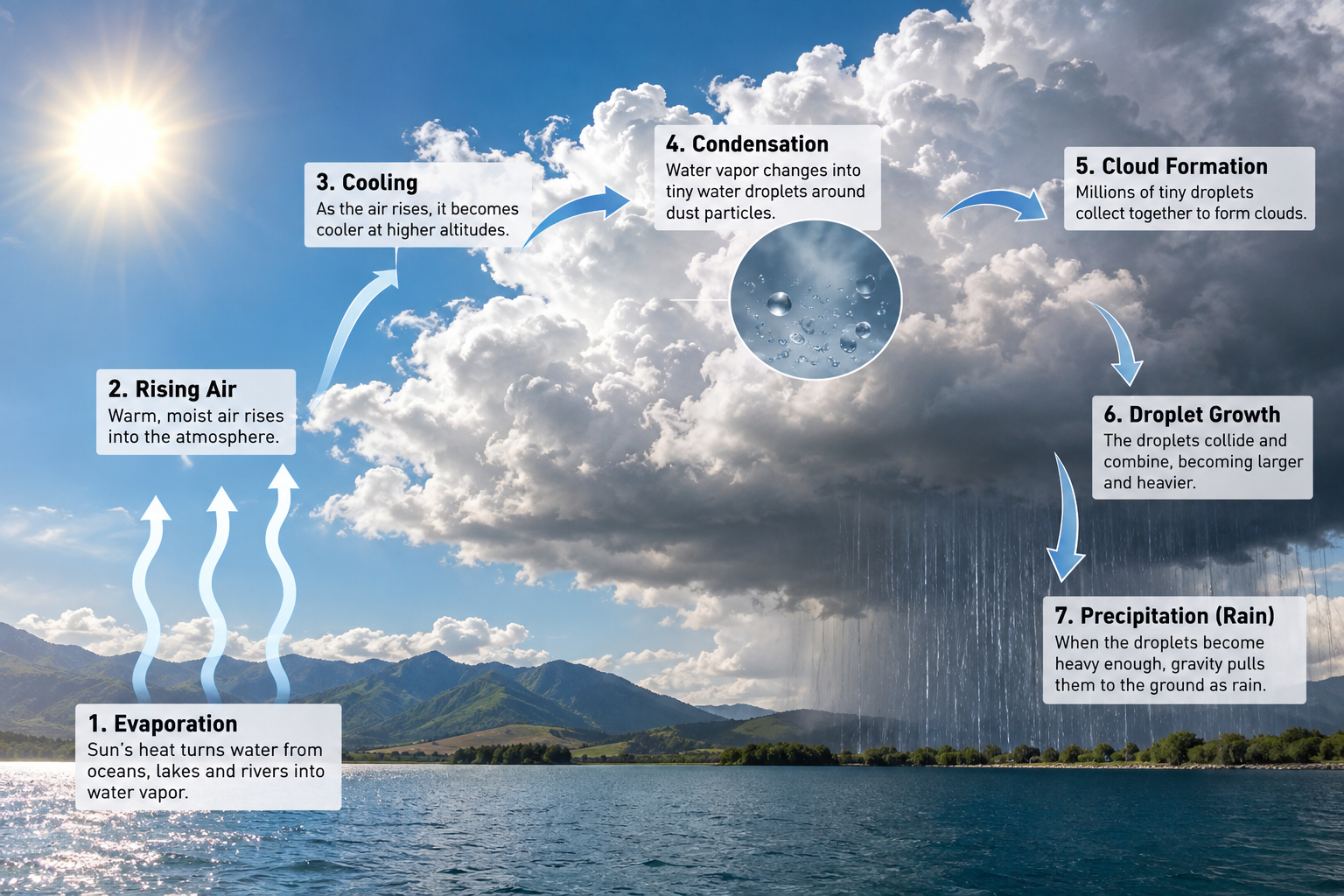
Rain begins with water from the surface of Earth. Heat from the Sun causes water from oceans, rivers, lakes, soil, and plants to enter the atmosphere as water vapor. This invisible vapor rises with warm air. As it travels higher into the atmosphere, the air becomes cooler. Eventually, the water vapor changes into tiny droplets of liquid water. These droplets gather together and form clouds.
However, the formation of a cloud does not automatically mean that rain will fall. The water droplets inside a cloud are extremely small. They must grow much larger before gravity can pull them toward the ground.
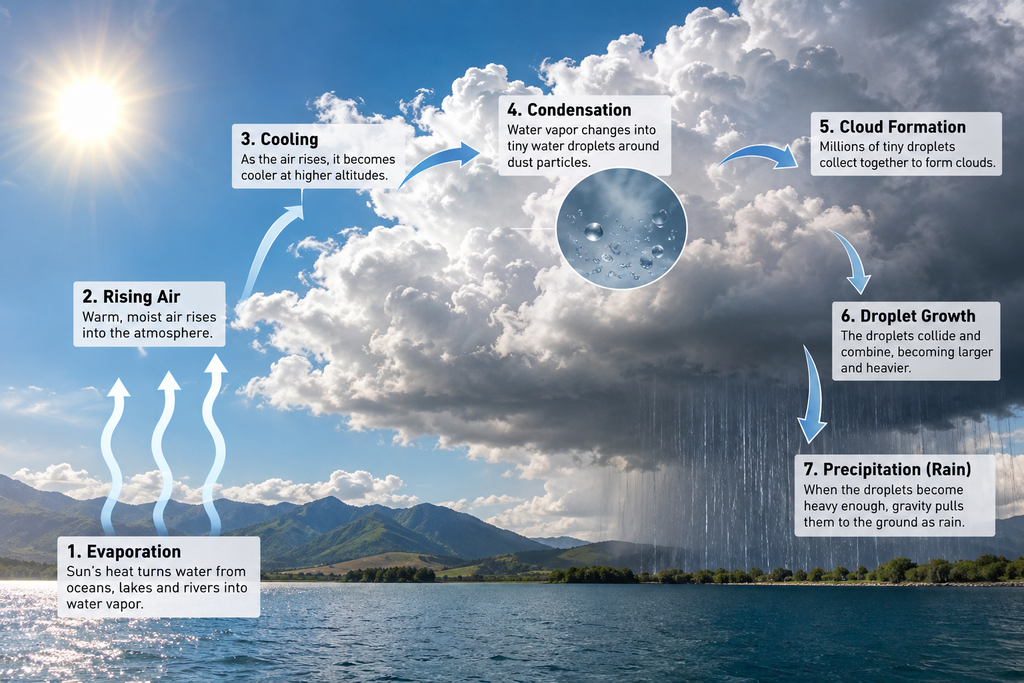
The complete process involves evaporation, rising air, cooling, condensation, cloud formation, droplet growth, and finally precipitation.
Understanding how rain forms inside clouds helps us understand not only weather but also the water cycle that supports almost every form of life on Earth.
Rain Begins With the Water Cycle
To understand how rain forms, we first need to understand the water cycle.
Earth has an enormous amount of water. Most of it is found in oceans, while smaller amounts exist in rivers, lakes, glaciers, soil, underground water, plants, animals, and the atmosphere.
This water is constantly moving.
The Sun provides the energy that powers much of this movement. When sunlight warms water at the surface of oceans, lakes, and rivers, some water molecules gain enough energy to escape into the air.
This process is called evaporation.
Liquid water becomes water vapor, which is an invisible gas. Water vapor then becomes part of the atmosphere.
Plants also contribute water vapor through a process called transpiration. Plants absorb water through their roots, transport it through their tissues, and eventually release some of it through tiny openings in their leaves.
Together, evaporation and transpiration continuously add moisture to the atmosphere.
Warm Air Carries Water Vapor Upward
Water vapor alone does not create rain. The moist air must usually rise.
Warm air is generally less dense than cooler air around it, so it tends to move upward.
Imagine the ground on a sunny day. Sunlight warms the surface, and the surface warms the air above it. This warm air begins to rise.
If the air contains plenty of water vapor, it carries that moisture upward with it.
Air may also rise when it encounters mountains, weather fronts, or large areas of low pressure.
No matter what causes the air to rise, something important happens as it moves higher.
It cools.
Why Does Rising Air Become Cooler?
Air pressure decreases with altitude.
Near the surface of Earth, the weight of the atmosphere creates relatively high pressure. Higher in the sky, there is less air above, so atmospheric pressure becomes lower.
When a parcel of air rises into an area of lower pressure, it expands.
Expansion requires energy. As the air expands, its temperature decreases.
This cooling process is extremely important because warm air can contain more water vapor than cool air.
As moist air rises and cools, it eventually reaches a temperature at which it can no longer keep all its water in the form of vapor.
This temperature is closely connected with what meteorologists call the dew point.
Once enough cooling occurs, condensation can begin.
Condensation Creates Cloud Droplets
Condensation is the process in which water vapor changes from a gas into liquid water.
When rising moist air cools sufficiently, water vapor begins to condense into tiny droplets.
However, water vapor usually needs something to condense onto.
The atmosphere contains enormous numbers of microscopic particles. These may include tiny pieces of dust, sea salt, smoke, pollen, and other materials.
Scientists often call suitable particles condensation nuclei.
Water molecules gather around these particles and form tiny droplets.
Each cloud may contain millions or even billions of these microscopic water droplets.
A cloud therefore looks like a large object from the ground, but it is actually made from an enormous collection of tiny droplets or ice crystals floating in the air.
Why Do Cloud Droplets Stay in the Sky?
A common question is why water inside clouds does not immediately fall.
The answer is mainly connected to size.
The droplets that initially form inside clouds are incredibly small. A typical cloud droplet may be only a tiny fraction of a millimeter across.
Because these droplets are so small, rising air currents can easily keep them suspended.
Gravity is always pulling the droplets downward, but air resistance and upward moving air can prevent them from falling very far.
For rain to develop, cloud droplets must become much larger.
How Do Tiny Droplets Become Raindrops?
There are two major processes through which precipitation can develop inside clouds.
One is common in warmer clouds and involves droplets colliding and combining.
The other is especially important in colder clouds and involves ice crystals.
Both processes can eventually create raindrops.
Collision and Coalescence
In warm clouds, many droplets remain liquid because temperatures are above freezing.
Not every cloud droplet is exactly the same size.
Some become slightly larger than others.
Larger droplets tend to fall faster through the cloud than smaller droplets. As a larger droplet moves downward, it may collide with smaller droplets.
If the droplets join together after colliding, the process is called coalescence.
The combined droplet becomes larger.
As it grows, it can fall faster and collide with even more droplets.
This creates a kind of growth process.
A droplet may begin as a microscopic speck of liquid water and gradually grow until it becomes large enough for gravity to overcome the air currents holding it inside the cloud.
It then begins falling toward Earth as rain.
This process is particularly important in warm tropical clouds.
Ice Crystals Can Also Help Create Rain
Many clouds extend into areas of the atmosphere where temperatures are below freezing.
These clouds may contain a mixture of water droplets and ice crystals.
Interestingly, some liquid droplets can remain unfrozen even when the temperature is below zero degrees Celsius. These are called supercooled water droplets.
Inside a cold cloud, ice crystals can grow as water vapor collects around them.
The ice crystals may also collide with other crystals and droplets, causing them to become larger.
Eventually, the growing ice particles become heavy enough to fall.
If they fall through warmer air below the cloud, they melt and become liquid raindrops before reaching the ground.
This means that some rain that reaches us as liquid water may actually have started its journey inside the cloud as ice or snow.
When Does a Drop Become Heavy Enough to Fall?
Cloud droplets are extremely small, while raindrops are much larger.
Once a water drop reaches sufficient size, gravity becomes strong enough to pull it downward despite resistance from the surrounding air.
As the drop falls, it may continue collecting smaller droplets.
However, raindrops cannot grow without limit.
Very large drops become unstable because air pushes against them as they fall.
Instead of looking like perfect teardrops, falling raindrops are usually closer to rounded shapes when small and become somewhat flattened underneath as they grow larger.
If a drop becomes too large, air resistance can cause it to break into smaller drops.
Does Every Cloud Produce Rain?
No.
Many clouds never produce rain that reaches the ground.
Some clouds simply do not contain enough moisture.
In other cases, droplets do not become large enough to fall.
Sometimes precipitation begins falling from a cloud but passes through dry air below it and evaporates before reaching the ground.
Meteorologists call this phenomenon virga.
From a distance, virga may appear as streaks hanging underneath a cloud that disappear before reaching Earth.
So the presence of dark clouds does not always guarantee rainfall.
Why Are Rain Clouds Often Dark?
Rain clouds frequently appear gray or dark because they are thick and contain large quantities of water droplets and ice crystals.
Thin clouds allow plenty of sunlight to pass through them.
Thicker clouds scatter and block more sunlight.
When a cloud contains a great depth of water droplets, less sunlight reaches its lower surface.
From the ground, the bottom of the cloud may therefore appear dark gray.
This is why approaching storm clouds often seem much darker than small fair weather clouds.
What Types of Clouds Produce Rain?
Different clouds can produce different kinds of rainfall.
Stratus clouds are relatively flat clouds that may cover large areas of the sky. They can produce light rain or drizzle.
Nimbostratus clouds are thick, widespread clouds associated with steady rain that may continue for hours.
Cumulonimbus clouds are tall storm clouds that can produce intense rain, thunder, lightning, strong winds, and sometimes hail.
These clouds may extend many kilometers upward through the atmosphere.
Strong rising air currents inside cumulonimbus clouds can carry water droplets and ice particles high into the cloud before they eventually become heavy enough to fall.
Why Does Some Rain Fall Gently While Other Rain Is Heavy?
Rainfall intensity depends on several factors.
One of the most important is the amount of moisture available inside the cloud.
A cloud containing large quantities of water can potentially produce heavier rainfall.
The strength of rising air currents also matters.
Strong upward currents can keep water droplets and ice particles inside a cloud for longer periods. During this time, the particles can continue growing.
Cloud depth is another factor.
Tall clouds provide more space for droplets and ice crystals to grow.
Weather conditions around the cloud also influence rainfall.
A gentle weather system may create steady light rain, while powerful thunderstorms may produce intense rainfall over a short period.
What Happens to Rain After It Reaches the Ground?
The journey of water does not end when a raindrop hits the ground.
Some rainfall flows across the surface into streams, rivers, lakes, and eventually oceans.
This movement is called runoff.
Some water enters the soil.
Plants may absorb part of this water through their roots.
Other water moves deeper underground and becomes groundwater.
Some rainwater may remain in lakes or reservoirs for long periods.
Eventually, heat from the Sun causes water to evaporate again.
The same water molecules may travel through the water cycle repeatedly for extremely long periods of time.
A drop of water falling during a rainstorm today may contain molecules that have moved through oceans, rivers, clouds, plants, and living organisms many times throughout Earth’s history.
Why Is Rain Important for Life?
Rain is essential for life on Earth.
Plants depend on water for photosynthesis, growth, and the transport of nutrients.
Animals depend on plants and water supplies that are maintained by rainfall.
Rain fills rivers, lakes, reservoirs, and underground water sources.
Agriculture also depends heavily on rainfall.
In many regions, farmers rely on seasonal rain to grow crops. Too little rain can lead to drought, while too much rain in a short period can cause flooding.
Rain also influences ecosystems.
Forests, grasslands, deserts, wetlands, and other environments receive different amounts of rainfall, helping determine which plants and animals can survive in each region.
Without the continuous movement of water through the atmosphere and the formation of rain inside clouds, Earth’s landscapes and ecosystems would look completely different.
Why Does Rainfall Differ Around the World?
Rain does not fall equally across Earth.
Some tropical regions receive enormous amounts of rainfall because warm temperatures create strong evaporation and rising moist air.
Deserts receive very little rainfall because atmospheric conditions often prevent moist air from rising and forming rain producing clouds.
Mountains can also strongly influence rainfall.
When moist air encounters a mountain range, it is forced upward. As the air rises, it cools and may produce clouds and rain.
The opposite side of the mountain can remain much drier because much of the moisture has already fallen.
This helps explain why wet forests may exist on one side of a mountain range while dry landscapes appear on the other.
Ocean temperatures, wind patterns, latitude, elevation, and large atmospheric circulation systems all influence rainfall around the world.
How Long Does It Take for Rain to Form?
There is no single answer.
Clouds can develop quickly when warm moist air rises strongly.
During thunderstorms, cloud formation and heavy rainfall can sometimes develop within a relatively short period.
Other weather systems develop much more slowly and may cover enormous areas.
The time needed for precipitation to form depends on temperature, humidity, cloud type, air movement, and the number and size of droplets and ice crystals inside the cloud.
What appears to us as a sudden shower is actually the result of many physical processes happening together in the atmosphere.
Is Rainwater Pure?
Rain begins from water that has evaporated from Earth’s surface.
When water evaporates, many dissolved substances such as salt are left behind.
This is why water evaporating from the ocean does not create salty rain.
However, falling raindrops can interact with gases and particles in the atmosphere.
Rainwater may therefore contain small amounts of dust, salts, gases, or pollutants collected from the air.
Its composition can vary depending on local atmospheric conditions.
The Amazing Journey Behind Every Raindrop
The next time rain begins falling, it is worth thinking about the journey behind every drop.
The water may have started in an ocean hundreds or thousands of kilometers away.
Sunlight caused part of that water to evaporate.
Winds transported the moist air across the atmosphere.
The air rose and cooled.
Water vapor condensed around microscopic particles.
Tiny droplets formed a cloud.
Those droplets collided, combined, froze, melted, or grew until gravity finally pulled them toward Earth.
What looks like a simple raindrop is actually the final result of a remarkable atmospheric process.
Final Thoughts
So, how does rain form inside clouds?
Rain begins when water evaporates from Earth’s surface and enters the atmosphere as water vapor. Moist air rises and becomes cooler. When the air cools enough, water vapor condenses around tiny particles and creates microscopic cloud droplets.
Inside the cloud, these droplets continue growing. In warm clouds, droplets collide and combine with one another. In colder clouds, ice crystals can grow and later melt as they fall through warmer air.
Eventually, the water droplets become large and heavy enough for gravity to pull them out of the cloud.
They fall toward the surface as rain.
This process is one of the most important parts of the water cycle. It connects oceans, atmosphere, land, plants, animals, and people through the continuous movement of water.
Rain may seem ordinary because we see it so often, but the science behind it shows how active and connected Earth’s atmosphere really is.
Every rainfall begins with sunlight, moving air, invisible water vapor, microscopic particles, and millions of tiny droplets working together inside a cloud.
That is how rain forms inside clouds.