Sugar dissolves faster in warm water because warm water molecules move more quickly and interact with sugar crystals more often. This extra molecular movement helps pull sugar particles away from the crystal and spread them throughout the water. It is a simple process that we can observe in everyday life, but it is also a good example of how temperature affects matter at the molecular level.
Most people notice this when making tea, coffee, lemonade, or another sweet drink. If sugar is added to cold water, it may settle at the bottom and require a lot of stirring. When the same amount of sugar is added to warm water, it usually disappears much more quickly. The sugar has not vanished. It has dissolved and become evenly mixed with the water.
Understanding why sugar dissolves faster in warm water helps us understand important ideas such as molecular motion, solubility, temperature, and the way substances interact.
What Does It Mean When Sugar Dissolves?
When sugar dissolves in water, its particles separate from the solid sugar crystal and become surrounded by water molecules.
A sugar crystal is made of many sugar molecules arranged together in an organized structure. When the crystal is placed in water, water molecules begin interacting with the sugar molecules on the surface.
Water molecules are attracted to sugar molecules because sugar contains several parts that can interact strongly with water. As water surrounds the sugar molecules, it gradually pulls them away from the crystal.
The separated sugar molecules then spread throughout the water.
This is why dissolved sugar can no longer be seen even though it is still present. If the water were removed by evaporation, the sugar could be left behind again.
Why Does Temperature Matter?
Temperature is closely connected with the movement of particles.
In colder water, water molecules have less kinetic energy. This means they move more slowly.
In warm water, the molecules have more kinetic energy. They move faster and collide with other particles more frequently.
These faster moving water molecules interact with the surface of the sugar crystal more often. As a result, sugar molecules are separated from the crystal at a faster rate.
This increased movement is one of the main reasons why sugar dissolves faster in warm water.
Faster Molecular Movement Helps Sugar Dissolve
Everything around us is made of particles that are constantly moving.
Even though a glass of water may look completely still, billions of water molecules are moving inside it.
When the water is heated, these molecules move faster.
Imagine the sugar crystal sitting at the bottom of a glass. Water molecules continuously strike the surface of the crystal. Each interaction can help loosen sugar molecules from the solid structure.
In warm water, more collisions occur in a shorter amount of time. This means sugar molecules can leave the crystal more quickly.
Once they enter the water, the faster movement also helps spread them through the liquid.
Warm Water Spreads Dissolved Sugar Faster
Dissolving is not only about pulling molecules away from a solid crystal. The dissolved molecules must also move away from the surface so that new water molecules can reach the remaining sugar.
Warm water helps this happen.
Because the particles are moving more quickly, dissolved sugar molecules are carried away from the crystal faster. This allows fresh water molecules to come into contact with the sugar surface.
The process continues until the sugar has dissolved or the water has reached the maximum amount of sugar it can hold under those conditions.
The Role of Diffusion
Another process involved in dissolving sugar is diffusion.
Diffusion is the natural movement of particles from an area where they are more concentrated to an area where they are less concentrated.
When sugar begins dissolving, there is a high concentration of sugar molecules near the crystal.
These molecules gradually spread into the rest of the water.
Higher temperatures generally increase the speed of molecular movement, so diffusion happens faster in warm water than in cold water.
This helps distribute the sugar more evenly throughout the liquid.
Does Warm Water Hold More Sugar?
Temperature can also affect how much sugar water can dissolve.
For many solid substances, including ordinary table sugar, warmer water can dissolve more material than colder water.
This property is known as solubility.
If sugar is continuously added to water, there eventually comes a point when no more sugar can dissolve. The solution is then described as saturated.
Warm water usually reaches this point after dissolving more sugar than cold water.
This is why heating is often used when preparing concentrated sugar solutions such as syrups.
Dissolving Speed and Solubility Are Different
It is useful to understand that dissolving speed and solubility are not exactly the same thing.
Dissolving speed describes how quickly a substance dissolves.
Solubility describes how much of that substance can dissolve under certain conditions.
Warm water can affect both.
Sugar often dissolves more quickly in warm water because the molecules move faster. Warm water can also usually dissolve a greater total amount of sugar.
These two effects are related, but they describe different parts of the process.
Why Does Stirring Help?
Stirring can make sugar dissolve even faster.
When sugar sits in water without movement, the water directly around the crystal quickly becomes rich in dissolved sugar.
This slows further dissolving because fewer fresh water molecules are reaching the crystal.
Stirring moves the sugar rich water away and brings fresh water into contact with the crystal.
This speeds up the dissolving process.
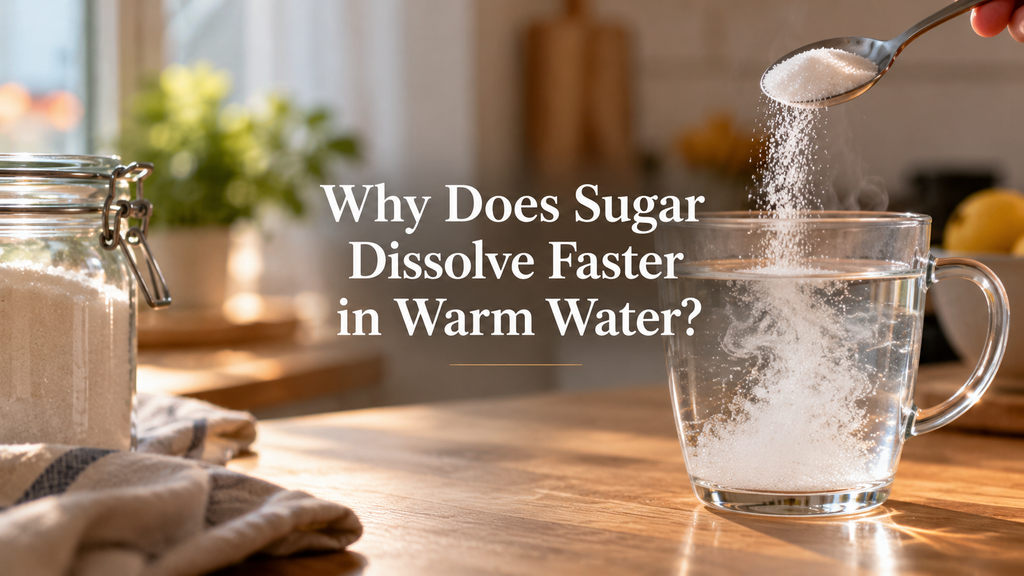
That is why sugar disappears very quickly when it is placed in warm tea and stirred with a spoon.
Warm temperature and stirring work together to increase the speed of dissolving.
Why Do Smaller Sugar Crystals Dissolve Faster?
The size of the sugar crystals also matters.
Smaller crystals have more surface area exposed to water compared with one large crystal containing the same amount of sugar.
More exposed surface means that more water molecules can interact with the sugar at the same time.
For example, fine sugar often dissolves faster than large sugar crystals.
Powdered sugar can dissolve even more quickly because its particles are extremely small.
Temperature, stirring, and particle size can all influence how fast sugar dissolves.
A Simple Experiment With Warm and Cold Water
You can easily observe the effect of temperature using a simple experiment.
Take two clear glasses and add the same amount of water to each one.
Fill one glass with cold water and the other with warm water.
Add the same amount of sugar to both glasses at the same time.
Try not to stir them at first.
You will usually notice that the sugar in the warm water begins disappearing more quickly.
If both glasses are stirred equally, the difference may become even more obvious.
The experiment shows how temperature changes the rate at which sugar dissolves.
What Happens at the Molecular Level?
At the molecular level, dissolving sugar is a continuous process.
Sugar molecules in the crystal are attracted to nearby sugar molecules. These attractions help keep the crystal together.
Water molecules are also attracted to sugar.
When water surrounds the crystal, these interactions can pull individual sugar molecules away from the solid surface.
In warm water, the water molecules move more energetically.
This increased movement makes it easier for the water to reach the surface, interact with the sugar, separate sugar molecules, and carry them away.
As more sugar molecules leave the crystal, the crystal becomes smaller until it disappears completely.
Why Does Sugar Dissolve Slowly in Cold Water?
Sugar still dissolves in cold water, but the process is slower.
The water molecules are moving with less energy, so their interactions with the sugar crystal occur more slowly.
Diffusion is also slower.
As a result, dissolved sugar molecules remain concentrated near the sugar crystal for longer periods.
Without stirring, sugar may remain visible at the bottom of a glass of cold water for quite some time.
This does not mean that cold water cannot dissolve sugar. It simply means the process generally takes longer.
Does Sugar Melt in Water?
People sometimes say that sugar melts in water, but dissolving and melting are different processes.
Melting happens when a solid changes into a liquid because of heat.
Ice melting into liquid water is an example.
When sugar is placed in water, it does not normally melt. Instead, its molecules separate from the crystal and become mixed with water molecules.
This is called dissolving.
The difference is important because dissolved sugar still exists as sugar molecules inside the solution.
Why Does Sugar Seem to Disappear?
Sugar seems to disappear because individual sugar molecules are far too small to see with our eyes.
Once the molecules separate from the crystal, they become distributed throughout the water.
The liquid may remain completely clear even though a large amount of sugar is present.
We know the sugar is still there because the water tastes sweet.
It is also possible to recover the sugar by allowing the water to evaporate.
As the water leaves, sugar molecules can come together again and form crystals.
Everyday Examples of Sugar Dissolving
The effect of warm water on dissolving can be seen in many everyday situations.
When sugar is added to hot tea, it usually dissolves quickly.
When making lemonade with cold water, people may first dissolve sugar in a smaller amount of warm water before mixing it with the rest of the drink.
Bakers and cooks often heat water when preparing sugar syrups because it helps large amounts of sugar dissolve efficiently.
Candy making also relies heavily on controlling temperature and sugar concentration.
These familiar activities are based on the same scientific principles.
Why Hot Drinks Are Easy to Sweeten
Hot drinks are especially easy to sweeten because the liquid is already warm.
When a spoonful of sugar is placed in hot coffee or tea, fast moving water molecules immediately begin interacting with the sugar.
Stirring increases this interaction even more.
Within seconds, the sugar crystal can completely disappear into the drink.
If the same spoonful were added to iced water, much more stirring might be needed.
This everyday observation demonstrates the relationship between temperature and dissolving speed very clearly.
Can Water Be Too Hot?
Heating water usually increases the speed at which sugar dissolves, but extremely high temperatures are not necessary for ordinary use.
Very hot water can cause burns and should always be handled carefully.
For drinks and simple kitchen purposes, moderately warm water is usually enough to speed up dissolving.
The scientific principle remains the same. Higher molecular movement generally leads to faster interaction between the sugar and water.
What Other Substances Behave Like Sugar?
Many solid substances dissolve faster in warm water.
Salt is one familiar example, although its solubility responds to temperature differently from sugar.
Some drink powders, food ingredients, and other soluble solids also mix faster when the liquid is warmer.
However, not every substance behaves in exactly the same way.
The effect of temperature depends on the chemical properties of the substance and the liquid.
This is why scientists measure the solubility of different materials at different temperatures.
The Importance of Surface Area
Surface area also explains why crushed sugar dissolves faster than a large sugar cube.
A sugar cube contains many crystals packed closely together.
Only the outer surfaces are initially exposed to the water.
If the cube is crushed into small pieces, much more sugar surface becomes available for water molecules to reach.
This increases the number of interactions happening at the same time.
For the fastest dissolving, warm water, stirring, and small sugar particles can all be used together.
A Useful Example of Particle Theory
The simple act of dissolving sugar in water helps demonstrate an important scientific idea known as particle theory.
Particle theory explains that matter is made of tiny particles that are constantly moving.
Their movement changes with temperature.
Heating generally increases particle motion.
Cooling generally reduces it.
The faster dissolving of sugar in warm water is therefore a visible result of invisible molecular activity.
Something that seems ordinary in the kitchen can teach us a great deal about how matter behaves.
Why Does Sugar Dissolve Faster in Warm Water?
The main reason sugar dissolves faster in warm water is increased molecular motion.
Warm water molecules move faster than cold water molecules. They collide with the sugar crystal more frequently, helping separate sugar molecules from the crystal.
The faster movement also increases diffusion, carrying dissolved sugar away from the crystal and spreading it throughout the liquid.
Warm water can usually dissolve more sugar as well, which makes it especially useful for preparing sweet drinks and concentrated sugar solutions.
Stirring and using smaller sugar particles can increase the dissolving speed even further.
Final Thoughts
Sugar dissolving in warm water is a simple everyday example of how temperature affects the behavior of matter.
The sugar does not disappear or melt. Its molecules separate from the crystal and become surrounded by water molecules.
Warm water speeds up this process because its molecules have more kinetic energy and move more rapidly. They interact with the sugar more often, help break molecules away from the crystal, and spread the dissolved sugar through the liquid.
Stirring, particle size, diffusion, and solubility also influence the process.
The next time you watch a spoonful of sugar disappear into a warm cup of tea, you are seeing molecular motion in action. It is a small everyday event, but it shows one of the most important ideas in science: temperature changes how particles move, and that movement can greatly affect how substances mix and dissolve.