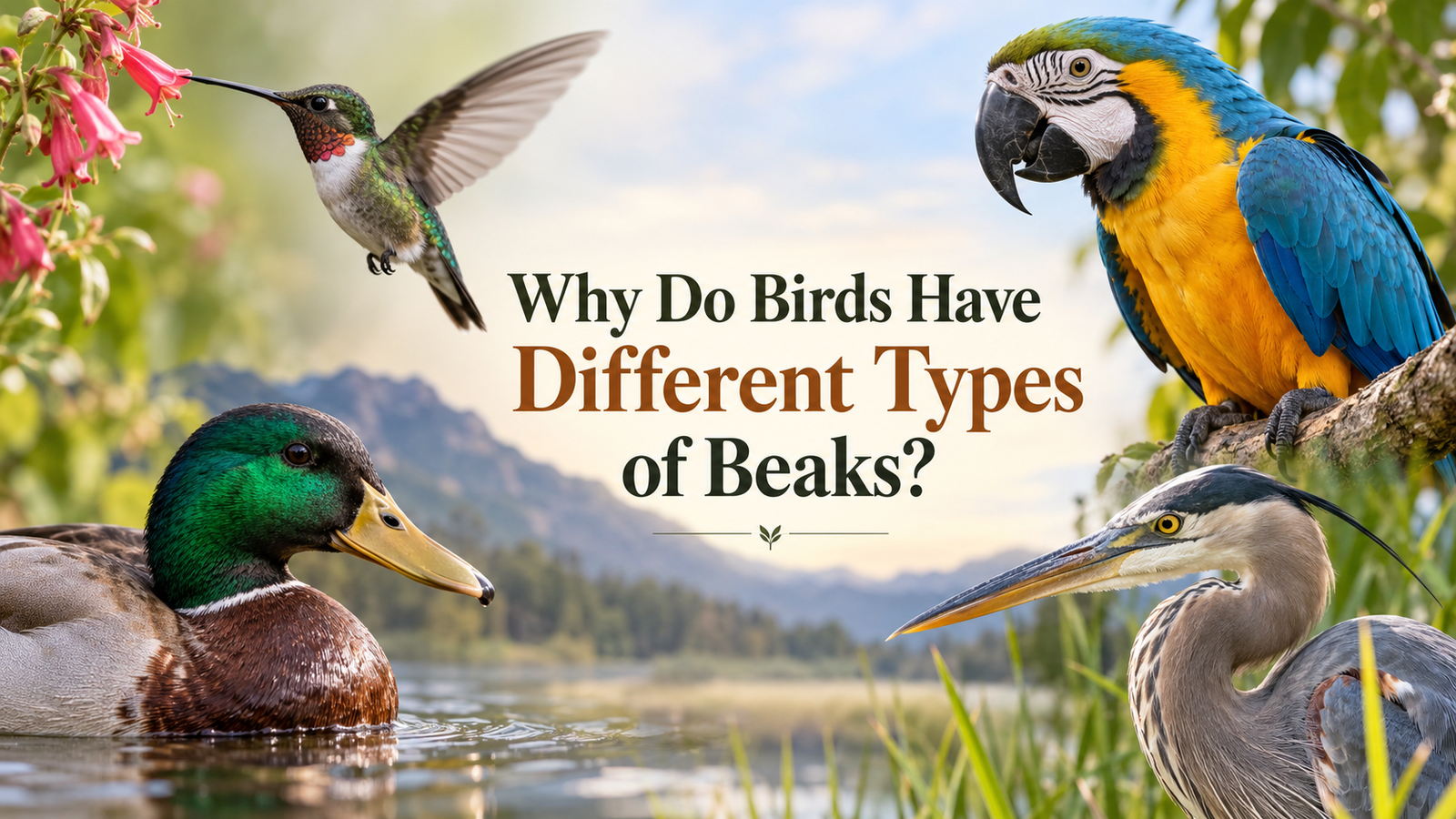
Birds are found almost everywhere on Earth, from forests and deserts to mountains, lakes, cities, and coastal areas. One of the most interesting things about birds is the great variety of their beaks. Some birds have short and strong beaks, while others have long, thin, curved, pointed, or flat beaks. These differences are not random. The shape of a bird’s beak is closely connected with the food it eats, the environment in which it lives, and the way it survives.
When we ask why birds have different types of beaks, the simple answer is that different beaks help birds perform different jobs. A bird that cracks hard seeds needs a different type of beak from a bird that catches fish. A bird that drinks nectar from flowers also needs a very different beak from a bird that tears meat. Over many generations, birds have developed beak shapes that make it easier for them to find food and survive in their surroundings.
Bird Beaks Are Adapted to Different Foods
Food is one of the main reasons birds have different types of beaks. Every bird needs to eat, but not all birds eat the same kind of food. Some eat seeds, some eat insects, some eat fruits, some eat fish, and some eat other animals.
A bird’s beak works like a natural tool. Its shape helps the bird collect, hold, break, tear, or swallow food.
Seed eating birds often have short, thick, and strong beaks. These beaks are powerful enough to crack the hard outer covering of seeds. Finches and sparrows are good examples. Their beaks may look small, but they can apply enough force to open many kinds of seeds.
Birds that eat insects usually have narrower and more pointed beaks. These beaks help them pick insects from leaves, tree bark, or small spaces. Some insect eating birds even catch insects while flying.
Birds that eat meat have another type of beak. Eagles, hawks, and vultures have strong, curved beaks with sharp tips. These beaks are useful for tearing meat into smaller pieces.
The connection between beak shape and food is one of the clearest examples of how animals are suited to their way of life.
Strong Beaks for Cracking Seeds
Many birds depend on seeds as their main food source. Seeds can be difficult to eat because they often have hard shells. Birds that regularly eat seeds need beaks that are strong enough to break these shells.
Finches have excellent seed cracking beaks. Their beaks are usually short and cone shaped. The wider base provides strength, while the pointed tip helps the bird handle smaller pieces of food.
Parrots also have strong beaks. A parrot’s beak is larger and more curved than the beak of a finch. It can use its powerful beak to break nuts, seeds, and fruits. Parrots can also use their beaks to hold objects and climb.
The strength of these beaks shows how the structure of a bird’s body can match its diet.
Long Beaks for Reaching Food
Some birds have long beaks because their food is difficult to reach. A longer beak allows the bird to search in places where a short beak would not be useful.
Hummingbirds are famous for their long, narrow beaks. They use them to reach nectar deep inside flowers. Their tongues can extend beyond the beak and help them collect the sweet liquid.
Herons also have long beaks, but they use them for a completely different purpose. Their sharp, pointed beaks help them catch fish and other small animals in shallow water.
Some shorebirds have long beaks that they push into wet sand or mud. They search for worms, insects, and other small creatures hidden below the surface.
This shows that even birds with similar beak lengths may use their beaks in very different ways.
Curved Beaks for Tearing Food
Birds of prey have some of the most powerful beaks in the bird world. Eagles, falcons, owls, and hawks usually have curved beaks with sharp points.
These birds often hunt animals or eat meat. Their beaks help them tear flesh into pieces that are easier to swallow.
The upper part of the beak curves downward and acts almost like a hook. This shape gives the bird control when pulling and tearing food.
Vultures also have curved beaks because they feed mainly on the bodies of dead animals. Their beaks help them remove meat from bones and tough skin.
A curved beak is therefore an important survival tool for many meat eating birds.
Flat Beaks for Finding Food in Water
Ducks have a very different type of beak. Their beaks are broad and flat. This shape helps them collect food from water and mud.
Many ducks take water into their mouths and then push it out through small structures along the edges of the beak. Food particles, small plants, insects, and tiny animals can remain inside.
The flat shape also helps ducks search through soft mud.
Flamingos have specially shaped beaks that help them feed in water. They often place their heads upside down and filter tiny organisms from the water.
These feeding methods would not be possible with the sharp beak of an eagle or the strong seed cracking beak of a finch.
Pointed Beaks for Catching Fish
Fish eating birds need beaks that help them catch slippery prey. Birds such as kingfishers and herons usually have long, pointed beaks.
A kingfisher watches the water carefully from a branch or another high position. When it sees a fish, it dives quickly into the water. Its sharp beak helps it catch the fish.
Herons stand quietly in shallow water and wait for fish to come close. They then strike rapidly with their long beaks.
Pelicans use a different method. They have very large beaks with expandable pouches underneath. These pouches help them scoop fish from the water.
Different fishing techniques have produced different beak shapes among water birds.
Beaks Help Birds Live in Different Habitats
Bird beaks are also connected with the environments in which birds live. A forest bird may need to search inside tree bark, while a wetland bird may need to find food in water.
Woodpeckers provide a good example. Their beaks are strong, straight, and pointed. They use them to hit tree trunks and make holes in wood. This allows them to reach insects hidden inside.
The woodpecker’s beak must be strong enough to handle repeated contact with hard surfaces.
In contrast, birds living near lakes may have beaks designed for catching fish or filtering water.
Habitat and food are closely connected. Birds that live in different environments often have access to different food sources, so their beaks develop in ways that help them use those resources.
Beaks Can Also Help Birds Build Nests
Eating is not the only reason birds have useful beaks. Birds also use their beaks for many daily activities.
One important activity is building nests.
Birds may carry grass, leaves, feathers, twigs, mud, or other materials in their beaks. Some birds carefully weave plant material together to create strong nests.
A bird may also use its beak to shape the inside of the nest or move materials into the correct position.
Because birds do not have hands, the beak performs many tasks that hands might perform in other animals.
Birds Use Their Beaks to Care for Feathers
Birds spend a lot of time cleaning and arranging their feathers. This behavior is often called preening.
A bird uses its beak to remove dirt, parasites, and damaged pieces from its feathers. It can also arrange feathers so they stay smooth and properly positioned.
Healthy feathers are important because they help birds fly, stay warm, and protect their bodies.
Some birds also spread natural oils through their feathers using their beaks. These oils may help keep the feathers in good condition.
This shows that a bird’s beak is not only a feeding tool. It is an important part of everyday body care.
Evolution Explains Different Bird Beaks
The variety of bird beaks becomes easier to understand when we look at evolution.
Bird populations contain natural differences. Some individuals may have slightly larger, smaller, stronger, or longer beaks than others.
If a certain beak shape helps a bird get food more successfully, that bird may have a better chance of surviving and reproducing. Over many generations, useful characteristics may become more common.
This process is known as natural selection.
A famous example comes from finches living on the Galapagos Islands. Different finch species have different beak shapes depending on the foods available in their environments.
Some have strong beaks for large seeds. Others have thinner beaks for insects. These differences show how closely beak structure can be connected with diet and survival.
Birds With Similar Beaks May Eat Similar Foods
Scientists can often learn something about a bird’s diet simply by studying its beak.
A thick, powerful beak may suggest that the bird eats hard seeds or nuts.
A sharp, hooked beak may suggest that the bird eats meat.
A long, narrow beak may suggest that the bird feeds from flowers, mud, or water.
A broad, flat beak may suggest that the bird filters food from water.
These are general patterns rather than strict rules. Birds can be flexible, and many species eat more than one type of food.
Still, beak shape provides an important clue about how a bird lives.
Beaks Are Made of Strong Material
A bird’s beak may look like bone, but its outer surface is covered with a strong material called keratin.
Keratin is also found in human hair and fingernails.
The beak must be strong because birds use it constantly. It may be used for eating, carrying materials, cleaning feathers, feeding young birds, protecting territory, or defending against danger.
The shape and strength of the beak are therefore important for survival.
Some birds also experience gradual wear on their beaks. Natural growth helps replace material that becomes worn through daily use.
Beaks Can Help Birds Defend Themselves
Birds may also use their beaks for protection.
A strong beak can be used to bite or strike an attacker. Birds may defend themselves, their nests, their partners, or their young.
Parrots, for example, have extremely powerful beaks and can deliver strong bites when threatened.
Herons can use their pointed beaks in defense if they feel trapped.
Even small birds may peck at animals or other birds that come too close to their nests.
The defensive role of beaks is another reason why beak strength and shape can be important.
Why Bird Beaks Are So Important
A bird’s beak is one of the most important parts of its body. It helps the bird interact with its environment every day.
Birds use their beaks to eat, drink, build nests, clean feathers, feed their young, collect objects, protect themselves, and sometimes communicate with other birds.
The wide variety of bird beaks reflects the wide variety of bird lifestyles.
A hummingbird feeding from a flower has completely different needs from an eagle hunting animals. A duck feeding in a pond faces different challenges from a woodpecker searching for insects inside a tree.
Their beaks are shaped according to these different needs.
Conclusion
So, why do birds have different types of beaks? Birds have different beak shapes because different species have adapted to different foods, habitats, and ways of life. Beaks act as specialized tools that help birds survive.
Strong beaks can crack seeds and nuts. Sharp, curved beaks can tear meat. Long beaks can reach nectar, fish, or hidden animals. Flat beaks can filter food from water. Pointed beaks can catch prey or reach insects inside trees.
The different types of bird beaks are excellent examples of adaptation in nature. By studying them, we can understand how animals develop features that match the challenges of their environment.
The next time you see a bird, look carefully at its beak. Its shape may tell you a surprising amount about what the bird eats, where it lives, and how it survives.