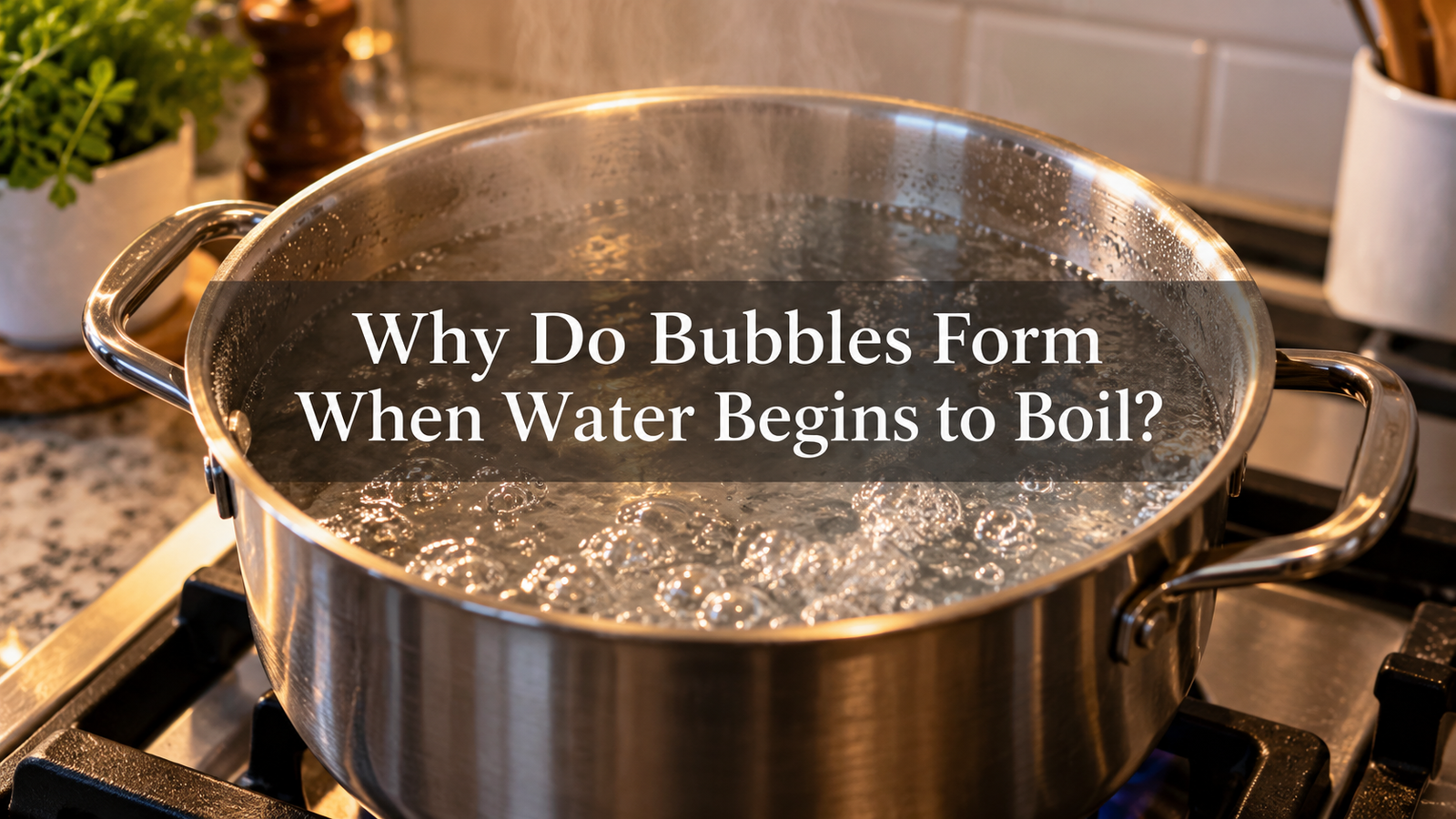
Boiling water is something we see almost every day. We boil water for tea, coffee, cooking, cleaning, and many other purposes. At first, the water may look completely still. After a short time, tiny bubbles begin to appear on the bottom and sides of the pot. As the temperature rises, these bubbles become larger and more active. Finally, the water starts moving strongly as bubbles rise rapidly to the surface.
This simple process raises an interesting science question. Why do bubbles form when water begins to boil?
The answer is connected to heat, gases dissolved in water, water vapor, pressure, and the movement of water molecules. Understanding what happens during boiling gives us a clear example of how matter changes from one state to another.
What Happens When Water Is Heated?
Water is made of extremely small particles called molecules. These molecules are always moving, even when the water looks completely still.
When heat is supplied to water, the water molecules absorb energy. As they gain energy, they begin moving faster.
At lower temperatures, the molecules remain close enough to each other for the water to stay in its liquid state. As the temperature continues to increase, some molecules gain enough energy to escape from the liquid and enter the air as water vapor.
This process can happen even before water reaches its boiling point.
The movement of molecules becomes much more intense when water approaches the temperature at which it boils.
Where Do the First Bubbles Come From?
Many people assume that every bubble appearing in heated water is made of steam. However, the first tiny bubbles that appear are often not water vapor.
They are usually gases that were already dissolved in the water.
Ordinary water contains small amounts of gases such as oxygen, nitrogen, and carbon dioxide. These gases enter the water when it comes into contact with air.
Cold water can hold more dissolved gas than hot water.
As the water becomes warmer, it becomes less able to keep these gases dissolved. The gases begin leaving the water and collecting in tiny bubbles.
These bubbles often form on the bottom or sides of the pot because small scratches and rough surfaces provide convenient places where gas can collect.
The bubbles then rise toward the surface and escape into the surrounding air.
Therefore, the first bubbles seen during heating are often dissolved gases rather than steam.
What Happens as Water Gets Hotter?
As heating continues, the temperature of the water keeps rising.
Water molecules move faster and collide more frequently. More dissolved gases leave the water, and more vapor begins to form.
At this stage, you may notice larger bubbles forming near the bottom of the container.
Some of these bubbles contain water vapor.
However, if the water has not yet reached its boiling point, the vapor bubbles may not survive long enough to reach the surface.
As they move upward, they enter slightly cooler water. The water vapor inside the bubbles may cool and turn back into liquid water.
This causes the bubbles to collapse.
This is one reason why water can make gentle sounds before it begins boiling strongly.
What Is the Boiling Point of Water?
The boiling point is the temperature at which a liquid begins changing rapidly into gas throughout the liquid.
At normal atmospheric pressure, pure water boils at about 100 degrees Celsius, or 212 degrees Fahrenheit.
However, the boiling point can change depending on air pressure.
At high elevations, atmospheric pressure is lower. Water therefore boils at a temperature below 100 degrees Celsius.
At locations closer to sea level, the pressure is higher, so the boiling temperature is closer to 100 degrees Celsius.
This relationship between pressure and boiling temperature is important for understanding how boiling bubbles form.
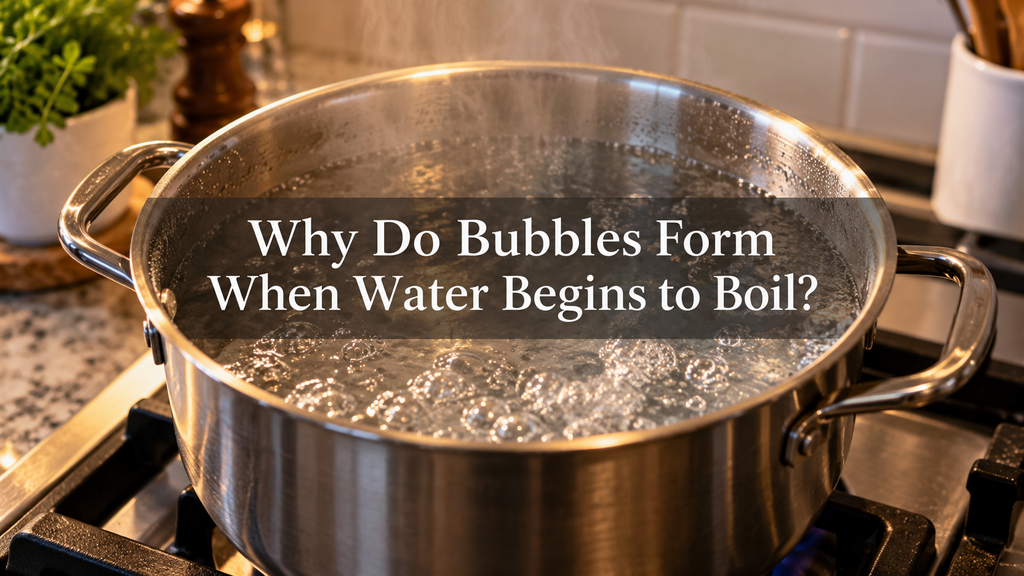
Why Do Steam Bubbles Form?
When water reaches its boiling point, some water molecules have enough energy to move from the liquid state into the gaseous state.
This gas is called water vapor.
Water vapor begins forming inside small spaces within the liquid. Instead of remaining dissolved in the water, the vapor collects into bubbles.
These bubbles contain water molecules in the form of gas.
As more water changes into vapor, the bubbles become larger.
Once the vapor pressure inside the bubbles becomes strong enough to overcome the surrounding pressure, the bubbles can grow and move upward through the water.
When they reach the surface, they burst and release water vapor into the air.
This is the main process we recognize as boiling.
Why Do Bubbles Rise to the Surface?
Bubbles rise because gas is less dense than liquid water.
Density describes how much matter is packed into a certain amount of space.
Liquid water is much denser than the water vapor inside a boiling bubble.
Because the bubble is less dense than the surrounding water, an upward force acts on it. This force is known as buoyancy.
The same basic principle explains why a balloon filled with a light gas may rise through air.
As a boiling bubble moves upward, it may also become larger because the pressure surrounding it becomes slightly lower.
When the bubble finally reaches the surface, the thin layer of water around it breaks.
The water vapor inside is then released into the air.
Are Boiling Bubbles Filled With Air?
During the early stages of heating, many bubbles contain gases from the air that were dissolved in the water.
Once the water is boiling strongly, however, most of the large bubbles are mainly filled with water vapor.
This is an important difference.
A boiling bubble is not simply a pocket of ordinary air.
It forms because liquid water is changing into a gas.
The gas inside the bubble is mostly water vapor.
When this vapor moves into cooler air above the pot, some of it may cool and condense into tiny droplets.
These droplets are what we often see as the white cloud above boiling water.
Is Steam the White Cloud Above Boiling Water?
It is common to call the white cloud above a boiling pot steam, but there is an interesting detail.
True water vapor is actually invisible.
The gas leaving the surface cannot normally be seen.
The white mist that becomes visible above boiling water is made of extremely small liquid water droplets.
Hot water vapor rises from the pot. When it reaches cooler air, some of the vapor loses heat and changes back into tiny drops of liquid water.
These droplets scatter light and create the visible white cloud.
This process is known as condensation.
Why Does Water Bubble More Strongly After It Starts Boiling?
Once water reaches its boiling temperature, additional heat does not immediately cause the temperature to rise much higher under normal conditions.
Instead, much of the added energy is used to change liquid water into water vapor.
This creates more vapor bubbles.
As heating continues, bubbles form quickly at many different points on the bottom and sides of the container.
They grow, rise, and burst at the surface.
This rapid movement makes boiling water appear active and turbulent.
The stronger the heating source, the faster energy enters the water, so more vapor can be produced.
This can make the boiling action look more violent.
Why Do Bubbles Usually Start at the Bottom of the Pot?
The bottom of a pot is normally the hottest part because it is closest to the heat source.
Heat moves from the stove or flame into the bottom of the container and then into the water.
This means the water touching the bottom often becomes hot before the water near the top.
Small scratches and imperfections on the surface of the pot also provide useful locations for bubbles to begin forming.
These small areas are sometimes called nucleation sites.
Tiny pockets of gas can collect there.
As the water gets hotter, vapor enters these pockets and the bubbles begin growing.
Smooth containers sometimes provide fewer places for bubbles to form.
Why Do Some Bubbles Collapse Before Reaching the Surface?
Before the entire pot of water reaches the boiling temperature, there may be a noticeable temperature difference between the bottom and the upper part of the water.
Water near the bottom may be hot enough to create vapor bubbles.
As those bubbles rise into cooler water, the vapor inside can lose heat.
The vapor then changes back into liquid water.
When enough vapor condenses, the bubble becomes smaller and may collapse completely.
This process can produce small clicking or rumbling sounds.
Once the whole body of water becomes hot enough, bubbles can survive the journey to the surface.
That is when a steady rolling boil develops.
How Is Boiling Different From Evaporation?
Boiling and evaporation both change liquid water into water vapor, but they happen in different ways.
Evaporation occurs only at the surface of the liquid.
It can happen at almost any temperature.
For example, water in a wet cloth slowly evaporates even when the water is nowhere near its boiling point.
Boiling happens throughout the liquid.
Vapor bubbles form inside the water and rise to the surface.
Boiling also requires the vapor pressure of the liquid to become equal to the pressure surrounding it.
This is why boiling appears much more dramatic than evaporation.
How Does Air Pressure Affect Boiling Bubbles?
Air pressure pushes down on the surface of water.
Before a vapor bubble can grow, the pressure inside the bubble must be strong enough to resist the surrounding pressure.
At sea level, atmospheric pressure is relatively high.
Water must reach about 100 degrees Celsius before its vapor pressure becomes strong enough for stable boiling bubbles to form.
At higher elevations, air pressure is lower.
The vapor inside a bubble does not need as much pressure to expand.
As a result, water boils at a lower temperature.
This is why cooking can sometimes take longer in high mountain areas. The water may be boiling, but its temperature can be lower than boiling water at sea level.
Why Does Boiling Water Make Noise?
Water often makes different sounds as it heats.
Some of the early sounds are produced by small vapor bubbles forming near the hot bottom surface and then collapsing when they enter cooler water.
As the temperature becomes more even throughout the pot, these bubbles survive longer.
The sound may change from gentle clicking or rumbling into the familiar sound of steady boiling.
The movement of bubbles, water, and vapor all contribute to the sounds we hear.
What Happens to Water Molecules During Boiling?
At the molecular level, boiling is a change of state.
Water molecules in liquid water attract each other.
Heat energy helps the molecules overcome some of these attractions.
When enough energy is available, molecules can separate from the liquid and move more freely as a gas.
Inside a boiling bubble, the molecules are much farther apart than they are in liquid water.
The bubble grows as more molecules enter the gas state.
When the bubble reaches the surface, those molecules escape into the air as water vapor.
Why Understanding Boiling Bubbles Matters
Boiling water may look like a simple everyday event, but it demonstrates several important scientific ideas.
It shows how heat energy affects molecular motion.
It demonstrates the difference between liquids and gases.
It also shows how pressure influences changes of state.
The bubbles allow us to actually see part of the process of liquid water becoming water vapor.
This makes boiling one of the easiest examples of physical change to observe in daily life.
Final Thoughts
So, why do bubbles form when water begins to boil?
During the early stages of heating, many tiny bubbles are made from gases that were already dissolved in the water. As the temperature continues to rise, water molecules gain more energy. When the water reaches its boiling point, liquid water begins changing rapidly into water vapor.
This vapor collects into bubbles inside the water. Because water vapor is less dense than liquid water, the bubbles rise toward the surface. When they reach the top, they burst and release the vapor into the surrounding air.
The entire process is controlled by heat energy, molecular movement, pressure, and changes between liquid and gas.
What seems like a simple pot of bubbling water is actually a clear example of physics and chemistry working together. Every rising bubble tells the same scientific story: heat is giving water molecules enough energy to leave the liquid state and become water vapor.