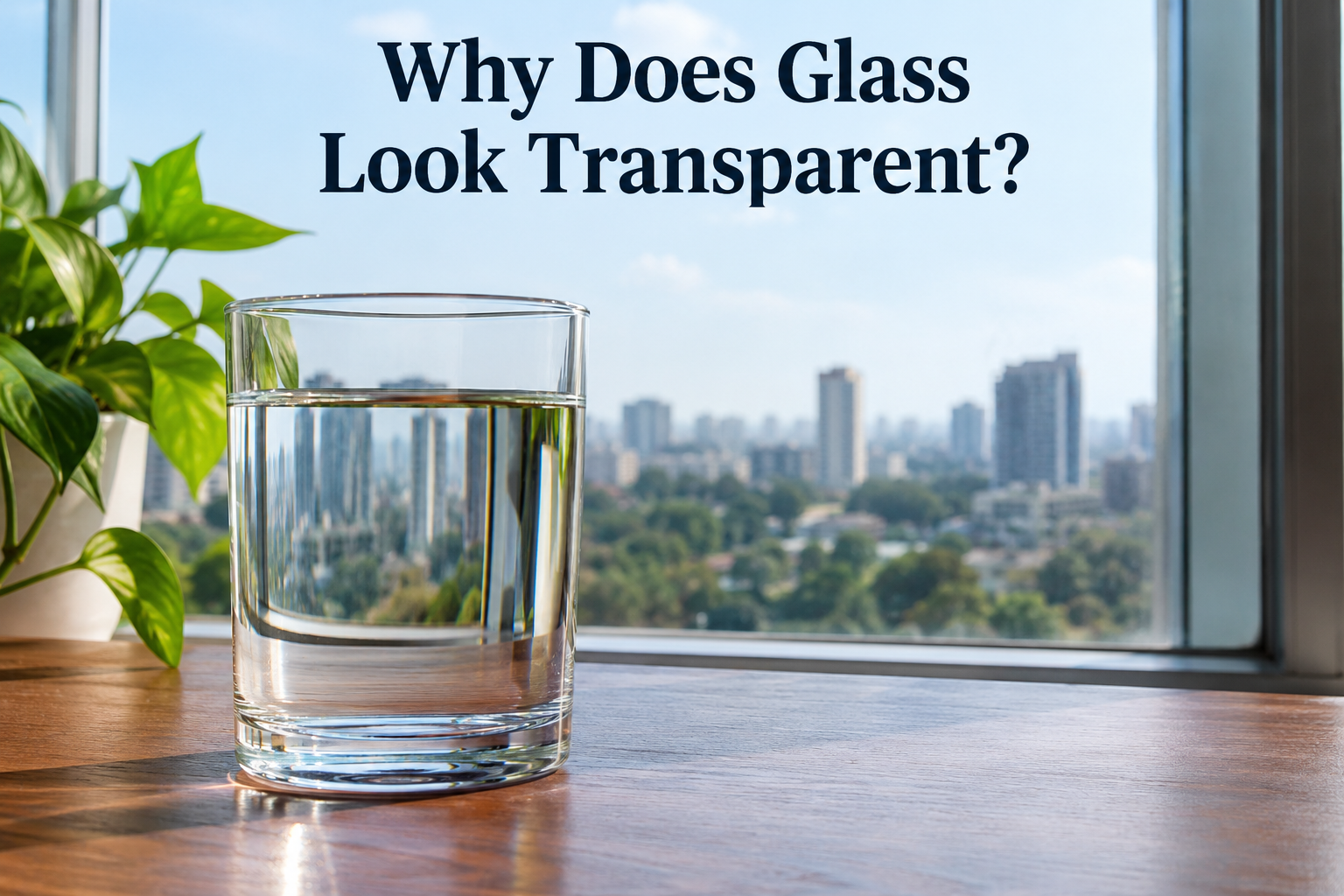
Glass is one of the most familiar materials in everyday life. We see it in windows, drinking glasses, mirrors, mobile phone screens, buildings, cars, and many other objects. One of the most interesting things about glass is that we can usually see through it. A solid material normally blocks our view, yet a clear piece of glass allows light to pass through almost as if nothing is there. This simple observation leads to an interesting science question: why does glass look transparent?
The transparency of glass is mainly connected to the way light interacts with the atoms and electrons inside the material. Glass does not allow every type of electromagnetic radiation to pass through it, but it allows much of the visible light that our eyes can detect. Because visible light passes through ordinary clear glass with relatively little absorption, we are able to see objects on the other side.
Understanding why glass is transparent becomes easier when we first understand light. Visible light is a form of electromagnetic radiation. It travels in waves and covers a small range of wavelengths that the human eye can detect. Different wavelengths appear to us as different colors, including red, orange, yellow, green, blue, and violet.
When light reaches a material, several things can happen. Some light may be reflected from the surface. Some may be absorbed by the material. Some may pass through the material. A transparent substance is one that allows a large amount of visible light to travel through it.
Glass is especially good at transmitting visible light because its internal structure does not strongly absorb most visible wavelengths.
What Is Glass Made Of?
Most ordinary glass is made mainly from silica, which comes from sand. Silica contains silicon and oxygen atoms. During glass manufacturing, silica is heated to a very high temperature until it melts. Other ingredients are usually added to make the glass easier to manufacture and more useful.
When the melted mixture cools, it becomes solid. However, the atoms in glass are not arranged in the same regular pattern found in many crystals. Instead, the atoms form a more irregular structure.
This type of solid is often described as amorphous. The word amorphous means that the atoms do not form a repeating crystal structure over long distances.
The unusual atomic arrangement of glass is important, but transparency is not simply caused by the atoms being randomly arranged. The more important reason involves the energy levels of electrons inside the glass.
How Light Interacts With Electrons
Every atom contains electrons. These electrons can absorb energy, but they cannot usually absorb just any amount of energy. They occupy particular energy states.
For an electron to absorb a photon of light, the photon must contain the right amount of energy to move the electron from one allowed energy state to another.
Visible light carries a certain range of energies. In ordinary glass, the energy differences between important electronic states are generally too large for most visible light photons to be absorbed.
In simple terms, visible light often does not have the correct amount of energy to excite the electrons in clear glass.
Since the light is not strongly absorbed, much of it continues traveling through the material.
This is one of the main scientific reasons why glass looks transparent.
Why Some Materials Look Opaque
Comparing glass with opaque materials can make the idea easier to understand.
Wood, metal, stone, and many plastics do not allow visible light to pass through them easily. Their electrons and internal structures interact with visible light in different ways.
In some materials, visible light is strongly absorbed. In others, light is reflected or scattered before it can travel through the material.
Metals are a good example. Metals contain electrons that can move relatively freely through the material. These electrons interact strongly with incoming visible light. Much of the light is reflected instead of passing through.
This is why metals normally look shiny but not transparent.
Glass behaves differently because most visible light can travel through it without being absorbed by the electrons.
Does All Light Pass Through Glass?
Although glass appears transparent, it does not allow every type of light to pass through equally well.
The electromagnetic spectrum includes much more than visible light. It also includes ultraviolet radiation, infrared radiation, microwaves, radio waves, X rays, and gamma rays.
Ordinary glass can block or absorb significant amounts of ultraviolet radiation. This is one reason sunlight passing through a closed window is not exactly the same as direct sunlight outdoors.
Some types of infrared radiation are also absorbed by glass.
Therefore, saying that glass is transparent does not mean that it is transparent to every form of electromagnetic radiation. It mainly means that ordinary clear glass transmits a large portion of the visible light detected by human eyes.
Why Can We Still See Glass?
If glass allows light through, why can we still see the glass itself?
The answer is that not all light passes directly through it.
When light reaches the surface of glass, some of it is reflected. This reflected light allows us to notice the glass surface. Reflections become especially obvious when bright light shines on a window.
You may have noticed that a window can sometimes act almost like a mirror. At night, for example, if a room is brightly lit and the outside is dark, your reflection can become very visible in the window.
Light is also bent when it enters glass. This bending is called refraction.
Refraction happens because light travels at different speeds in different materials. When light moves from air into glass, its speed changes and its path may bend.
This bending can make objects viewed through thick or curved glass appear distorted.
Therefore, glass is transparent, but it still interacts with light in noticeable ways.
Why Does Thick Glass Look Different?
A thin glass window may appear almost perfectly clear, while a very thick piece of glass may show a slight green or blue tint.
This happens because real glass is not perfectly transparent.
Even high quality glass absorbs a small amount of visible light. When light travels through a thicker piece of glass, it has to travel through more material. This gives the glass more opportunity to absorb certain wavelengths.
Small amounts of iron and other impurities can also influence the color of glass.
This is why the edges of thick window glass sometimes look green.
Special manufacturing methods can reduce these impurities and produce glass with very high clarity.
Why Is Frosted Glass Not Transparent?
Frosted glass is made from glass, yet we usually cannot see clearly through it.
The reason is light scattering.
The surface of frosted glass contains many tiny irregularities. When light reaches these uneven areas, it is scattered in many different directions.
Light still passes through the glass, but it no longer travels in a clear and organized path.
As a result, shapes on the other side become blurred.
This type of material is often called translucent rather than transparent.
Transparent materials allow light to pass through clearly. Translucent materials allow light through but scatter it. Opaque materials block most visible light.
This difference shows that transparency depends not only on whether light enters a material but also on what happens to the light while it travels through and leaves the material.

Why Does Colored Glass Look Different?
Colored glass is created by adding certain substances to the glass mixture.
These added materials absorb particular wavelengths of visible light while allowing others to pass through.
For example, if a piece of glass allows mainly green wavelengths to pass through while absorbing more red and blue light, the glass may appear green.
Different metal compounds can produce different colors.
The important point is that colored glass is still transparent if enough visible light can pass through it clearly. However, it does not transmit every visible wavelength equally.
Clear glass is designed to transmit a broader range of visible wavelengths with as little absorption as possible.
Why Does Glass Sometimes Reflect Like a Mirror?
A normal glass window can suddenly become very reflective depending on lighting conditions.
This happens because every glass surface reflects some incoming light.
During the daytime, when the outside is bright, your eyes receive a large amount of light from the outdoor scene through the window. The reflection from the glass may seem weak in comparison.
At night, the situation can change.
If the room is bright while the outside is dark, very little light comes through the window from outside. The reflection of the bright room becomes much easier to see.
The glass itself has not changed. Only the balance of light has changed.
This is a good example of how our perception of transparency depends partly on the surrounding environment.
Is Perfectly Transparent Glass Possible?
No ordinary piece of glass is perfectly transparent.
Some light is always reflected from its surfaces. Small amounts may also be absorbed or scattered inside the material.
However, modern glass can be extremely clear.
Manufacturers carefully control the chemical composition of glass to reduce impurities. They can also apply special coatings that reduce reflections.
These technologies are important in camera lenses, scientific instruments, telescopes, displays, and high quality windows.
Optical glass must often meet very strict standards because even small imperfections can affect how light travels through it.
Why Scratches Make Glass Harder to See Through
A smooth glass surface allows light to travel in a fairly predictable direction.
When glass becomes scratched, dirty, or damaged, its surface becomes less regular.
Tiny scratches can scatter light. Dust and fingerprints can also absorb or scatter some of the incoming light.
This reduces clarity.
That is why cleaning a window can make such a noticeable difference. The glass itself may still be transparent, but anything on its surface can interfere with the path of light.
This is also why polished glass normally appears much clearer than rough glass.
Why Water and Glass Can Both Look Transparent
Water and glass are very different materials, yet both can appear transparent.
The basic reason is similar.
In both substances, visible light is not strongly absorbed across much of the visible spectrum.
The molecules in water interact with light differently from the atoms in glass, but much of the visible light can still travel through.
However, very deep water can appear blue because water absorbs different wavelengths by different amounts. In the same way, thick glass can reveal colors that are difficult to notice in a thin sheet.
Transparency is therefore not always an absolute property. It can depend on thickness, purity, wavelength, surface quality, and the internal structure of the material.
Why Transparency Matters in Daily Life
The transparency of glass makes it incredibly useful.
Windows allow natural light into buildings while protecting people from wind, rain, dust, and changes in temperature.
Car windshields allow drivers to see the road while remaining protected from outside conditions.
Glasses and contact lenses use transparent materials to help correct vision.
Microscopes and telescopes use carefully shaped pieces of glass to control light and create detailed images.
Modern mobile phones also use strong transparent glass to protect displays while allowing us to see and interact with the screen underneath.
Without transparent materials, many everyday technologies would work very differently.
The Simple Science Behind Transparent Glass
The question of why glass looks transparent has a fascinating answer.
Glass allows most visible light to pass through because the photons of visible light generally do not have the right energy to be strongly absorbed by the electrons in ordinary clear glass.
As a result, much of the visible light continues through the material and reaches our eyes.
At the same time, some light is reflected, refracted, scattered, or absorbed. This explains why we can still notice glass surfaces, see reflections, observe distortion, and detect slight colors in thick glass.
The transparency of glass is therefore not the absence of interaction with light. Glass actually interacts with light in several ways. It simply allows a large amount of visible light to pass through without being absorbed.
The next time you look through a window, you are seeing a remarkable example of physics in everyday life. A solid wall of atoms is standing in front of you, yet visible light is able to travel through it because of the way the electrons inside glass respond to light.
Something as ordinary as a window can therefore reveal an important scientific idea. Whether a material looks transparent, colored, reflective, translucent, or opaque depends on the interaction between light and matter. Glass happens to have properties that make it especially good at letting visible light pass through, which is why we can look through a solid piece of glass and clearly see the world on the other side.